
Views: 0 Author: Site Editor Publish Time: 2026-08-03 Origin: Site


Consumers often ask why round food bakes in a round oven but ships in a square container. For pizzeria operators and procurement managers, packaging is a critical operational variable. The wrong box leads to soggy crusts, compromised structural integrity during transit, and negative brand perception. You need containers that perform under extreme heat and moisture stress. We will evaluate commercial packaging from an engineering perspective. Understanding the mechanics behind the standard square shape informs the selection of advanced materials. You must evaluate specific variants to optimize delivery operations and unit economics. Upgrading packaging materials directly supports modern digital marketing efforts. We will break down how to turn a simple delivery vessel into a highly functional branding tool.
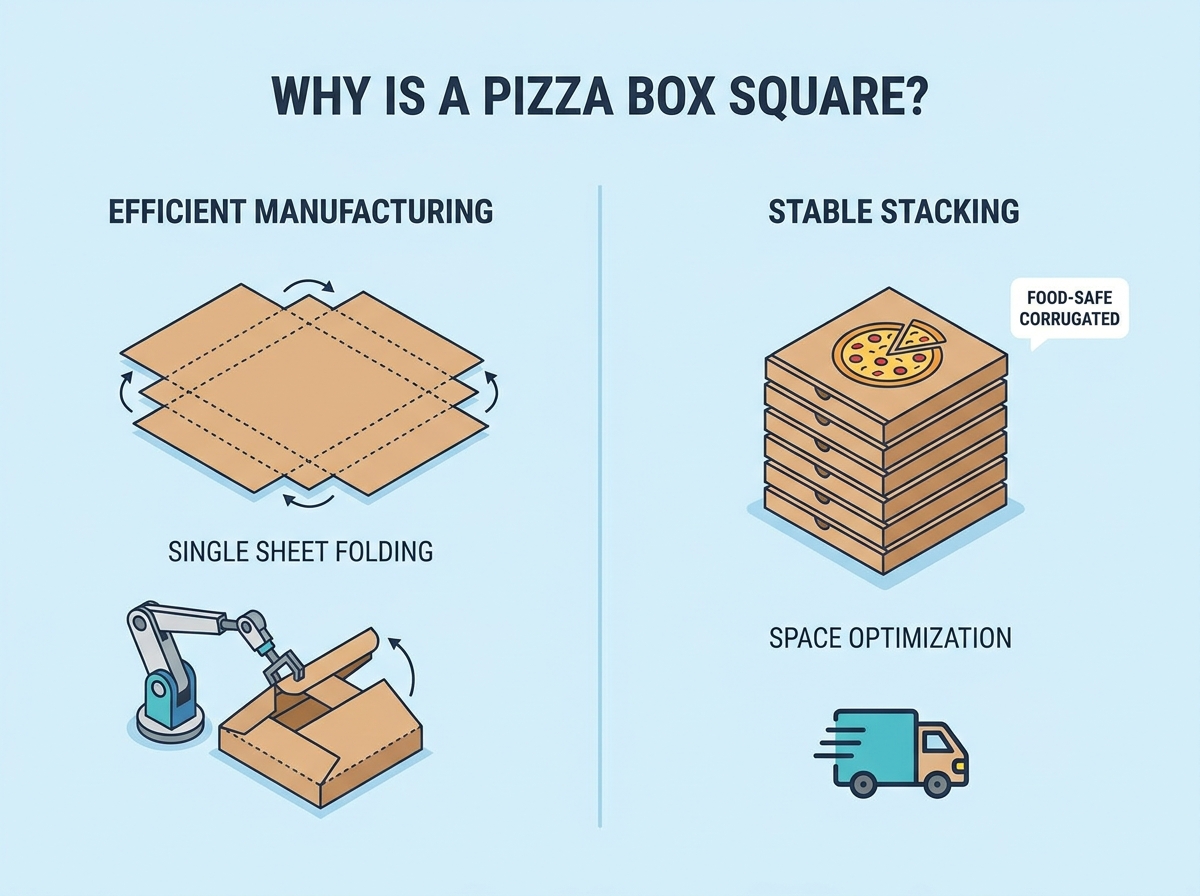
Manufacturing & Storage Efficiency: Square boxes are stamped from a single sheet of cardboard and store flat, drastically reducing manufacturing costs and back-of-house storage requirements compared to round alternatives.
Thermal & Moisture Dynamics: The empty corners in a square box are not wasted space; they provide critical airflow that prevents steam buildup, keeping the crust crisp during delivery.
Material Specifications Matter: Upgrading to a food-safe corrugated pizza box with specific grease and moisture barriers is essential for high-hydration doughs or heavy-topping pizzas.
Branding, SEO, & Social ROI: Investing in a custom pizza box requires balancing minimum order quantities (MOQs) with the marketing value of the packaging—including its ability to drive local SEO reviews and ensure positive sentiment during social media unboxings.
Commercial packaging must satisfy strict success criteria. The primary goals include heat retention, moisture management, structural crush resistance, and minimal operational friction. A standard pizza box achieves these goals through simple, highly effective engineering. Operators need containers that protect the product while seamlessly integrating into high-volume kitchen environments. Every millimeter of corrugated board must perform a specific function during the journey from the cut station to the customer's dining table.
The manufacturing process dictates the final shape of the container. Square boxes require a single, simple die-cut from standard corrugated sheets. This straight-line cutting process produces zero wasted material along the edges. Corrugated board plants run these straight-edged dies at maximum machine speeds. Complex shapes require intricate dies, slower machine speeds, and generate substantial off-cut waste. When you scale production to millions of units, even a five percent increase in material waste destroys profit margins.
Back-of-house operations heavily favor this geometry. Restaurant shelving space remains a premium commodity. Flat-pack storage maximizes limited square footage. You can stack flat bundles tightly from floor to ceiling without instability. A standard warehouse pallet can hold thousands of flat square boxes, whereas pre-assembled or oddly shaped containers drastically reduce pallet density. This directly impacts freight costs. Shipping air is expensive. By maximizing the number of units per pallet, operators reduce their inbound freight expenses.
Die-Cut Waste and Production Speed Comparison
Geometry | Die-Cut Complexity | Material Waste Percentage | Machine Run Speed |
|---|---|---|---|
Square (Standard) | Low (Straight lines) | Near 0% | Maximum |
Hexagonal | Medium (Angled cuts) | 10% - 15% | Moderate |
Round (Molded Fiber) | High (Custom molds) | N/A (Pulp process) | Slow |
Peak service hours demand relentless efficiency. Kitchen staff must fold containers rapidly without losing momentum. The ergonomics of box folding heavily favor the traditional square design. A trained employee can fold a standard one-piece square container in under three seconds. The fold lines are intuitive, requiring only basic gross motor skills to snap the rigid walls into place. At the cut station, space is tight. Employees typically pull from a stack of flat boxes stored directly above the cutting board.
Here is the standard operational sequence for assembling a square container:
Pull a single flat sheet from the prep line stack.
Fold the front panel inward along the primary crease.
Fold the two side panels up to a 90-degree angle.
Snap the side locks into the front panel slots to form the base.
Fold the back hinge and leave the lid open for the cut station.
Multi-tab hexagonal or round prototypes introduce severe operational friction. These alternative designs often require interlocking tabs, precise alignment, and fine motor skills. During a Friday night rush, complex folding sequences lead to torn cardboard, collapsed walls, and delayed dispatch times. The square design eliminates these bottlenecks entirely.
The empty corners surrounding a round pie serve a vital thermodynamic function. Freshly baked dough releases massive amounts of steam. A pie leaves the oven at over 200 degrees Fahrenheit internally. If trapped, this steam condensates on the interior lid and drips back down, turning a crisp crust into a soggy disappointment. The gaps in the four corners provide necessary ventilation.
These corner voids allow steam to escape while the rigid side walls retain ambient heat. The box needs to keep the food above 140 degrees Fahrenheit for food safety while venting excess moisture. The physics of steam ventilation rely on this exact ratio of empty space to product mass. The corners act as exhaust vents, balancing internal humidity levels. This passive climate control prevents the crust from steaming itself into a soggy state during a thirty-minute delivery route.
Selecting the right material grade directly impacts food quality and brand perception. Solution categories vary widely based on menu offerings. A thin-crust pie requires different structural support than a deep-dish, heavily topped alternative. Operators must break down the available material grades to align packaging performance with their specific culinary requirements.
Direct food contact materials must meet strict regulatory standards. FDA guidelines dictate what chemicals and fibers can safely touch hot, consumable items. A true food-safe corrugated pizza box utilizes virgin kraft paper on the interior liner. Virgin fibers guarantee that no toxic chemicals, heavy metals, or residual inks migrate from the packaging into the hot food.
Recycled corrugated board offers environmental benefits but carries inherent risks for direct food contact. Recycled pulps often contain trace contaminants from previous lifecycles. To maintain safety, manufacturers apply specialized barriers over recycled layers or restrict recycled content to the exterior fluting. Structural rigidity also varies. Virgin kraft provides superior tensile strength, preventing the lid from sagging onto the cheese during transit. You must specify the exact flute profile. B-flute offers excellent crush resistance for heavy pies, while E-flute provides a smoother printing surface and takes up less storage space.
High-fat toppings and olive oil drizzles introduce severe operational risks. Grease bleed-through compromises the structural integrity of the cardboard. Oil breaks down the hydrogen bonds in the paper fibers. A saturated bottom panel can tear during handling, dropping the product onto the floor. Furthermore, oil-soaked packaging damages car seats during delivery and leaves greasy residue on customers' kitchen counters.
To combat this, operators must specify a grease-resistant pizza box. Manufacturers achieve this resistance through advanced barrier coatings. The industry measures this using the Kit Test, which rates the degree of repellency to oil and grease. Higher Kit values indicate stronger resistance. Clay coatings applied to the interior liner create a smooth, non-porous surface that stops oil absorption. Other solutions include specialized food-grade polymer liners. Procurement teams must evaluate these barriers carefully to ensure they prevent oil migration without compromising the overall recyclability of the cardboard.
Certain operational environments demand extreme moisture management. High-moisture scenarios include frozen retail transport, extreme weather delivery, and highly hydrated Neapolitan doughs. Standard corrugated board acts like a sponge in high humidity, losing its crush resistance rapidly. When structural failure is not an option, operators turn to specialized moisture barriers.
A waterproof pizza box utilizes polymer linings or heavy wax alternatives to block moisture penetration entirely. The industry measures water absorption using the Cobb test. A lower Cobb value means the paper absorbs less water. These containers maintain their rigid shape even when exposed to condensation from frozen supply chains or torrential rain during last-mile delivery. Cold chain logistics present unique challenges. Moving a pallet from a sub-zero freezer to a loading dock generates massive condensation. Waterproofing prevents the boxes from collapsing under their own weight. However, operators must analyze the trade-offs. Waterproof polymer linings often complicate environmental sustainability mandates. Procurement teams must verify that these specialized coatings do not negatively impact local recycling ecosystems or commercial composting initiatives.
Packaging serves as a physical billboard inside the consumer's home. Operators must weigh the marketing return on investment against strict procurement constraints. Evaluating these dimensions requires a clear understanding of printing technology, digital marketing integration, and volume scaling.
Printing on corrugated board generally falls into two categories: flexographic and lithographic. Flexographic printing dominates the industry due to its speed and efficiency on porous surfaces. It utilizes flexible relief plates and fast-drying, water-based inks. This method easily handles one-to-three color designs, making it ideal for standard logos and brand messaging.
Lithographic printing, often involving a laminated top sheet, provides high-resolution, photographic quality. This method suits premium brands requiring intricate artwork. Regardless of the method, compliance remains non-negotiable. Custom branding must utilize food-safe, water-based inks. Heavy metal inks or toxic solvents cannot be used in environments where heat and steam could cause chemical migration into the food.
Print Method Comparison for Corrugated Board
Printing Method | Ideal Use Case | Setup Cost | Image Quality |
|---|---|---|---|
Flexographic | Standard logos, 1-3 colors | Low | Standard |
Lithographic | Photographic artwork, full color | High | Premium |
Bridging physical and digital marketing transforms packaging into a revenue driver. A custom pizza box acts as a direct conduit to online engagement. Integrating prominent QR codes on the lid drives offline customers directly to digital platforms. Place the QR code near the front thumb tab so the customer sees it immediately upon opening. Scanning the code can prompt satisfied customers to leave Google My Business reviews, directly boosting local SEO rankings and driving future foot traffic. Design the call-to-action clearly, offering an incentive like a discount on their next order for scanning.
The visual presentation heavily influences influencer and video promotion. Social media unboxings require pristine aesthetics. A structurally sound container ensures a clean, positive visual sentiment during taste tests on YouTube or Instagram. Conversely, a failing, oil-soaked container damages brand perception instantly. High-quality packaging guarantees that the product looks appetizing the moment the lid opens on camera.
Transitioning from blank to custom printed packaging requires careful financial analysis. The cost curve dictates that scaling up custom print orders reduces the per-unit cost significantly. However, large print runs increase upfront capital expenditure and demand substantial dry storage space. Independent operators must balance their desire for premium branding with their physical storage limitations. Franchises can leverage their volume to drive down unit costs, making high-end custom printing highly economical.
Innovators frequently attempt to disrupt the standard square design. Evaluating these alternative geometries requires analyzing the conceptual trade-offs between packaging innovation and operational reality. Overall value influencing factors determine whether a new shape can survive the rigors of commercial delivery.
High-profile attempts to reinvent the wheel occasionally capture industry attention. Apple famously patented a round container with top-ventilation holes for its corporate cafeterias. This molded fiber design perfectly matches the shape of the pie, eliminating corner voids entirely. It looks sleek and functions well for short-distance transport.
However, these innovations generally succeed only in closed-loop environments. In mass-market delivery, molded fiber round containers fail multiple operational tests. They lack the vertical stacking strength of corrugated board. Delivery drivers cannot stack five round molded containers without the bottom lid crushing into the cheese. Furthermore, molded fiber retains heat poorly compared to the trapped air inside corrugated fluting.
Shifting away from the industry standard introduces severe hidden costs. Non-square packaging requires proprietary manufacturing dies, instantly driving up procurement expenses. The physical footprint of round or hexagonal containers increases shipping volume, reducing the number of units that fit on a standard freight pallet.
Operational frictions multiply at the store level. Non-standard containers often prove incompatible with existing insulated delivery bags. A standard square box fits snugly into a square delivery bag, preventing movement. Drivers struggle to secure odd shapes in their vehicles, leading to sliding and product damage. Assembly times increase, slowing down the kitchen during peak hours.
To mitigate these risks, operators should conduct pilot testing. Follow these steps before a full operational rollout:
Order a small batch of the non-standard containers.
Test the assembly time with your fastest kitchen staff during a mock rush.
Load the containers into your existing insulated delivery bags to check for fit.
Conduct a thirty-minute drive test to evaluate heat retention and structural integrity.
Roll out the new packaging exclusively on a limited-time-offer menu item to gauge customer feedback.
The square pizza box remains the industry standard because it represents the optimal intersection of manufacturing efficiency, thermal dynamics, and operational scalability. The geometry facilitates fast assembly, dense storage, and precise moisture control. Procurement decisions should focus less on changing the shape of the container and more on upgrading the material composition to match specific culinary requirements. Base your selection on the exact physical demands of your product. Prioritize grease-resistant barriers for heavy-meat pies and highly ventilated virgin kraft for crispy crusts. Upgrading the substrate yields far better operational results than experimenting with novel geometries.
Take immediate action to optimize your packaging strategy:
Audit your current packaging failure rates by tracking customer complaints regarding sogginess or grease bleed.
Request detailed specification sheets from suppliers to verify FDA compliance and material grades.
Order physical samples of upgraded materials and test them under actual thirty-minute delivery conditions.
Calculate the storage footprint required for custom print MOQs before committing to a bulk order.
A: Round boxes require multiple pieces or complex, interlocking folds, making them significantly more expensive to manufacture, ship, and assemble in a fast-paced kitchen. The square design uses a single die-cut sheet that stores flat and folds in seconds.
A: Food-safe corrugated boxes are manufactured using virgin materials or heavily regulated recycled fibers, ensuring no toxic chemicals or heavy metals migrate into the hot food. Standard shipping cardboard lacks these strict sanitary controls.
A: It utilizes a specialized inner liner or a food-grade coating that creates a barrier, preventing hot oils from soaking into the porous cardboard and compromising its structural integrity. This keeps the box rigid and prevents leaks.
A: For standard delivery, a highly ventilated box is usually better to prevent steam buildup. Waterproof boxes are typically reserved for frozen retail pizzas or specific high-moisture transit scenarios where external condensation is a major risk.
A: Costs vary based on print complexity and volume, but custom boxes generally add 10% to 30% to the unit cost, offset by the marketing value of placing your brand directly in the consumer's home and driving digital engagement.
A: Heavily soiled portions cannot be recycled as oil ruins the paper pulping process. However, the clean top half of a square box can typically be torn off and recycled safely in most municipal waste systems.


