
Views: 0 Author: Site Editor Publish Time: 2026-05-24 Origin: Site


Pizza delivery acts as a brutal logistical stress test for packaging. When standard containers fail during transit, restaurants immediately lose revenue through soggy crusts, cold cheese, and crushed toppings. Diners expect perfect oven-fresh quality right at their front doors, putting immense pressure on your packaging choices. Food service operators often explore alternative materials like folding cartons or rigid plastic containers to stand out in a crowded market. However, corrugated board remains the uncontested standard for off-premise dining across the global industry. It delivers unmatched reliability where other materials consistently fall short. Leading corrugated pizza box manufacturers engineer these specific containers to balance thermal retention, structural rigidity, supply chain efficiency, and brand visibility. This comprehensive guide breaks down the precise technical and commercial logic behind specifying corrugated board for your restaurant or distribution network. You will learn exactly how material physics drive better customer experiences and protect your bottom line.
Thermal Dynamics: The fluted inner structure creates insulating air pockets that trap heat while allowing steam to escape through engineered vents.
Structural Integrity: Corrugated board (specifically B, C, and E flutes) provides necessary vertical stacking strength (measured via Edge Crush Test) to prevent crushing during transit.
Cost vs. Performance: Corrugated material offers an unmatched strength-to-weight ratio, keeping shipping logistics efficient and per-unit costs viable for high-volume delivery.
Brand Impact: Modern flexographic printing enables highly scalable branding, from full-coverage graphics to trending Minimalist Custom Printed Pizza Boxes.
Every off-premise dining order faces a harsh physical environment. A freshly baked pizza acts like an active heat and moisture generator. When you place this food into a standard, unoptimized container, three distinct physical failures occur almost immediately. Understanding these failures highlights exactly why operators rely on corrugated materials.
The Moisture Problem: Hot pizza releases significant steam during transit. Standard flat paperboard or enclosed plastic traps this moisture inside the container. This trapped steam rapidly cools and turns into condensation, dripping back onto the food. The result is a soggy, ruined crust.
The Insulation Deficit: Solid, single-layer materials conduct heat away from the food too rapidly. Plastic and thin folding cartons offer minimal thermal resistance. They allow the ambient cold air in the delivery vehicle to strip heat from the product, resulting in cold, solidified cheese upon arrival.
The Stacking Hazard: Delivery drivers frequently stack multiple orders on top of one another to maximize their route efficiency. Packaging without high crush resistance simply collapses under the weight. The lid bows downward, pressing molten cheese and toppings directly into the cardboard.
Operators do not choose corrugated board out of blind habit. They specify this exact material because it solves these three precise physical challenges simultaneously. It acts as an insulator, a moisture manager, and a structural shield.
To appreciate how corrugated packaging protects food, you must look at its microscopic structure. A standard corrugated sheet features two flat liners sandwiching a ruffled, wavy central layer called the fluted medium. This unique anatomy transforms ordinary paper into an advanced engineering marvel.
The fluting acts as a physical barrier. More importantly, it creates continuous insulating air pockets throughout the entire sheet. Because stagnant air is a notoriously poor conductor of heat, these pockets drastically reduce heat convection. The pizza stays hot because the box physically prevents the heat from escaping into the surrounding environment.
Choosing the correct flute profile dictates how well the packaging performs under pressure. Industry professionals categorize these profiles by their thickness and structural behavior:
B-Flute (1/8") & C-Flute (3/16"): These serve as the gold standards for the food service industry. They provide the optimal balance of vertical stacking strength and robust thermal protection. You will see these profiles used for large, heavy orders.
E-Flute (1/16") & F-Flute (1/32"): These micro-flutes suit thin-crust items, specialized retail frozen products, or high-end graphic applications. They offer superior print surfaces and minimize storage bulk, though they sacrifice some insulation capability.
Beyond insulation, moisture management remains critical. Leading engineers design these boxes with strategic ventilation. Engineered vents release excess steam at a controlled rate. They prevent internal moisture buildup without sacrificing the internal temperature required to keep the food appetizing.
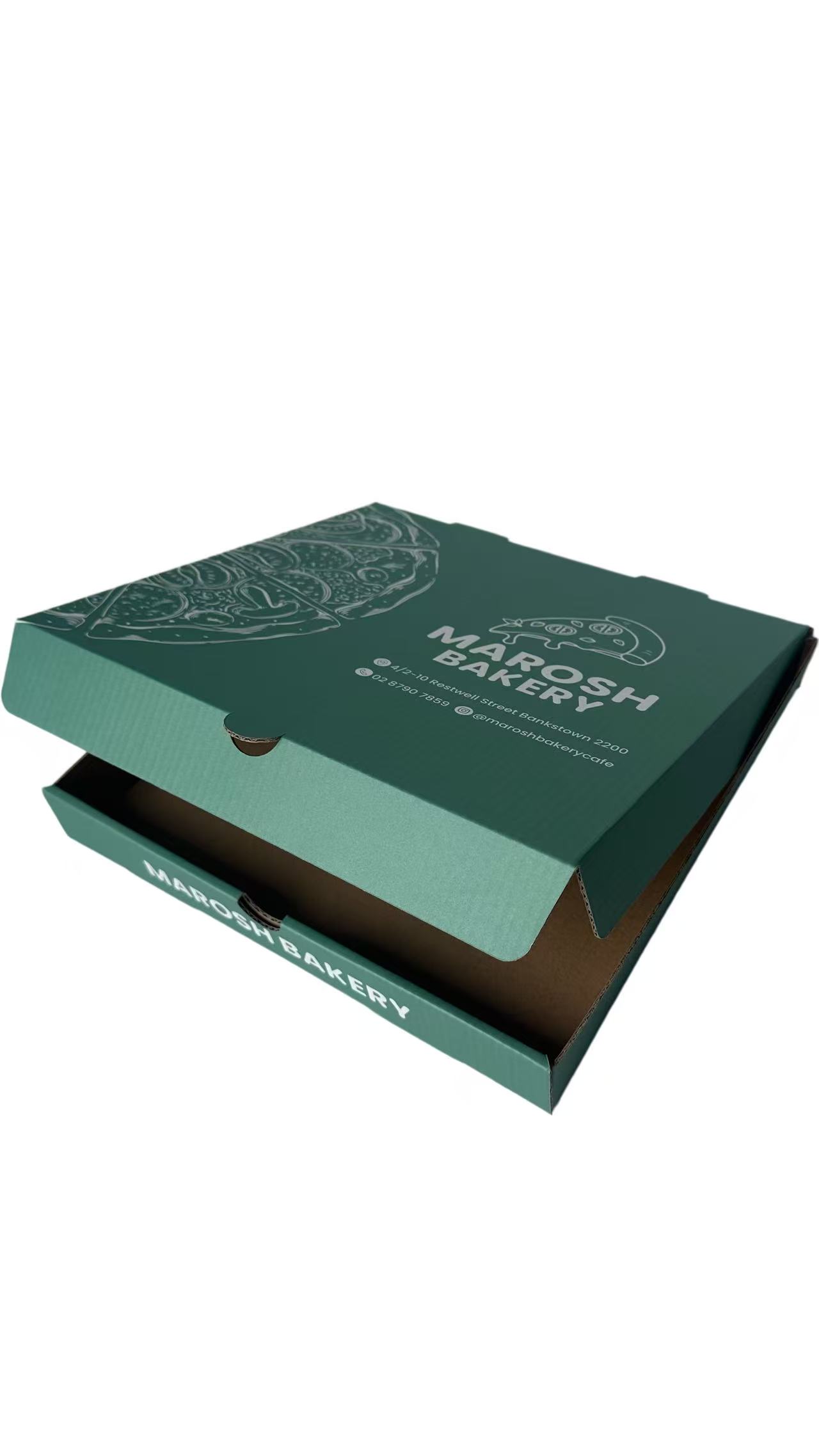
Procurement teams frequently debate whether to use corrugated board or folding cartons. Each material serves a distinct operational purpose. Making the wrong choice directly impacts both food quality and unit economics.
You should choose corrugated material when your business handles heavy delivery volumes, frequent multi-pizza orders, and long transit times. Corrugated board offers superior thermal performance and durability. It survives the chaotic environment of third-party delivery vehicles.
Conversely, folding cartons—typically made from Solid Bleached Sulfate (SBS) or Coated Recycled Board (CRB)—work best in different scenarios. They suit dine-in leftovers, single-slice retail environments, or frozen grocery aisles. In these situations, nobody stacks heavy, hot food on top of the box. The premium smooth surface of SBS allows for photographic-quality offset printing, making it ideal for retail freezer displays.
Performance Factor | Corrugated Board | Folding Cartons (SBS/CRB) |
|---|---|---|
Thermal Insulation | Excellent (Traps heat via air pockets) | Poor (Rapid heat loss) |
Stacking Strength | High (Resists downward crushing) | Low (Prone to collapsing) |
Best Use Case | Off-premise delivery, catering | Leftovers, retail, single slices |
Print Capability | Flexographic (Bold, simple graphics) | Offset (High-resolution, complex art) |
Both materials face grease resistance realities. Untreated paper absorbs oils quickly, weakening the structure and creating an unappealing presentation. Manufacturers address this by adding food-grade polyethylene (PE) liners or aqueous coatings. A PE liner prevents grease leaks entirely and strengthens the base. However, you face a distinct trade-off. Thick plastic coatings often render the box ineligible for local municipal composting programs, complicating your brand's environmental messaging.
Visual presentation matters just as much as structural performance. The unboxing experience happens on the customer's dining table, turning the packaging into a primary marketing vehicle. Manufacturers leverage specific technologies to make this branding highly scalable and cost-effective.
High-volume production relies heavily on flexographic printing. This process utilizes large, flexible rubber plates to stamp designs directly onto the paperboards. Combined with fast-drying water-based inks, flexography allows plants to produce tens of thousands of units per hour. It keeps manufacturing economics highly favorable for independent pizzerias and national chains alike.
Design trends have shifted significantly in recent years. Instead of full-color, glossy graphics, many operators now prefer Minimalist Custom Printed Pizza Boxes. By using one or two simple ink colors on unbleached kraft paper, brands project an artisanal, sustainable image. This minimalist approach sharply reduces ink consumption and plate costs while aligning perfectly with modern consumer aesthetics.
Branding extends far beyond ink on paper. A true Custom Design Pizza Box incorporates structural customization. Clever engineering transforms a simple container into an interactive tool. Designers add custom die-cuts for precise vent placements, integrated dipping sauce compartments, or perforated tear-away plates. These thoughtful structural additions elevate the end-user experience, proving your brand cares about convenience.
Securing the right packaging solves only half the puzzle. How you handle these materials in your warehouse dictates their ultimate performance. Improper storage ruins high-quality paperboard before it ever touches food.
Many operators commit a critical operational failure: they store inventory directly on bare concrete floors. Concrete holds latent moisture. Through a process called wicking, or capillary action, the corrugated board absorbs this ground moisture like a sponge. This destroys the structural integrity of the fluting. Always utilize wooden or plastic pallets to keep your inventory elevated and dry.
Freight and palletization logistics strongly favor corrugated solutions. These products ship flat, commonly referred to as "knocked down." This flat profile optimizes warehouse space and maximizes the number of units you can fit onto a single truck. Because the material consists mostly of air and lightweight paper fibers, it boasts a remarkably low tare weight, keeping freight shipping rates manageable.
You must also navigate sustainability claims versus environmental reality. Corrugated board is inherently highly recyclable and biodegradable, unlike rigid plastic alternatives. However, end-of-life disposal depends heavily on the food itself. Heavy grease saturation ruins paper fibers for standard recycling facilities. If a box becomes soaked in cheese oils, consumers should compost it rather than recycle it. Educating your customers on proper disposal enhances your overall sustainability impact.
Partnering with a reliable supplier guarantees consistent quality and protects your brand reputation. You must look past unit pricing and evaluate technical competence. Knowing what questions to ask separates robust suppliers from unreliable vendors.
First, always check for the Box Maker's Certificate (BMC). This circular stamp, typically printed on the bottom flap, acts as a guarantee of structural integrity. It verifies critical industry metrics like the Edge Crush Test (ECT) or the Mullen Burst Test ratings. The ECT specifically measures the material's ability to withstand vertical compression, assuring you that the packaging will survive multi-order stacking.
Next, evaluate supply chain resilience. Reliable corrugated pizza box manufacturers provide transparent lead times and realistic Minimum Order Quantities (MOQs). Ask about their raw material sourcing. Can they provide FSC-certified kraft paper? Do they use high-quality virgin fibers for strength, or do they rely too heavily on weaker test liners?
Finally, demand strict food safety compliance. Direct food contact requires stringent oversight. Ensure your chosen vendor uses food-safe, low-migration inks that will not off-gas or transfer harmful chemicals onto the hot food. They must fully comply with FDA regulations or equivalent local health standards governing direct and indirect food contact materials.
Specifying the correct packaging requires a strategic approach rather than a simple purchasing habit. Corrugated board dominates the delivery market because it actively manages moisture, traps heat, and resists crushing under severe logistical stress. Balancing product integrity with intelligent unit economics guarantees better customer satisfaction.
To optimize your off-premise dining experience, take immediate action on your procurement strategy. Request physical samples from multiple vendors and verify their Edge Crush Test ratings. Conduct your own real-world transit tests to monitor thermal drops and moisture buildup over a thirty-minute drive. By refining your material choices and exploring structural customizations, you protect your food quality and elevate your brand presence in the customer's home.
A: Square boxes are significantly cheaper to manufacture. Factories stamp them from a single sheet of corrugated board with zero waste. Additionally, square formats are much easier to store flat in tight kitchen spaces and can be folded quickly by staff on a busy prep line.
A: Most manufacturers advise against it. Corrugated board can pose a fire risk at high temperatures inside a microwave. Furthermore, certain printing inks or heavily recycled fibers present in the material may not meet microwave-safe standards, potentially releasing unwanted odors or chemicals.
A: Ensure you are sourcing boxes with adequate internal depth or utilizing a plastic "pizza saver" tripod. More importantly, specify a rigid flute type, like B-flute, which successfully resists downward crushing when delivery drivers stack multiple orders together.
A: Standard sizing typically includes Small (10-inch), Medium (12-inch), Large (14-inch), and Extra-Large (16-inch). However, exact inner dimensions and depths can vary slightly depending on the specific manufacturer and regional market preferences.


