
Views: 0 Author: Site Editor Publish Time: 2026-07-21 Origin: Site


Standard pizza boxes have remained structurally unchanged for decades. Modern takeout logistics expose the limitations of the traditional flat-box design. Operators face a constant tension between minimizing packaging unit costs and maximizing customer convenience, food integrity, and brand presentation. Awkwardly carrying multiple flat boxes often leads to dropped orders, thermal loss, or the necessity of secondary carrier bags. Third-party delivery drivers, urban foot traffic, and multi-item orders demand better structural solutions.
Upgrading to a Handle Pizza Box is not a universal solution. It requires a calculated assessment of your customer demographics, back-of-house workflow, and unit economics. This guide breaks down the operational realities, cost trade-offs, and specific scenarios where handled packaging drives measurable ROI. We will examine assembly times, delivery bag stacking, and the exact metrics needed to justify the switch from standard corrugated flats.
Cost Offsetting: The higher unit cost of a pizza box with handle is often neutralized by eliminating the need for secondary plastic or paper carrier bags.
Operational Friction: Handled designs require evaluation for back-of-house assembly speed, flat-storage footprint, and vertical stacking stability during peak volume.
Targeted Application: Carry handle designs yield the highest ROI for pizzerias with high pedestrian traffic, transit-commuting customers, and high-volume multi-item ticket averages.
Sustainability Compliance: Like standard takeaway pizza packaging, handled variants must be evaluated for local recycling and composting compliance, specifically regarding grease contamination, food scrap removal, and non-paper material detachment.
The traditional corrugated flat box has served the industry well, but it introduces distinct friction points in the modern consumer journey. Carrying a standard box requires two hands to keep the pie level. When customers attempt to carry multiple boxes, open doors, or navigate public transit, the risk of dropping the order increases significantly. A tilted box causes hot cheese and toppings to slide, ruining the presentation and frustrating the customer. Standard B-flute and E-flute corrugated boards offer decent crush resistance, but they do nothing to solve the ergonomic nightmare of carrying three large pies and a two-liter soda down a crowded sidewalk.
The shift toward integrated handles solves these physical challenges. Modern handle designs utilize die-cut top flaps and interlocking tabs that fold upward, shifting the center of gravity. This allows for secure, one-handed transport while keeping the base perfectly horizontal. The engineering behind a carry handle pizza box relies on distributing the weight of the pizza across the reinforced top panel rather than relying on the customer to pinch the sides.
When evaluating a switch to this style of takeaway pizza packaging, operators must measure success against specific baseline metrics. Assembly time must remain efficient during rush hours. Thermal retention cannot be compromised by the handle cutouts. Finally, the customer experience must demonstrably improve, reducing complaints about damaged food during transit. You need to track remake requests due to dropped boxes before and after implementing the new design to see the real operational impact.
Pizzerias located in dense urban centers or near transit hubs serve a high volume of walk-in patrons and commuters. For these customers, the journey from the counter to their destination involves navigating crowded sidewalks, subway turnstiles, and apartment stairwells. A one-handed carry design dramatically reduces customer frustration. By preventing the box from tipping, the structural integrity of the pizza remains intact, ensuring the product looks just as good upon arrival as it did when it left the oven. Foot traffic dictates packaging needs. If your store relies on a parking lot, flat boxes work. If your customers walk more than two blocks, handles prevent disaster.
Takeout orders rarely consist of just one pizza. Customers frequently add two-liter beverages, heavy salads, wings, or dessert boxes. Carrying a flat box with two hands makes transporting these additional items incredibly awkward. An integrated handle frees up a hand, indirectly supporting higher ticket sizes. When customers know they can physically manage a larger order without struggling, they are more likely to accept upsell offers at the counter or during online checkout. You cannot sell a customer a heavy side item if they physically cannot carry it out the door.
Packaging structure heavily influences the psychological perception of food value. A custom handled pizza box signals a premium experience. For high-end artisanal pizzerias, corporate catering services, and event drop-offs, presentation serves as a core competitive differentiator. Walking into a corporate office with neatly stacked, handled boxes looks significantly more professional than struggling with a precarious stack of standard flat cardboard. Catering managers specifically look for packaging that makes their job easier during setup.
Operational Scenario | Standard Flat Box Suitability | Handled Box Suitability | Primary Business Driver |
|---|---|---|---|
Suburban Drive-Through / Curbside | High | Low | Speed of service, low unit cost. |
Urban Walk-In / Commuter Transit | Low | High | Ergonomics, spill prevention. |
Corporate Catering Drop-offs | Medium | High | Professional presentation, easy transport. |
High-Volume Third-Party Delivery | High | Medium | Stackability in insulated bags. |
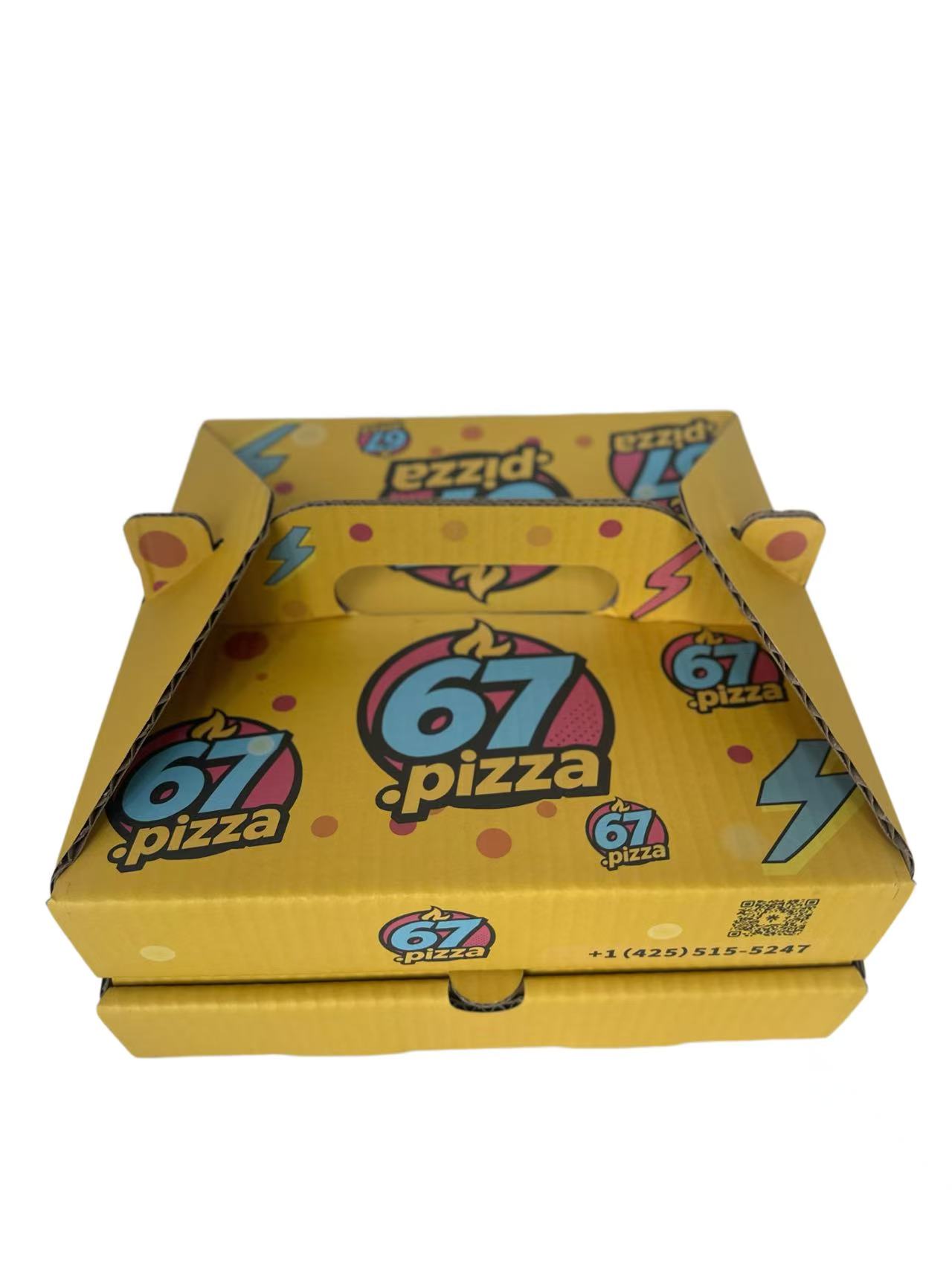
The folding mechanics of a standard box are deeply ingrained in pizzeria muscle memory. Introducing a pizza box with handle requires staff to learn a new folding sequence. The handle locking mechanism involves interlocking tabs that must be secured properly to prevent the box from opening during transport. Operators must identify potential bottlenecks during Friday night rushes. While initial assembly may take a few seconds longer, proper training quickly mitigates this labor friction. You must run time studies at the expo station.
Pre-fold all major creases on the flat cardboard before attempting to lock the corners.
Secure the rear ventilation tabs first to establish the structural base of the box.
Fold the front wall and lock the side panels into the base slots.
Push the die-cut handle tabs upward from the lid before closing the box.
Interlock the left and right handle grips securely to ensure the lid will not pop open under weight.
Delivery drivers rely on insulated bags that hold five to ten pizzas vertically. Protruding handles can interfere with this stacking process. Operators must evaluate the structural integrity of the die-cut design. Does the handle cutout weaken the center of the lid? If the top box sags under the weight of other items, it will crush the crust and toppings below. The best designs feature fold-flat handles that remain flush until the customer pulls them up. Test your current 18x18x20 delivery bags to ensure the new boxes slide in without catching on the thermal lining.
Moisture is the enemy of a crispy crust. Standard boxes use small rear or side vents to allow steam to escape. Handle cutouts naturally alter the airflow dynamics inside the packaging. Operators must analyze how these cutouts impact steam escape. Proper placement of standard ventilation holes relative to the handle is critical to prevent moisture buildup, balancing heat retention with necessary airflow. If the handle creates too large of a gap, the pizza loses heat rapidly. If it seals too tightly, the crust turns to mush.
Handled variants carry a different unit cost compared to standard corrugated boxes. This delta is driven by the complex die-cutting process required to create the interlocking handle tabs. Operators must calculate this percentage increase per unit and weigh it against the operational benefits and customer experience improvements. You are paying for the extra tooling and the slightly larger cardboard footprint required to fold the handle inward.
The most direct financial justification for handled packaging is the elimination of secondary carrier bags. Many pizzerias purchase large plastic or heavy-duty paper bags specifically to hold multiple flat boxes for walk-in customers. By calculating the monthly spend on these bags, operators can determine the break-even point. Often, the savings from eliminating the bag completely offsets the increased unit cost of the handled box. Stop paying for bags that just end up in the trash.
A flat box carried horizontally offers zero visibility to passersby. Conversely, a handled box carried vertically acts as a walking billboard. The top lid faces outward, exposing the restaurant's logo to street-level traffic. This increased brand visibility provides a measurable marketing ROI, effectively turning every pickup customer into a mobile advertisement for the pizzeria. Pedestrians see the logo clearly from twenty feet away, which drives organic foot traffic back to your storefront.
Sustainability requires strict attention to material composition. Operators must verify that the addition of a handle does not introduce mixed materials, such as hidden plastic reinforcements, which would disqualify the box from single-stream recycling. The contaminant stripping process is vital. Consumers must remove non-paper materials—including adhesive thermal receipts, sealing tape, and plastic pizza savers—prior to placing the box in a recycling bin. Check with your municipal waste authority regarding acceptable corrugated grades.
The reality of pizza box disposal is divided by grease. Clean, grease-free sections, which almost always include the top lid and the integrated handle, are perfectly recyclable. However, heavily grease-soiled bottom panels disrupt the paper pulping process and must go to the trash or municipal composting facilities. Commercial composting serves as a high-value sustainability alternative where local infrastructure allows. Operators can also utilize greaseproof inserts or parchment paper to minimize bottom contamination, thereby preserving the recyclability of the structural cardboard.
Packaging sustainability fails if the consumer disposes of it incorrectly. Operators should print clear, concise disposal instructions directly on the packaging. Simple directives like "Remove food scraps, tear off clean top and handle to recycle, compost greasy base" significantly improve local recycling compliance. Do not assume the customer knows how to separate the lid from the base.
Alternative Solution | Operational Pros | Operational Cons |
|---|---|---|
Standard Boxes + Handled Carrier Bags | Familiar BOH assembly; easy vertical stacking in delivery bags. | Double inventory management; increased environmental footprint; subject to local bag taxes. |
String/Twine Tying | Provides a traditional, artisanal aesthetic; highly secure. | Extremely labor-intensive; severely slows down the expo station during peak volume. |
Reusable Pizza Carriers | Maximum sustainability; excellent for zero-waste initiatives. | High upfront cost; relies on a complex customer return and deposit ecosystem. |
Using traditional boxes placed inside large plastic or paper bags is the most common alternative. It requires no change to back-of-house assembly muscle memory and allows for standard stacking. However, it forces the operator to manage two separate inventory streams and increases the overall environmental footprint, while also exposing the business to municipal bag taxes. Storing pallets of bags takes up valuable dry storage space.
Tying multiple flat boxes together with twine offers a highly secure carry method and a rustic, artisanal presentation. While visually appealing, it is incredibly labor-intensive. Tying knots requires time and dexterity, which creates massive bottlenecks at the expo station during a busy Friday night rush. You cannot afford to have your expo person spending forty seconds tying knots when ten orders are waiting in the window.
For hyper-local or community-focused pizzerias, reusable hard-plastic or silicone carriers offer maximum sustainability. While they eliminate single-use waste, they require a complex deposit and return ecosystem. The logistics of tracking, sanitizing, and storing returned carriers make this option difficult to scale for high-volume operations. Health department regulations regarding the sanitization of customer-returned items add another layer of operational friction.
Audit your current takeout demographics to determine the exact percentage of walk-in versus delivery orders.
Calculate your current monthly expenditure on secondary plastic or paper carrier bags to establish a break-even budget.
Request a sample run of 100 to 200 handled boxes from your packaging supplier to test in your specific environment.
Conduct a back-of-house time study during a slow shift to evaluate assembly speed and stacking compatibility.
Solicit direct feedback from pickup customers regarding the carrying experience before committing to a full pallet order.
A: Yes, they typically carry a higher unit cost due to the complex die-cut manufacturing process. This cost is often offset by eliminating the need to purchase separate plastic or paper carrier bags for walk-in customers.
A: It depends on the specific design. Many modern carry handle pizza boxes feature fold-flat handles or recessed grips specifically engineered to allow traditional vertical stacking in insulated delivery bags without crushing the box below.
A: If engineered correctly, the handle cutouts act as secondary ventilation holes. They allow steam to escape and prevent a soggy crust without compromising the core thermal retention of the corrugated cardboard.
A: Yes, provided they are made of 100% corrugated cardboard without plastic reinforcements. Consumers must remove all food scraps, plastic stabilizers, and adhesive receipts. Clean sections can be recycled, while greasy bottoms should be composted or trashed.
A: Initial assembly may take a few seconds longer than a standard box due to the locking tabs on the handle. Staff muscle memory typically reduces this friction within the first week of implementation, bringing assembly times back to normal.
A: Yes, most commercial packaging suppliers offer custom printing on handled boxes. Because the box is carried vertically by the customer, the top lid acts as a highly visible billboard for your brand, making it an excellent canvas for printing custom logo graphics.


