
Views: 0 Author: Site Editor Publish Time: 2026-07-18 Origin: Site


Treating takeout packaging as a simple commodity carries significant operational and reputational risks. Substandard boxes compromise food quality, introduce chemical contamination risks, and damage brand perception. Restaurant operators must balance thermal retention and structural integrity with strict regulatory compliance. The challenge lies in identifying packaging that prevents grease bleed-through and moisture buildup without relying on hazardous chemical coatings.
A technical breakdown of what constitutes a truly compliant, high-performance takeout container is essential. This guide provides a framework for evaluating materials, verifying supplier claims, and selecting a Food-Safe Pizza Box that protects both the consumer and the business.
Material Compliance is Non-Negotiable: True food grade pizza packaging requires verified, PFAS-free materials, utilizing FDA-compliant adhesives and food-safe inks.
Performance Dictates Customer Experience: The optimal box balances moisture ventilation to preserve crust texture with thermal insulation to maintain safe holding temperatures.
Consumer Misuse Requires Mitigation: Packaging must account for end-user behaviors, such as unsafe oven reheating, through clear on-box messaging and heat-resistant structural design.
Branding Must Not Compromise Safety: Developing a personalized pizza box requires strict separation between exterior branding applications and interior food-contact surfaces.
Evaluating corrugated board profiles determines the structural rigidity, crush resistance, and thermal insulation of your packaging. The industry standard relies heavily on B-flute and E-flute configurations. B-flute offers excellent crush resistance and stacking strength, making it ideal for larger, heavier pizzas. E-flute provides a smoother printing surface and takes up less storage space, though it sacrifices some thermal insulation compared to thicker profiles. Selecting the right flute profile depends on your specific menu items and delivery radius.
When choosing between virgin and recycled fibers, operators face a trade-off between purity and sustainability. Virgin kraft paper offers the highest purity level for direct food contact, ensuring no legacy contaminants migrate into the food. Recycled materials, while environmentally friendly, require rigorous testing protocols. Manufacturers must verify that recycled pulps do not contain heavy metals, mineral oils, or residual chemicals from previous lifecycles. Many high-quality boxes use a hybrid approach: a virgin kraft inner liner for safe food contact and a recycled outer layer for structural support.
Grease and moisture barriers are critical for maintaining box integrity during transit. Physical barriers, such as dense fiber weaving and natural wax paper liners, provide excellent resistance without introducing harmful chemicals. Dense fiber weaving tightens the paper matrix, slowing oil absorption. Natural wax liners create a physical shield between the hot cheese and the cardboard. These physical methods are vastly superior to chemical coatings, which often rely on controversial substances to achieve grease resistance.
Flute Type | Thickness | Primary Advantage | Best Use Case |
|---|---|---|---|
B-Flute | Approx. 1/8 inch | High crush resistance, excellent insulation | Large, heavy pizzas; long delivery routes |
E-Flute | Approx. 1/16 inch | Superior printability, space-saving | Personal pizzas, highly branded packaging |
F-Flute | Approx. 1/32 inch | Ultra-thin, rigid | Frozen pizzas, retail display |
Alternative takeout containers consistently fail to meet the specific demands of hot pizza delivery. Expanded polystyrene (foam) shells and plastic hinged containers trap excessive condensation. When a pizza exits the oven at temperatures exceeding 180°F, it releases massive amounts of steam. Foam and plastic lack breathability, forcing that steam back into the crust, resulting in a soggy, unappetizing product. Furthermore, these materials risk chemical leaching when exposed to high heat and acidic tomato sauces.
Aluminum pans present a different set of problems. While they do not trap moisture as aggressively as plastic, aluminum is a highly conductive material. It accelerates cooling through rapid thermal dissipation. A pizza placed in an aluminum container will drop below safe holding temperatures much faster than one in a corrugated box. Corrugated cardboard provides superior insulation through its fluted air pockets while simultaneously absorbing excess surface moisture, preserving both temperature and texture.
Foam containers trap steam, destroying crust texture within minutes.
Plastic clamshells warp under high heat and risk chemical migration.
Aluminum pans conduct heat away from the food, accelerating cooling.
Corrugated cardboard insulates via trapped air while absorbing excess moisture.
The adhesives used in corrugated board manufacturing must withstand high heat and high humidity without off-gassing or degrading. FDA-approved, non-toxic glues are mandatory. If a substandard glue breaks down during delivery, the box loses its structural integrity, and chemical vapors can contaminate the food. Operators must verify that their suppliers use starch-based or specifically formulated food-safe synthetic adhesives.
The industry has aggressively shifted away from per- and polyfluoroalkyl substances (PFAS). Historically used for their exceptional grease resistance, PFAS are now recognized as harmful "forever chemicals." Verifying "PFAS-free" supplier claims is a mandatory step in sourcing food grade pizza packaging. You must request independent laboratory testing results from your manufacturer to confirm the absence of these compounds.
Ink formulations also play a major role in chemical compliance. Petroleum-based inks contain volatile organic compounds (VOCs) that can transfer to food, especially in enclosed, hot environments. Water-based or soy-based inks must be used for all printing. These alternatives provide vibrant colors without the risk of toxic off-gassing or heavy metal contamination.
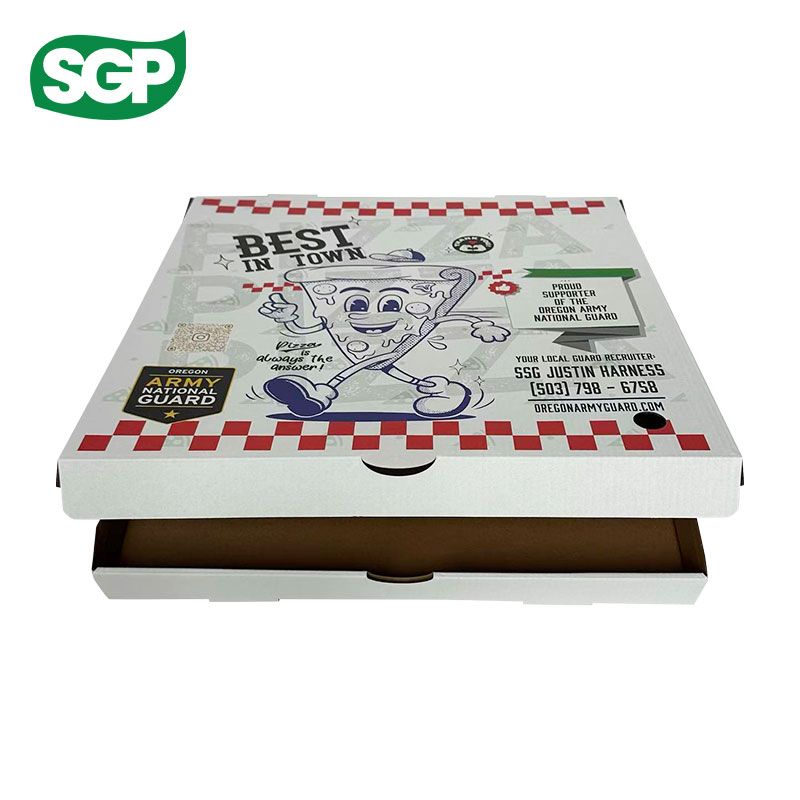
Managing the condensation problem requires precise engineering. Trapped steam degrades crust texture and accelerates bacterial growth if temperatures drop below safe holding thresholds (typically 135°F). Ventilation engineering involves evaluating the size, placement, and adjustability of vent holes. Vents must allow enough steam to escape to keep the crust crisp, but not so much that the pizza cools too rapidly. Rear-facing vents or adjustable side tabs offer the best balance, allowing operators to modify airflow based on the specific pizza type and delivery distance.
Size calibration is equally important. Matching box dimensions precisely to standard sizes prevents lateral movement during transit. Precise physical calibration protects crust texture, prevents toppings from sliding against the sidewalls, and minimizes empty air volume. Excess air volume inside the box acts as a heat sink, accelerating the cooling process. A properly sized box hugs the pizza, maximizing thermal retention.
High-volume delivery operations demand exceptional structural integrity. Assessing the box's load-bearing capacity ensures it can withstand multi-order stacking without collapsing. A collapsed box ruins the presentation, forces cheese onto the lid, and leads to customer refunds. Stacking strength is primarily determined by the quality of the corrugated fluting and the moisture resistance of the outer liner.
Grease penetration resistance must be tested under realistic operational conditions. The bottom layer must withstand oil saturation over a 45-to-60-minute delivery window without structural failure. If grease soaks through the bottom liner, the cardboard weakens, increasing the risk of the box tearing open when the customer carries it. High-density paper fibers and natural wax inserts provide the necessary defense against heavy grease loads.
Understanding the FDA 21 CFR regulatory baseline for indirect and direct food additives in paper and paperboard packaging is non-negotiable. This regulation dictates which substances can safely come into contact with food. Identifying credible third-party certifications validates supplier compliance. Look for FSC certification for sustainable sourcing and GFSI-recognized audits (such as SQF or BRCGS) for manufacturing facilities. These certifications prove that the manufacturer adheres to strict hygiene and safety protocols.
A strict operational rule restricts all decorative inks to the exterior of the branded food box. Printing on the inside of the box introduces severe direct food contact risks. Even with food-safe inks, the combination of high heat, steam, and acidic grease can cause ink degradation. Keeping all branding on the outside eliminates this variable entirely.
Ink migration risks must be managed even with exterior printing. High temperatures and grease can cause exterior inks to bleed through low-density cardboard, eventually reaching the food. Specifying high-holdout liners prevents this migration. A high-holdout liner has a tighter fiber structure that stops ink from penetrating deeply into the corrugated board, keeping the branding crisp and the food safe.
Addressing the common consumer hazard of reheating pizza in the box is a critical safety measure. Cardboard ignition risks, wax liner degradation, and toxic fume release from heated glues or inks necessitate clear "Do Not Put in Oven" disclaimers. Many consumers mistakenly believe corrugated boxes are oven-safe. Prominent warning labels protect the consumer from fire hazards and protect your business from liability.
Incorporating USDA-aligned guidelines for refrigerator storage improves consumer safety and extends product quality. Print instructions advising customers to transfer leftovers to clean containers, store them at 40 °F or below within 2 hours, and consume them within 3 to 4 days. This proactive messaging demonstrates a commitment to food safety that extends beyond the initial delivery.
Assessing the footprint of flat-packed boxes versus pre-assembled inventory optimizes space in constrained kitchen environments. Flat-packed boxes require less storage space but demand labor time for assembly during peak hours. Pre-assembled boxes save time but consume massive amounts of shelving. Operators must calculate their peak volume requirements to determine the optimal storage strategy.
Protocols for storing a safe takeaway box inventory must prevent contamination. Boxes must be stored at least six inches off the floor to protect against moisture and cleaning chemicals. Storage areas must be regularly inspected for pest ingress points. Cardboard absorbs ambient odors and moisture, so boxes should never be stored near strong-smelling chemicals or in highly humid areas like dishwashing stations.
Heavy grease and cheese residue render most pizza boxes unrecyclable in standard municipal streams. When grease soaks into the paper fibers, it disrupts the recycling process, causing entire batches of recycled paper to be rejected. Operators should educate customers on proper disposal, advising them to tear off the clean lid for recycling and discard the greasy bottom half.
Evaluating the safety of composting boxes requires verifying the chemical makeup of the packaging. Ensure that the inks and adhesives used do not introduce heavy metals or microplastics into compost systems. While clean, unbleached corrugated board is highly compostable, boxes heavily saturated with synthetic grease barriers or petroleum inks will contaminate compost piles.
Auditing a supplier's Safety Data Sheets (SDS) for adhesives, inks, and paperboard treatments verifies chemical safety. Do not accept vague assurances. Request specific documentation detailing the chemical composition of every component used in the box manufacturing process. If a supplier hesitates to provide an SDS, consider it a major red flag.
Requiring a written Letter of Guarantee (LOG) from the manufacturer is critical. This document legally states that the packaging meets all applicable food safety regulations for its intended use. The LOG should explicitly mention compliance with FDA 21 CFR guidelines and confirm the absence of PFAS and heavy metals.
Moving beyond unit price requires factoring in the operational costs of collapsed boxes, ruined food, and potential liability from chemical migration. A box that costs two cents less but collapses under the weight of a large pizza will cost you significantly more in refunded orders and lost customers. Evaluate the structural failure rate during your testing phase to understand the true cost of the packaging.
Balancing the desire for custom branding with Minimum Order Quantities (MOQs) addresses inventory holding costs. Ordering massive quantities of a personalized pizza box to secure a lower unit price can backfire if the cardboard degrades in storage. Corrugated board absorbs moisture over time, losing its rigidity. Order only what you can reasonably use within a three-to-six-month window to ensure optimal performance.
Request material specification sheets from current or prospective suppliers to verify chemical documentation and PFAS-free materials.
Order physical samples for in-house stress testing, focusing on heat retention, grease penetration, and stacking capabilities under realistic delivery conditions.
Audit current custom designs to identify and eliminate any ink migration risks, ensuring all printing remains strictly on the exterior.
Implement strict kitchen storage protocols to keep packaging inventory elevated, dry, and away from potential contamination sources.
A: No. Corrugated cardboard can ignite at standard oven baking temperatures. Additionally, intense heat causes food-safe glues, wax linings, and exterior inks to break down, melt, or release harmful chemical fumes that contaminate the food.
A: Food grade packaging uses virgin or highly purified recycled paperboard, FDA-compliant adhesives, and non-toxic (often water- or soy-based) inks, ensuring no harmful chemicals transfer to the food under high heat and grease conditions.
A: Historically, some packaging used PFAS for grease resistance. However, regulatory shifts and safety standards now require reputable suppliers to provide certified PFAS-free boxes. Always request documentation from your vendor.
A: Yes, provided the box utilizes soy-based or water-based inks and non-toxic adhesives. However, heavily greased portions are better suited for commercial composting facilities rather than home compost bins.
A: According to USDA guidelines, pizza leftovers should be stored at 40 °F or below within 2 hours of preparation and must be consumed within 3 to 4 days. For optimal hygiene, transfer the pizza from the original delivery box to an airtight food-grade container before refrigerating.
A: An improperly sized box allows excessive air circulation, which rapidly cools the pizza into the bacterial danger zone. It also allows toppings to slide, ruining the presentation and potentially compromising the structural integrity of the box.
A: Not if manufactured correctly. Safe custom boxes restrict all printing to the exterior, use high-density liners to prevent ink bleed-through, and utilize verified food-safe inks.


