
Views: 0 Author: Site Editor Publish Time: 2026-07-31 Origin: Site


Standard corrugated packaging frequently fails under high-moisture and high-temperature conditions, leading to compromised structural integrity and degraded product quality during transit. While manufacturers offer various moisture and grease barriers, inconsistent application—specifically poor coating uniformity—results in localized failures, chemical migration risks, and negative end-user experiences. Procurement and packaging engineers must look beyond basic material claims to verify actual manufacturing tolerances. Establishing a rigorous framework for evaluating how suppliers measure and enforce coating uniformity is critical for sourcing reliable, compliant, and high-performing packaging.
Uniformity Determines Viability: Even premium barrier materials (PLA, PE, clay, or aqueous coatings) will fail if application thickness varies, making stringent uniformity checks non-negotiable.
Testing Methodologies Matter: Reliable suppliers utilize both inline optical inspection and offline standardized testing (e.g., Cobb, Kit, and peel adhesion tests) to validate moisture and grease resistance.
Compliance is Tied to Application: Inconsistent coatings increase the risk of chemical migration, complicating compliance with FDA and strict PFAS-free regulations.
Substrate Interaction: The base material, particularly in highly porous kraft pizza boxes, dictates the required coating weight and the complexity of achieving a uniform barrier.
Moving beyond basic water-resistant marketing claims requires measurable, reproducible data. Packaging engineers rely on Moisture Vapor Transmission Rates (MVTR) and grease holdout metrics to determine actual barrier effectiveness. A high-performance pizza box must maintain its structural rigidity while trapping heat and blocking grease from penetrating the fluting. If MVTR values fluctuate across a single packaging run, the barrier application is fundamentally flawed. You need consistent metrics to ensure the packaging performs under the stress of hot, oil-heavy foods emitting active steam.
Testing for MVTR involves sealing a sample of the coated board over a desiccant-filled cup and placing it in a controlled environmental chamber, typically set to 38°C and 90% relative humidity. The weight gain of the desiccant over 24 hours indicates the volume of moisture vapor passing through the barrier. Uniform coatings yield tight standard deviations in these test results. When uniformity drops, the standard deviation spikes, indicating that some boxes in the production run will fail in the field while others survive.
Evaluating the chemical composition of barrier coatings reveals significant differences in application methods, machinery requirements, and performance outcomes. Traditional Polyethylene (PE) offers excellent moisture resistance but faces severe recycling limitations at standard pulping facilities. Polylactic Acid (PLA) provides a commercially compostable alternative, though it requires precise temperature control during the extrusion and lamination process to prevent thermal degradation. Plant-based aqueous coatings and mineral-based clay coatings operate as direct liquid-applied barriers. They penetrate the paper fibers differently than laminated film linings like PE or PLA.
Direct liquid applications demand rigorous uniformity checks at the wet end of the corrugator or coating line. If the liquid coating pools in the valleys of the paper surface or spreads unevenly across the peaks, the resulting barrier will have microscopic weak spots. Laminated films offer inherent thickness consistency because they are manufactured as a separate web before application, but they require perfect thermal bonding to prevent delamination. Analyzing how each chemical composition interacts with corrugated surfaces helps determine the best approach for specific packaging needs.
Coating Chemistry | Application Machinery | Moisture Resistance Profile | Primary Uniformity Challenge |
|---|---|---|---|
Polyethylene (PE) | Extrusion Coater / Laminator | Extremely High (Vapor & Liquid) | Thermal bonding consistency, edge sealing, and web tension control. |
Polylactic Acid (PLA) | Extrusion Coater / Laminator | High (Vapor & Liquid) | Heat sensitivity during lamination causing film distortion or thinning. |
Aqueous Dispersion | Rod Coater / Anilox Roll | Medium-High (Liquid focused) | Managing absorption rates, viscosity fluctuations, and surface tension. |
Mineral Clay Coating | Blade Coater / Air Knife | Medium (Short-term exposure) | Achieving even thickness over highly porous, unbleached fibers. |
The base material dictates exactly how a liquid coating behaves upon contact. Standard unbleached board and highly porous kraft pizza boxes possess vastly different surface tensions, fiber alignments, and absorption rates compared to tightly woven bleached boards. Kraft paper absorbs liquid coatings rapidly due to its open fiber network. This rapid absorption can pull the barrier material too deep into the substrate, leaving the actual food-contact surface exposed and vulnerable to grease.
Achieving coating uniformity on porous substrates requires specialized application techniques. Manufacturers often utilize higher coating weights, increased viscosity formulations, or multi-pass applications (a primer coat followed by a top coat) to ensure a continuous protective layer remains on the surface. If the supplier fails to adjust their coating machinery to account for the specific porosity of the kraft board batch, the resulting packaging will exhibit severe pinholing and rapid barrier failure.
Microscopic gaps, pinholes, or thin spots in the barrier layer lead directly to rapid moisture ingress. When active steam from hot food hits a thin spot in the coating, condensation bypasses the barrier and saturates the underlying paper fibers. This triggers capillary action, where the moisture wicks rapidly through the board, causing the infamous soggy bottom effect and eventual structural collapse. A barrier is truly only as strong as its thinnest point. Even a 99% perfect coating will fail entirely if that 1% defect aligns with a high-moisture contact zone, such as the center of the box directly beneath the food.
Grease penetration follows a similar mechanical failure path. Hot oils lower the viscosity of the grease, allowing it to flow easily into any microscopic surface defects. Once the grease breaches the barrier, it stains the exterior of the box, weakening the structural integrity of the fluting and creating an unappealing presentation for the end user. Uniformity ensures that no such breach points exist across the entire surface area of the packaging.
Applying excess coating to compensate for uneven distribution or poor machinery calibration creates an entirely new set of mechanical problems. Excessive coating increases unit weights and drives up manufacturing expenses unnecessarily. More importantly, it compromises the foldability of the corrugated board. Thick, rigid coatings crack at the score lines during assembly. This cracking instantly destroys the moisture barrier at the box's structural weak points, allowing grease and steam to penetrate the edges.
Furthermore, over-applied barriers can interfere with assembly adhesives. If the coating is too thick or uneven, standard packaging glues cannot penetrate the surface to create a strong fiber-tearing bond. This results in boxes that pop open during transit or fail to hold their shape when stacked. Precision application is required to balance barrier efficacy with mechanical foldability and adhesive compatibility.
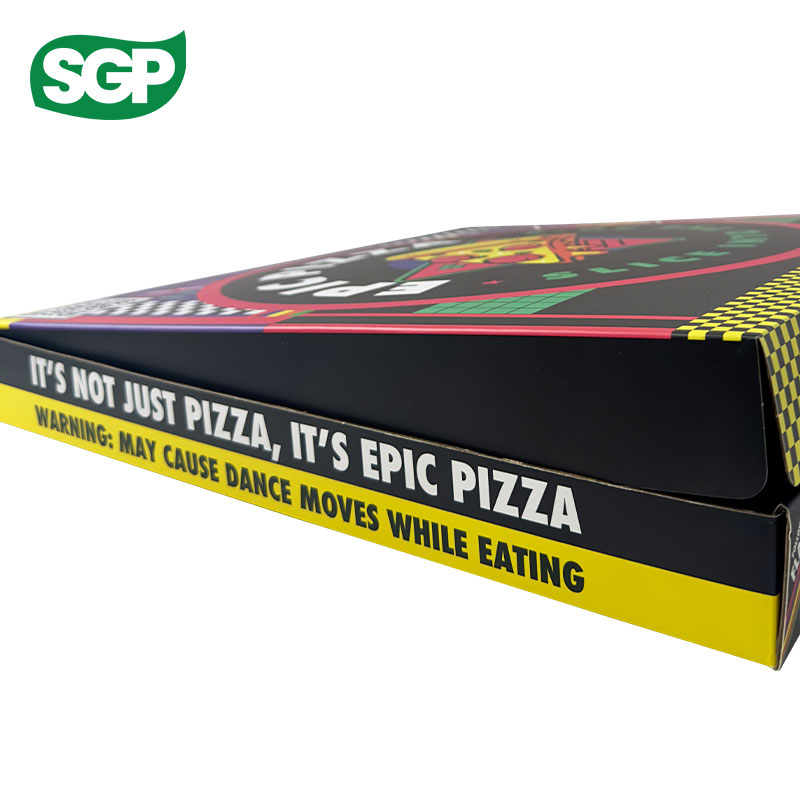
Uneven surface tension resulting from poor coating uniformity disrupts ink adhesion on the opposite side of the board. When producing custom printed pizza boxes, inconsistent internal barriers can affect the board's overall moisture profile and dimensional stability, indirectly impacting exterior print quality. Ink mottling, poor dot reproduction, or flaking often traces back to substrate instability caused by uneven internal moisture barriers.
The interaction between internal barrier coatings and exterior surface finishes requires careful management by the packaging engineer. Gloss or matte varnishes applied to the exterior offer scuff resistance and visual appeal, but they do not replace internal food-contact barriers. You must ensure dual-sided moisture management without causing the board to warp. Warping occurs when there is mismatched surface tension or moisture absorption rates between the heavy inner coating and the lighter outer varnish. Uniformity on both sides prevents this curling effect.
Modern, high-volume manufacturing relies heavily on automated optical inspection, beta-ray sensors, and infrared spectrophotometry during the extrusion or coating process. These sensors scan the moving web at high speeds, detecting microscopic variations in coating thickness and moisture content. Beta-ray sensors measure the basis weight of the board before and after the coating station, calculating the exact coat weight applied in real-time.
Real-time closed-loop feedback systems are essential for maintaining uniformity. When the inline sensors detect a drop in coating weight or an uneven profile across the web, the system automatically adjusts application pressure, anilox roll speeds, or air knife angles. This dynamic adjustment prevents long runs of defective packaging and ensures the barrier remains within the specified engineering tolerances throughout the entire production shift.
Inline sensors provide continuous data, but they require validation through rigorous offline laboratory testing to ensure calibration accuracy. Packaging engineers must audit the supplier's offline testing protocols.
Cobb Sizing Test (ISO 535 / TAPPI T 441): This test verifies the water absorptiveness of the coated board. A technician clamps a metal ring over the coated sample, pours a specific volume of water into the ring, and waits for a set timeframe (usually 2 minutes for standard checks, or 30 minutes for heavy-duty barriers). After pouring off the water, the sample is blotted and weighed. A low Cobb value confirms the barrier effectively repels water.
Kit Testing (TAPPI T 559): Technicians use this method to measure the degree of repellency and surface resistance to grease. They apply drops of numbered test solutions (varying mixtures of castor oil, toluene, and heptane) to the surface. If the solution darkens the board within 15 seconds, the coating fails at that Kit number. High-fat food applications typically require a Kit rating of 8 or higher.
Dye Penetration Tests: Using aggressive visual indicators like colored alcohol solutions, this test identifies pinholes, micro-fractures, and coverage gaps in the coating layer that optical sensors might miss. The dye will immediately bleed through any defect, providing a clear visual map of coating uniformity.
Adhesion and Fiber Tear Testing: This ensures laminated linings or heavy coatings do not delaminate under high-humidity conditions. Technicians apply specialized tape to the coating and pull it away at a specific angle. A passing result shows fiber tear (the paper breaks before the coating lifts), proving the barrier is securely anchored to the substrate.
Coating inconsistencies directly exacerbate the risk of chemical migration. Unreacted monomers, plasticizers, or barrier chemicals can leach into high-temperature, high-fat foods if the coating degrades or if thin spots allow direct food-to-chemical contact. Uniform application ensures the barrier cures correctly, cross-links fully, and maintains a stable, inert interface between the packaging and the consumable product.
Migration testing involves exposing the coated board to food simulants (like vegetable oil or acetic acid) at elevated temperatures for extended periods. If the coating is uneven, the thinner areas may break down under the thermal and chemical stress of the simulant, leading to a failure in regulatory compliance. Consistent coat weights are the primary defense against migration failures.
The packaging industry is rapidly shifting away from per- and polyfluoroalkyl substances (PFAS) due to global regulatory bans. Evaluating alternative grease-proofing agents is now mandatory for all procurement teams. You must verify supplier claims regarding PFAS-free manufacturing through independent laboratory testing. Alternative coatings, particularly aqueous polymer blends and natural waxes, require significantly stricter uniformity controls to match the performance of legacy PFAS chemicals.
PFAS chemicals were highly effective because they lowered the surface energy of the paper so drastically that even a microscopic, uneven layer provided excellent grease holdout. Modern PFAS-free alternatives rely on creating a continuous physical film over the fibers. Therefore, inconsistent application of PFAS-free barriers leads directly and immediately to grease bleed-through. Suppliers must upgrade their application machinery to handle these new, demanding formulations.
Buyers must request specific, standardized certifications to validate the efficacy of a supplier's uniformity checks. FDA 21 CFR compliance documentation and GFSI-recognized audits (such as SQF or BRCGS) provide baseline assurance of manufacturing hygiene and material safety. However, you must also demand batch-specific testing data, including Certificates of Analysis (CoA) showing Cobb and Kit test results for your specific run.
Traceability ensures that if a failure occurs in the field, you can isolate the specific production run, identify the raw material batch, and pinpoint the breakdown in quality control. Robust traceability requires suppliers to print date codes and machine identifiers on every box, linking the physical product back to the inline sensor data recorded during its manufacture.
Balancing manufacturing costs against field performance is a constant challenge for procurement teams. Tight-tolerance coating uniformity requires advanced machinery, frequent sensor calibration, and dedicated laboratory personnel, all of which increase upfront production costs. However, this investment drastically reduces product failure rates, customer complaints, and costly returns.
Cheap, inconsistently coated packaging ultimately costs more in brand damage and ruined food. When a box collapses due to moisture ingress, the end-user blames the food service provider, not the packaging manufacturer. Investing in verified uniformity acts as an insurance policy against catastrophic structural failures during delivery.
End-of-life realities complicate material selection and coating specifications. Heavily coated waterproof pizza boxes often struggle in standard recycling streams due to the difficulty of separating thick plastic films or heavy clay layers from the recoverable paper fibers. Standard pulping operations reject heavily laminated boards, sending them to landfills.
Conversely, lightly coated, highly uniform alternatives offer excellent repulpability and compostability. Precision application allows manufacturers to use significantly less barrier material while achieving the exact same moisture resistance. By controlling uniformity tightly, you improve the packaging's sustainability profile, ensuring it passes repulpability protocols established by organizations like the Fibre Box Association (FBA).
Assess whether a supplier can maintain strict uniformity tolerances during high-volume, continuous production runs. Scaling up production often strains legacy quality control systems. If a supplier relies entirely on manual offline testing, they cannot catch inline defects fast enough during a high-speed run, resulting in thousands of defective boxes before the machine is adjusted.
Ensure their automated systems scale alongside their production capacity. Ask for data on their machine speeds versus their sensor sampling rates. High-speed corrugators require high-frequency scanning to ensure the coating remains uniform from the first box off the line to the millionth. Do not accept unacceptable lead time increases disguised as quality control delays; capable suppliers integrate QC seamlessly into their high-speed operations.
Request detailed inline and offline QC protocols from all prospective packaging suppliers immediately.
Mandate batch-specific sample testing for MVTR and grease resistance (Kit testing) under your specific operational temperatures before approving full production runs.
Require comprehensive Declaration of Compliance (DoC) documentation proving PFAS-free status and chemical migration safety.
Disqualify vendors who rely solely on generic material specification sheets without providing verifiable, run-specific Cobb and Kit test data.
A: Uniformity is measured using a combination of inline optical sensors during manufacturing and offline laboratory tests, such as the Cobb test for water absorption and the Kit test for grease resistance, to ensure consistent barrier thickness.
A: Sogginess typically occurs due to poor coating uniformity (pinholes or thin spots in the barrier) or inadequate ventilation that traps steam, causing moisture to bypass the protective layer and break down the cardboard fibers.
A: Clay coatings use natural minerals to create a smooth, printable surface with mild grease resistance, whereas aqueous coatings are water-based, plant-derived liquid barriers engineered specifically for high-performance moisture and oil resistance.
A: Gloss and matte varnishes or laminations are applied primarily to the exterior of custom printed pizza boxes. While they offer scuff protection and minor resistance to external moisture (like rain), they do not replace the heavy-duty internal food-contact barrier coatings required to prevent grease and steam from weakening the inner board.
A: Yes, provided the manufacturer uses FDA-compliant, PFAS-free barriers (like PLA or specific aqueous coatings) and maintains strict uniformity to prevent chemical migration into the food.
A: Yes. Highly porous materials like kraft pizza boxes absorb coatings differently than tightly woven bleached boards, requiring specialized application techniques and stricter uniformity checks to achieve an effective barrier.
A: PE (Polyethylene) is a traditional plastic film offering strong moisture resistance but poor recyclability, whereas aqueous coatings are water-based, plant-derived liquids that provide comparable barriers when applied uniformly and are generally easier to recycle or compost.


