
Views: 0 Author: Site Editor Publish Time: 2026-07-20 Origin: Site


High-ticket catering orders carry massive operational and reputational risks. A collapsed lid, crushed toppings, or a soggy crust destroys a restaurant's reputation instantly. Standard packaging specifications fail to scale. As pizza diameter increases from 18 inches to 24 inches and beyond, structural physics dictate that center-sag and torsional twisting increase exponentially. These physical realities demand advanced heavy-duty packaging engineering to protect the product during transit. You cannot rely on standard materials for oversized orders. We will break down a technical evaluation framework for selecting an Extra Large Pizza Box. This guide focuses on material chemistry, structural engineering, thermal dynamics, storage footprint, and unit economics to optimize high-volume group catering operations.
Structural integrity in large pizza packaging requires specific corrugated flute profiles (typically B-flute or heavy-duty BC-flute double-wall) to prevent center-sag and support multi-box stacking.
Moisture management is critical; an oversized pizza takeaway box requires engineered venting arrays to release steam without sacrificing thermal retention.
Edge Crush Test (ECT) ratings are the ultimate metric of performance; heavy-duty applications require a minimum of 42 ECT to 48 ECT to resist collapse under heavy loads.
The ROI of a custom large pizza box extends beyond branding; optimized surface areas serve as highly visible corporate billboards, which can be monetized via co-branding to offset higher Unit Minimum Order Quantities (MOQs).
The extra large threshold begins when standard packaging mechanics fail. This typically occurs at 18-inch, 20-inch, and 24-inch diameters, as well as with rectangular catering slabs. At these dimensions, the weight curves of multi-topping pies increase dramatically. A fully loaded 24-inch pizza can weigh several pounds, placing immense stress on the bottom linerboard and the structural walls of the packaging. Operators must understand that scaling up a standard 12-inch box design to 24 inches without changing the material specifications guarantees failure. The span is simply too wide to support its own weight once introduced to heat and moisture.
Weight distribution and center-sag prevention require careful analysis. A wide-span cardboard surface faces localized steam, high humidity, and intense heat stress. Traditional circular or square boxes often fail under these conditions because the center of the lid is too far from the supporting sidewalls. Octagonal designs offer reinforced corner structures that effectively mitigate center-sag by reducing the unsupported span of the cardboard. The angled corners act as structural pillars, distributing the downward force more evenly across the box's perimeter. While pizza savers or plastic spacers provide some support, they must function as a redundancy. They cannot fix the inherent weaknesses of low-quality cardboard. If the lid sags enough to rest heavily on the spacers, the spacers will eventually press into the pizza, damaging the presentation.
Stacking strength dictates how well your packaging survives the delivery process. Edge Crush Test (ECT) and Mullen Burst Test standards provide objective performance metrics for food service delivery. Standard 32 ECT packaging collapses rapidly in high-humidity delivery bags. Upgrading to 44 ECT metrics ensures the packaging withstands the crush weight of four to five stacked boxes in a delivery vehicle. A successful large pizza packaging solution maintains rigid sidewalls and a flat lid throughout the entire transit cycle, even when subjected to the humid microclimate of an insulated delivery bag.
Box Size | Standard ECT | Recommended Heavy-Duty ECT | Max Stack Height (Full) |
|---|---|---|---|
18-inch | 32 ECT | 42 ECT | 4 Boxes |
20-inch | 32 ECT | 44 ECT | 3 Boxes |
24-inch | 42 ECT | 48 ECT | 3 Boxes |
Rectangular Slab | 44 ECT | 51 ECT (Double Wall) | 4 Boxes |
Understanding these metrics prevents catastrophic failures during large catering runs. When a driver stacks five 20-inch pizzas in a single bag, the bottom box bears the combined weight of the four pizzas above it, plus the weight of the cardboard itself. If that bottom box utilizes a standard 32 ECT rating, the sidewalls will buckle, crushing the bottom pizza and potentially destabilizing the entire stack.
Flute profiles determine the vertical crush resistance and cushioning of your packaging. E-flute serves well for standard 10-14 inch pizzas, offering a smooth printing surface and compact storage. However, B-flute features thicker, wider arches that provide superior cushioning and structural support for larger diameters. The increased thickness of B-flute creates a larger air gap between the linerboards, which acts as a thermal insulator, keeping the pizza hotter for longer periods.
For ultra-heavy 24-inch pies or rectangular catering slabs, BC-Flute Double-Wall corrugated cardboard becomes necessary to prevent structural buckling. This configuration combines the tight printing surface of a C-flute with the structural rigidity of a B-flute, creating an incredibly strong barrier. Flute direction also impacts box rigidity during carrying. Horizontal flute orientation along the primary carry axis prevents the box from folding in half when a customer carries it with one hand. If the flutes run parallel to the carry axis, the box will easily crease and fold under the weight of the pizza.
Linerboard weight specifications directly influence tear resistance and moisture barriers. Standard 42# Kraft liners work for average orders, but 69# heavy-duty Kraft liners provide the tensile strength required for oversized formats. The heavier linerboard resists tearing when the box is dragged across a counter or pulled from a tight delivery bag.
You must also evaluate virgin Kraft paper against recycled content (Testliner). Virgin Kraft offers superior tear resistance and moisture barrier properties because the paper fibers are longer and more tightly bound. Recycled materials appeal to sustainability metrics but absorb moisture rapidly. The recycling process shortens the paper fibers, making the resulting board more porous. This rapid absorption compromises structural rigidity in oversized formats, leading to catastrophic packaging failures during delivery. A heavy duty pizza box requires virgin Kraft on the inside liner to withstand the grease and moisture emitted by the pizza.
Maintaining the structural integrity of the bottom linerboard requires effective grease resistance. Food-safe clay-coated interiors and specialized grease barriers prevent oils from saturating the cardboard fibers. Once grease penetrates the linerboard, it destroys the adhesive holding the flutes to the liner, causing the cardboard to delaminate and lose all structural strength.
Vent hole engineering manages moisture control. The mathematics of vent placement involve analyzing the size, geometry, and quantity required to release hot steam. Proper venting prevents soggy crusts without accelerating heat loss or creating structural weak points along the box walls. Vents should be placed on the rear and side panels, never on the top lid, as top vents allow heat to escape too rapidly and weaken the lid's resistance to center-sag.
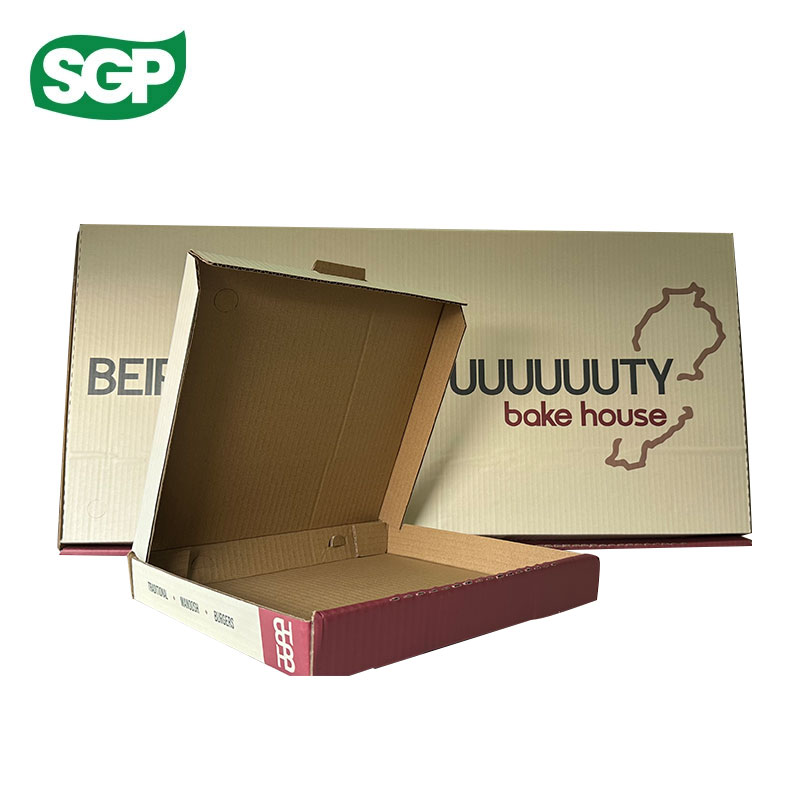
Balancing thermal insulation with air circulation requires a strict thermodynamic framework. You must evaluate how different delivery radiuses dictate the required thermal performance of the oversized pizza takeaway box. Deliveries under three miles allow for more aggressive venting, as the pizza will reach the customer before significant heat loss occurs. Deliveries over six miles require tighter thermal management, relying on the box's insulation to maintain temperature while carefully managing the resulting condensation.
Transport methods also influence this balance. Heated delivery bags actively push heat back into the box, meaning you can utilize larger vent holes to release steam without worrying about the pizza getting cold. Passive insulated wraps trap existing heat but also trap moisture, requiring a box with excellent internal moisture absorption properties. Open-air delivery requires maximum thermal retention and minimal venting to protect the pizza from ambient cold air.
Back-of-house realities dictate operational efficiency. The physical storage footprint of flat, un-assembled 18-inch to 24-inch boxes consumes significantly more space than standard 12-inch boxes. A bundle of fifty 24-inch boxes can take up an entire prep table shelf. Operators must plan their storage logistics carefully, often requiring daily deliveries from local distributors rather than holding weeks of inventory on-site.
You must evaluate folding mechanics and labor costs. Standard tuck-in flap designs require more assembly time, forcing staff to fold multiple creases and lock tabs into place. Rapid corner-lock or crash-lock systems drastically reduce labor time, providing crucial speed during peak weekend dinner rushes. While crash-lock boxes cost slightly more per unit, the labor savings and increased throughput during a Friday night rush often justify the expense.
The regulatory landscape regarding PFAS (per- and polyfluoroalkyl substances) in grease-resistant packaging coatings is shifting rapidly. Many municipalities have banned these forever chemicals entirely. You must identify compliant PFAS-free alternatives, such as mechanical clay-coating or plant-based barriers, to ensure regulatory compliance. These alternatives rely on physical barriers rather than chemical treatments to repel grease.
Furthermore, verify industrial compostability and local curbside recyclability claims for grease-stained oversized cardboard to meet customer expectations and municipal waste guidelines. Many recycling facilities reject heavily grease-stained cardboard, making compostability a more viable end-of-life scenario for pizza packaging. Ensure your supplier provides BPI certification or equivalent documentation to back up their compostability claims.
Choosing the right print method impacts both cost and visual fidelity. Flexographic printing remains economical for standard one to three colors at high volumes. It uses flexible rubber plates to stamp ink onto the cardboard, making it ideal for simple logos and text. Digital or lithographic printing provides high-fidelity, multi-color graphics suitable for premium catering tiers. Litho-lamination involves printing high-quality graphics onto a paper sheet, which is then glued to the corrugated board, resulting in magazine-quality imagery.
The massive surface area of a 24-inch box provides up to four square feet of printable space. This acts as a high-visibility marketing asset for corporate catering, office lunches, and community events. When a stack of 24-inch pizzas arrives at an office building, the packaging serves as a billboard for everyone in the lobby and breakroom. You can also monetize this space via co-branding, selling print space on the inside lid to corporate partners to offset custom printing premiums.
Custom printing involves cash-flow trade-offs. Lower per-unit costs typically require 5,000+ unit MOQs, which ties up capital in slow-moving inventory. For a 24-inch box, 5,000 units represent multiple pallets of material. If your restaurant lacks on-site storage for bulk custom pallet loads, you must calculate third-party logistics (3PL) warehousing and freight costs.
A custom large pizza box requires careful inventory planning to maximize ROI without crippling your storage capacity. Work with suppliers who offer drip-shipping or warehousing programs, allowing you to commit to a large MOQ for the price break while taking delivery in smaller, manageable increments over several months.
Procurement requires analyzing lead-time risks. Domestic sourcing typically involves four to six weeks of lead time, offering faster turnarounds but often at a higher per-unit cost. Overseas manufacturing can stretch to 12-16 weeks, factoring in port customs, ocean freight, and potential rail delays. While overseas sourcing offers significant cost savings on large runs, it requires meticulous demand forecasting.
You must establish inventory safety stock buffers specifically calibrated for high-demand seasonal periods, such as Super Bowl Sunday, graduation season, and corporate holiday parties. Running out of 24-inch boxes during the Super Bowl rush forces you to downgrade orders to multiple smaller pizzas, frustrating customers and disrupting kitchen workflows.
Less-Than-Truckload (LTL) freight and parcel carriers apply dimensional weight calculations to flat-packed, oversized packaging pallets. Because empty pizza boxes are relatively light but take up significant volume, carriers charge based on the space they occupy rather than their actual weight. These calculations can severely inflate shipping costs, sometimes doubling the landed cost of the packaging.
To mitigate these expenses, negotiate freight-included pricing terms with your suppliers. Optimize pallet configurations and stack heights to maximize trailer space. Coordinate localized distributor stocking agreements to reduce long-haul freight dependencies. By moving the bulk inventory to a local distributor, you only pay for the short-haul delivery to your restaurant.
Selecting the right packaging is a technical balancing act between structural physics, heat preservation, and unit economics. You must match box specifications directly to your product's weight and your maximum delivery radius to ensure consistent quality upon arrival.
Execute the following in-kitchen stress testing protocol before finalizing any procurement order:
Request physical sample boxes from two to three different manufacturers to compare flute profiles and linerboard strength.
Bake the heaviest, highest-moisture pizza in your catalog and place it in the sample box.
Stack three weighted empty boxes on top of the test box and place the entire stack inside a standard delivery bag for 45 minutes.
Audit the bottom box for center-sag, lid collapse, corner condensation pooling, and crust texture degradation.
A: Common industry dimensions for extra large boxes are 18-inch, 20-inch, and 24-inch squares. These differ from rectangular catering and party sheet slabs, which require specialized elongated packaging to accommodate different slicing grids and oven profiles.
A: Sagging occurs due to the wide span width combined with steam accumulation. Inadequate structural flute thickness, such as using standard E-flute instead of heavy-duty B-flute, causes the cardboard to lose rigidity when exposed to heat and moisture.
A: B-flute features thicker, wider arches that provide superior vertical crush resistance and thermal cushioning. E-flute is thinner and denser, offering a smoother printing surface but lacking the structural support needed for heavy, wide-diameter pizzas.
A: Prevent sogginess by utilizing strategically placed side and rear vent knockouts to release steam. Use raised-embossed paper liners to elevate the crust, and avoid non-breathable plastic delivery bags that trap condensation inside the packaging.
A: Yes, the physical footprint of flat, oversized boxes triggers dimensional weight shipping surcharges from freight carriers. You can mitigate these costs through regional distributor sourcing and optimizing pallet stack heights to maximize trailer space.
A: Local, state, and federal regulations increasingly target fluorinated grease-proofing agents. You must verify compliance via third-party certifications, such as BPI certification, to ensure your packaging uses safe, mechanical, or plant-based grease barriers.


