
Views: 0 Author: Site Editor Publish Time: 2026-07-16 Origin: Site


The pizza box is the only marketing asset guaranteed to enter 100% of your customers' dining rooms. It sits on the table during family dinners, parties, and late-night cravings. This makes it a direct touchpoint for brand perception and product quality. If your box fails, the pizza fails. A flimsy container leads to soggy crusts, cold cheese, and a negative customer experience before anyone takes the first bite.
Pizzerias face a constant tension between operational costs, structural requirements like heat retention, and the need for high-impact branding. Overspending on premium offset printing eats into tight margins. Underspending on cheap materials compromises the food. The optimal middle ground for most operators is the combination of unbleached corrugated kraft and flexographic printing. This guide provides a technical framework for evaluating, designing, and sourcing a high-quality Kraft Flexo Pizza Box to maximize your return on investment.
Cost-to-Value Ratio: Flexographic printing on kraft board offers the lowest cost-per-unit at scale while maintaining professional brand visibility, provided designs are optimized for the medium.
Structural Priority: Material specifications (flute size, paper weight) and geometric shape dictate heat retention and grease resistance; aesthetics must not compromise structural integrity.
Sizing & Fit: Selecting the correct box dimensions and shapes (square vs. octagonal) prevents transit damage and optimizes heat retention.
Design Constraints: Flexo printing on porous kraft material requires specific design adaptations—primarily utilizing 1-to-3 solid colors and avoiding complex gradients or photographic imagery.
Supplier Vetting: Evaluating a packaging partner requires looking beyond unit price to assess Minimum Order Quantities (MOQs), storage logistics, food-safe ink certifications, and supply chain reliability.
Pizzerias need a scalable packaging solution that protects the product during transit without sacrificing brand identity. The margins in the pizza industry demand efficiency. The delivery experience demands quality. A reliable box must insulate heat, vent steam, resist grease, and display your logo clearly. Achieving all these requirements at a low unit cost is the primary challenge for operators scaling their delivery volume.
Understanding the cost structure of different printing methods is necessary for packaging procurement. Flexographic printing utilizes flexible polymer plates to transfer ink directly onto the corrugated board. This process relies on an anilox roller to meter the exact amount of ink applied to the plate. It offers a significantly lower per-unit cost at high volumes. The polymer plates are durable and can be reused for thousands of runs. This makes a flexo printed pizza box highly economical once the initial setup is complete.
Offset printing involves higher setup costs. It typically requires clay-coated paperboard to achieve its signature vibrant graphics. While offset delivers premium visual fidelity, the material and production costs are often prohibitive for standard pizza delivery. Once a pizzeria reaches a consistent weekly order volume, the flexo method becomes the most financially viable option.
Feature | Flexographic Printing | Offset Printing |
|---|---|---|
Setup Cost | Low to Moderate (Polymer Plates) | High (Metal Plates, Setup Time) |
Substrate Compatibility | Excellent on rough, porous kraft | Requires smooth, coated boards |
Color Capability | 1-3 Spot Colors recommended | Full CMYK Photographic Quality |
Production Speed | Very High | Moderate |
The structural integrity of kraft pizza packaging stems from the material itself. Unbleached kraft paper retains longer wood fibers compared to heavily processed bleached white board or lower-grade recycled cardboard. These longer fibers yield higher tear resistance and superior crush strength. They ensure the box maintains its shape when stacked in a delivery bag.
Consumer perception heavily favors unbleached brown kraft. It signals an eco-friendly approach that aligns with modern sustainable brand values. Customers associate the natural look of kraft with artisanal quality and environmental responsibility. This makes it a strategic choice for brand positioning.
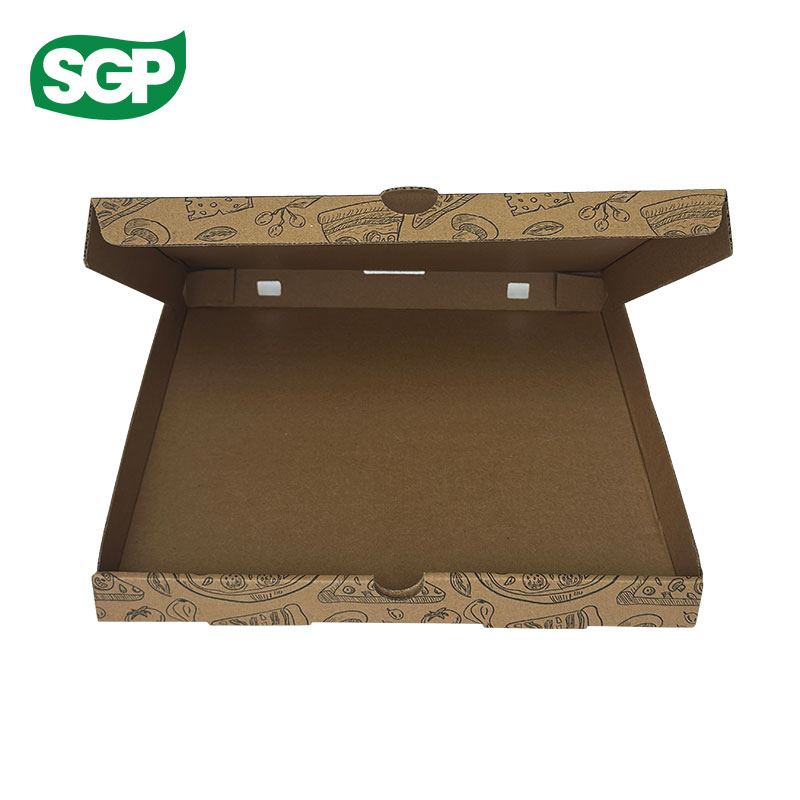
Selecting the right box goes beyond picking a logo color. The physical performance of the packaging directly impacts the quality of the food upon arrival. You must evaluate how the box handles heat, moisture, and grease.
Corrugated board relies on its fluted center layer for insulation and rigidity. The flute profile dictates the box's performance. B-flute offers thicker arches, providing excellent crush resistance and insulation. It takes up more storage space. E-flute is thinner, allowing for more boxes per pallet. It offers slightly less insulation. Choosing between them depends on your storage capacity and delivery radius.
Steam release vents are necessary for balancing heat retention against the risk of a soggy crust. Hot pizza releases significant moisture. If the box is sealed too tightly, the steam condenses and ruins the crust. Proper vent placement allows just enough steam to escape while trapping the heat necessary to keep the cheese melted.
Flute Type | Thickness (approx) | Flutes per Linear Foot | Best Application |
|---|---|---|---|
B-Flute | 1/8 inch | 47-53 | Heavy pizzas, long delivery routes, maximum crush resistance. |
E-Flute | 1/16 inch | 90-96 | Thin crust pizzas, limited storage space, high-quality print surfaces. |
The paper weight, measured in Grams per Square Meter (GSM), determines the board's ability to withstand heavy toppings and oil. A higher GSM means thicker, more robust paper that resists grease pooling. If the paper is too thin, oil from pepperoni or extra cheese will soak through. This weakens the bottom panel and creates a messy customer experience.
Operators must evaluate whether their specific pizza style requires a heavier board grade or the addition of greaseproof inserts. While inserts add a layer of protection, they also increase the per-unit cost and assembly time. Upgrading to a higher GSM kraft board is often a more efficient solution.
Matching the box size precisely to the pizza diameter prevents the pie from sliding during transit. Sliding causes ingredient shifting and a ruined presentation. The standard sizing directory ranges from personal 10-inch boxes to extra-large 18-inch options. A tight fit is essential for maintaining product integrity.
You must also choose between square and octagonal shapes. Square boxes are easier to fold rapidly. They provide maximum surface area for a custom kraft pizza box design. Octagonal boxes feature shaved corners. These corners improve stackability, reduce excess air space to keep the pizza hotter, and minimize board waste during manufacturing.
The composition of the corrugated board affects both performance and brand perception. Understanding the layers will help you specify the right product for your needs.
Virgin kraft paper is made directly from wood pulp. It offers superior strength and better moisture resistance. It handles the rigors of delivery exceptionally well. Recycled kraft has a lower cost and higher eco-credentials. The shorter, broken fibers can result in weaker structural integrity. This makes the box more prone to crushing or tearing under heavy loads.
The material must not interfere with the food. High-quality virgin kraft avoids the chemical, musty odors sometimes associated with lower-grade recycled cardboard. Ensuring the pizza’s aroma remains untainted during delivery is vital for customer satisfaction. A bad-smelling box will ruin the perception of the food inside.
A double sided kraft box utilizes kraft liner on both the inside and outside of the fluting. It avoids cheaper white or grey interior liners. This specification offers significant operational and branding benefits.
The double-sided construction provides superior structural rigidity. It presents a clean, uniform appearance. It also enables the premium unboxing experience of internal print marketing. You can print social handles, coupons, or brand stories on the inside lid. This engages the customer exactly when they open the box to eat.
Flexographic printing on porous kraft material requires specific design adaptations. You cannot simply apply a digital logo file directly to the box and expect perfect results.
Printing on brown, porous substrates causes color shifting and muted tones. The kraft paper absorbs the ink, altering its appearance. You must use high-contrast inks like black, dark red, forest green, or navy to ensure visibility. White ink is particularly challenging. It requires multiple passes or specific plate setups to achieve opacity on brown board, often increasing costs.
To maximize impact within flexo constraints, use bold typography and thick line weights. Limit the design to 1-3 spot colors. Avoid complex gradients or photographic imagery, which will render poorly.
Incorporate custom social media callouts and localized messaging.
Ensure prominent logo placements on side panels for visibility while the box is being carried.
Strategically place high-contrast QR codes linking to menus or loyalty programs.
Ensure QR codes remain scannable on the kraft substrate by testing contrast levels.
Registration refers to the alignment of different color plates during printing. High-speed flexo rollers can cause slight alignment shifts. To prevent blurry or misaligned logos, design "traps". Traps are slight overlaps between adjacent colors. Avoid tight multi-color alignments. Simple, bold designs perform best during high-speed production runs.
Choosing the right supplier is as important as choosing the right box. You must evaluate their capabilities beyond just the quoted unit price.
There is a constant trade-off between bulk pricing and restaurant warehouse footprint. High volumes yield lower prices, but pizza boxes consume massive amounts of space. Calculate your optimal order volume based on your weekly pizza output and available dry storage. This prevents overwhelming your back-of-house operations.
Proper logistics prevent product degradation before you even fold the first box. Ensure the supplier utilizes flat-pack shipping and pallet optimization. Moisture-controlled warehouse storage is critical. If corrugated sheets absorb ambient humidity, they will warp and lose their structural integrity.
Compliance is non-negotiable. Ensure the supplier uses FDA-approved, water-based, food-safe inks. Sourcing from unverified overseas suppliers carries immense risks. These risks include chemical leaching and odor transfer to the food. Always demand proper certification.
Evaluate domestic versus international sourcing carefully for bulky items like corrugated boxes. International shipping can introduce significant delays. Your supplier must have contingency plans and guaranteed lead times to prevent operational shutdowns caused by packaging shortages.
Request physical samples from shortlisted suppliers to evaluate board strength, flute thickness, and print quality.
Ask for specific dielines for your design team to ensure artwork is formatted correctly for flexo printing constraints.
Conduct a "crush, stack, and grease" test in your own kitchen with hot pizzas before signing a bulk contract.
Verify all food safety certifications and water-based ink documentation with your chosen supplier.
A: Flexo printing uses flexible polymer plates to apply ink directly to the corrugated board. It offers lower costs at scale and utilizes 1-3 solid colors. Offset printing uses clay-coated boards for high-resolution graphics but involves significantly higher setup and per-unit costs.
A: Unbleached kraft retains longer wood fibers, providing superior tear resistance and crush strength. It also appeals to consumer preferences for eco-friendly, natural-looking packaging, avoiding the heavily processed appearance of bleached boards.
A: Flute size determines insulation and rigidity. B-flute is thicker, offering better heat retention and crush resistance but taking up more storage space. E-flute is thinner, saving space but providing slightly less insulation.
A: Yes, but it is challenging. The porous brown kraft absorbs ink, often making white look dull or grey. Achieving a solid white requires multiple ink passes or specific plate setups, which can increase production costs.
A: A double-sided kraft box uses unbleached kraft liner on both the outside and the inside of the corrugated fluting. This provides better structural rigidity, a cleaner interior appearance, and allows for internal print marketing.


