
Views: 0 Author: Site Editor Publish Time: 2026-07-10 Origin: Site


A pizza box is the only marketing asset that sits directly on a customer's dining table for 30 to 60 minutes. This extended exposure makes it a critical touchpoint for brand retention and the overall customer experience. Pizzeria operators face a constant challenge balancing structural integrity, such as heat retention, grease resistance, and ventilation, with high-quality visual branding. Achieving this balance without overwhelming back-of-house storage requires careful planning and a deep understanding of packaging mechanics.
Sourcing the right packaging demands more than just picking a logo and a color. It requires a systematic approach to material science and supply chain management. This guide provides a clear framework for evaluating materials, sizes, printing methodologies, and logistics. You will learn how to source packaging that protects product quality, enhances your brand visibility, and ultimately drives repeat business without clogging up your prep area.
You must establish baseline performance metrics before considering graphic design. Heat retention duration and grease resistance are paramount. A box must prevent structural collapse during multi-box delivery runs. Drivers often stack four or five orders together in a single thermal bag. If the bottom box crushes under the weight of the others, the cheese sticks to the lid, and the pizza is ruined. You need to test your packaging under real-world delivery conditions, leaving the pizza in the box for at least 45 minutes to simulate a worst-case delivery scenario.
Analyze the ventilation mechanics of your chosen packaging. Steam vents play a crucial role in moisture management. Their placement and size prevent soggy crusts by allowing steam to escape. However, excessive venting compromises heat retention and reduces the printable surface area. You must evaluate the trade-off between heavy-duty materials and the clarity of your custom pizza box printing. Thicker corrugated boards insulate well but can distort fine graphic details, meaning your logo might look blurry if you choose the wrong flute type.
Consider the grease barrier properties. A standard corrugated board will absorb grease rapidly, leading to unsightly stains on the bottom and sides of the box. This not only looks unappetizing but weakens the structural integrity of the cardboard. You might need to incorporate grease-resistant coatings or use a separate parchment liner. Testing different crust types, from thin crust to heavy deep-dish, will reveal how much grease your specific pizzas release and what level of barrier protection you actually need.
The unboxing experience directly influences customer perception. A well-designed logo pizza box encourages social media visibility. Customers frequently share user-generated content featuring attractive packaging. This organic reach acts as free advertising for your pizzeria. When a customer carries your box down the street or leaves it on their counter during a party, it serves as a miniature billboard. The design needs to be recognizable from a distance.
Assess the value of utilizing the box exterior for cross-promotion. You can integrate QR codes seamlessly into the artwork. These codes can direct customers to loyalty programs, app downloads, or menu expansions. Define your brand positioning clearly. The tactile feel and visual design of the box must align with the price point of your pizza. An artisan or premium pie requires different packaging aesthetics than a high-volume, value-oriented product. If you sell a premium wood-fired pizza, a flimsy, generic white box contradicts the quality of the food inside.
Think about the messaging hierarchy on the box. The top lid should feature your primary branding and logo. The side panels are excellent for website URLs, phone numbers, and social media handles because they remain visible even when boxes are stacked. The bottom of the box is usually reserved for recycling information, manufacturer stamps, and mandatory compliance text. Planning this layout ensures you maximize the marketing potential of every square inch.
Modern pizzerias leverage specific design trends to stand out in a crowded market. Clean, high-contrast aesthetics dominate current packaging strategies. You want a design that pops on camera and looks intentional.
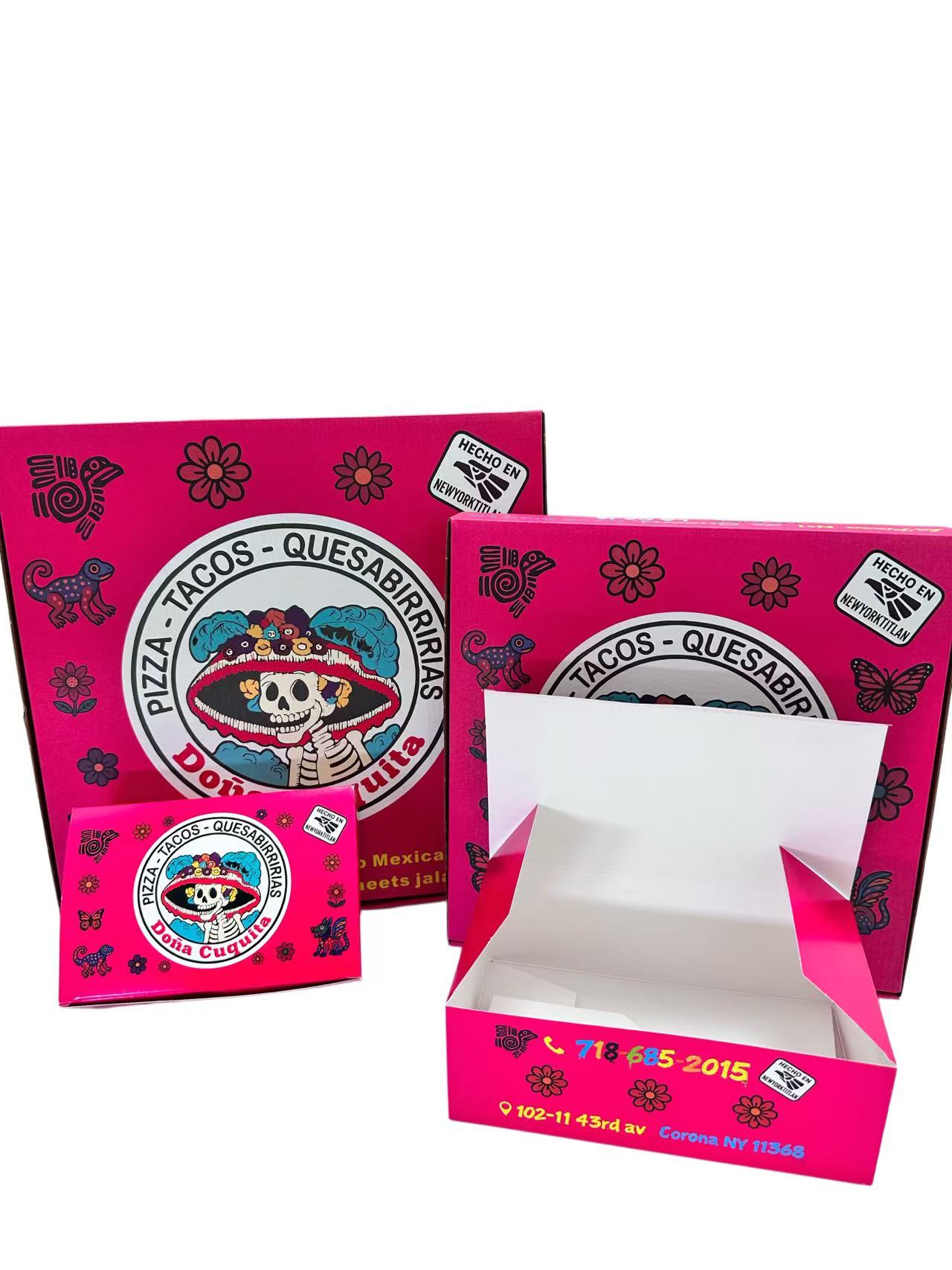
Selecting the correct dimensions prevents product damage. You must match the box size to your specific crust profile and style. A box that is too large allows the pizza to slide, while a box that is too small will crush the crust.
| Size Category | Dimensions | Primary Application | Structural Requirement |
|---|---|---|---|
| Personal / Small | 7-inch to 10-inch | Individual pizzas, flatbreads, or side items. | Standard E-Flute or B-Flute. Minimal risk of center sag. |
| Medium | 12-inch | The industry standard for lunch specials and single-to-two-person meals. | Standard B-Flute. Requires good corner crush resistance. |
| Large | 14-inch to 16-inch | The high-volume family size standard. | Heavy-duty B-Flute. Needs strong ventilation to manage steam from larger surface area. |
| Extra-Large / Party | 18-inch to 24-inch | Catering events, massive party pies. | Requires enhanced structural integrity and specialized heavy corrugated board to prevent center sag. |
Evaluate standard depth versus deep-dish requirements. Standard boxes range from 1.5 inches to 1.75 inches deep. Deep-dish styles, like Chicago or Detroit pizzas, require depths of 2 inches to 2.5 inches. Poor sizing leads to immediate quality issues. If the box is too large, the pizza slides during transit. This displaces toppings and causes structural damage. If the box is too small, the crust pinches against the sides. This causes grease leak-through and creates flat, compressed edges.
You also need to consider the storage footprint of these different sizes. A stack of one hundred 18-inch boxes takes up significantly more space than a stack of 12-inch boxes. If your kitchen is tight on space, you might need to limit your menu offerings to two or three standard sizes to avoid overwhelming your storage racks. Always measure your prep tables and overhead shelving before committing to a massive order of oversized boxes.
The fluting inside the corrugated board dictates both insulation and print quality. You must choose the right profile for your operational needs. The flute is the wavy paper sandwiched between the inner and outer liners.
When deciding between B-Flute and E-Flute, consider your delivery radius. If your drivers routinely take 30 minutes to reach a customer, the superior insulation of B-Flute is necessary. If your business is primarily carry-out where the customer eats the pizza within 10 minutes, E-Flute provides a sleeker presentation and better print quality without sacrificing necessary heat retention.
The exterior paper grade impacts your brand image and print capabilities. Kraft board projects an eco-friendly, artisanal image. It carries a lower base cost but limits color vibrancy. Colors often appear darker or muted because the brown background absorbs the ink differently than a white background. Kraft works best for black or dark, single-color designs. If your logo relies on bright yellows or light blues, they will look muddy on kraft paper.
Bleached white board provides maximum color contrast. It ensures vibrancy for complex artwork and premium branded pizza packaging. It carries a higher base cost and shows grease stains more easily unless treated. A white box looks incredibly clean when it leaves the store, but a greasy fingerprint from a cook can ruin the presentation instantly. You must train your staff to handle white boxes with clean hands.
Clay-Coated Newsback (CCNB) is often used for frozen pizza boxes. You should evaluate it carefully if considering it for hot takeaway due to significant moisture absorption risks. CCNB can become flimsy when exposed to the heavy steam generated by a fresh, hot pizza. Stick to virgin kraft or bleached liners for hot delivery applications to ensure the box remains rigid.
The standard square shape remains the most universally stackable option. It maximizes printable real estate and simplifies assembly. Your staff can fold a standard square box in seconds using muscle memory. Octagonal or corner-cut boxes reduce material waste. They prevent the pizza from sliding during transit by cradling the round pie. They also offer a distinct visual silhouette that stands out from the competition.
Consider the assembly style. The clamshell design, featuring an attached lid, is the standard for speed of assembly. High-volume kitchens rely on this efficiency. The 2-piece design, with a separate lid and base, is reserved for premium, oversized, or deep-dish applications where presentation outweighs assembly speed. A 2-piece box allows the customer to completely remove the lid, turning the base into a serving tray, which is excellent for catering or large gatherings.
Flexographic printing uses flexible relief plates and fast-drying inks applied directly onto the corrugated board. This method dominates the high-volume pizza industry. The process is similar to a massive rubber stamp rolling over the cardboard at high speeds.
It works best for one-to-three color vector designs, simple logos, and bold typography. Flexography offers the lowest cost per unit at scale. However, it requires an upfront investment in printing plates. You will pay a plate fee for every color in your design. It struggles significantly with photographic images or complex color gradients. If your design relies on simple, striking visuals, this method provides the best efficiency and speed.
Lithographic printing achieves unmatched visual fidelity. The artwork prints onto a paper label, known as a litho-label. The manufacturer then laminates this label onto the corrugated box. This process allows for magazine-quality graphics on your packaging.
This method suits photo-realistic imagery and full CMYK color spectrums. It creates truly premium packaging. The main drawbacks are the highest cost per unit and the requirement for very high Minimum Order Quantities (MOQs). You must justify the substantial setup costs through massive order volumes or a high-margin product offering. Litho-lamination is typically reserved for frozen retail pizzas or ultra-high-end artisan pizzerias that treat their box as a luxury item.
Digital printing utilizes inkjet technology to print directly onto the box. It completely eliminates the need for printing plates. The printer reads the digital file and sprays the ink directly onto the corrugated board, much like a desktop printer.
This method excels for short runs, seasonal promotions, local event branding, or A/B testing new designs. You face zero tooling or plate costs, and turnaround times are rapid. However, the higher per-unit cost makes digital printing prohibitive for high-volume, everyday use. It serves best as a specialized tool for targeted marketing campaigns. If you want to print 500 boxes for a specific holiday or a local sports team championship, digital printing is the only viable option.
You must analyze the inverse relationship between volume discounts and warehouse space. Ordering 10,000 units might drop your unit price significantly, but it requires four pallets of storage. Most independent pizzerias lack this back-of-house footprint. Storing boxes in damp basements or near hot ovens will warp the cardboard and ruin your inventory.
Calculate the hidden costs of storage. Factor in rent per square foot and the risk of environmental damage from humidity or pests. Tying up cash flow in massive inventory piles restricts operational flexibility. Evaluate vendor warehousing programs. Drip-shipping or make-and-hold agreements allow you to secure volume discounts while the manufacturer stores the bulk of your inventory. They ship you a few pallets a month, keeping your back room clear and your cash flow manageable.
Food safety compliance is non-negotiable. Water-based inks represent the industry standard for food packaging. They produce low odor and remain environmentally friendly. However, they require coated paper for maximum vibrancy. If you use water-based ink on raw kraft paper, the colors will soak in and look washed out.
Soy or vegetable-based inks offer a highly sustainable alternative. They provide excellent color payoff but suffer from slower drying times during production. You must ensure your vendor provides documentation proving that all inks and adhesives meet FDA or regional equivalent standards for indirect and direct food contact. Health inspectors can and will ask for this documentation if they suspect you are using non-compliant packaging materials.
Consumers increasingly demand sustainable packaging. You must navigate the differences between recyclable, compostable, and biodegradable claims accurately. Grease-soaked corrugated board often cannot be recycled through standard municipal streams because the oil ruins the paper recycling process. Educate your customers on proper disposal methods directly on the box. Verifiable sustainability certifications protect your brand from greenwashing accusations and align with modern consumer expectations. Using recycled content in your board is a great start, but ensure it doesn't compromise the structural integrity of the box.
A: B-Flute corrugated board is the industry standard for heat retention. Its thicker profile traps air effectively, insulating the pizza while maintaining structural rigidity during transit.
A: Yes, interior printing is possible and popular for branding. However, you must strictly use FDA-approved, food-safe inks since the printed surface may come into direct or indirect contact with the food.
A: Brown kraft paper absorbs ink and lacks a white base layer, causing colors to appear darker and muted. For vibrant, true-to-color designs, you should use bleached white board.
A: Steam vents allow moisture to escape, preventing the crust from becoming soggy. Proper placement is crucial; too many vents cause rapid heat loss, while too few ruin the pizza's texture.
A: No. Digital printing has a higher per-unit cost, making it inefficient for daily, high-volume use. It is best reserved for short runs, seasonal promotions, or testing new designs.


