
Views: 0 Author: Site Editor Publish Time: 2026-08-09 Origin: Site


Over 1 billion pizzas are delivered annually. Packaging remains the lifeblood of the restaurant industry. For pizzerias, ghost kitchens, and food franchises, packaging stockouts present a massive operational risk. Running out of boxes means halting deliveries, frustrating customers, and losing immediate revenue. Miscalculating production and shipping lead times when transitioning to a new packaging partner or scaling up order volumes frequently causes severe supply chain bottlenecks.
To avoid these disruptions, operators must understand realistic manufacturing schedules and the variables that dictate lead times. This guide provides a technical breakdown of bulk production timelines. We detail how to evaluate a partner's reliability before committing to a high-volume contract. You will learn exactly how long the manufacturing process takes, what factors cause delays, and how to keep your delivery operations running smoothly without interruption.
Standard vs. Custom Timelines: Stock boxes ship immediately, but a custom pizza box manufacturer typically requires 2 to 4 weeks for an initial production run.
The First-Run Bottleneck: Initial orders take longer due to design approval, dieline setup, and custom tooling (printing plates and cutting dies). Reorders are significantly faster (often 10–14 days).
Volume vs. Speed: While bulk orders reduce per-unit costs and production cycle frequency, massive production runs require scheduling alignment with the manufacturer's machine capacity.
Risk Mitigation: Partnering with manufacturers that offer warehousing, staggered deliveries, or split shipments protects against unexpected delays.
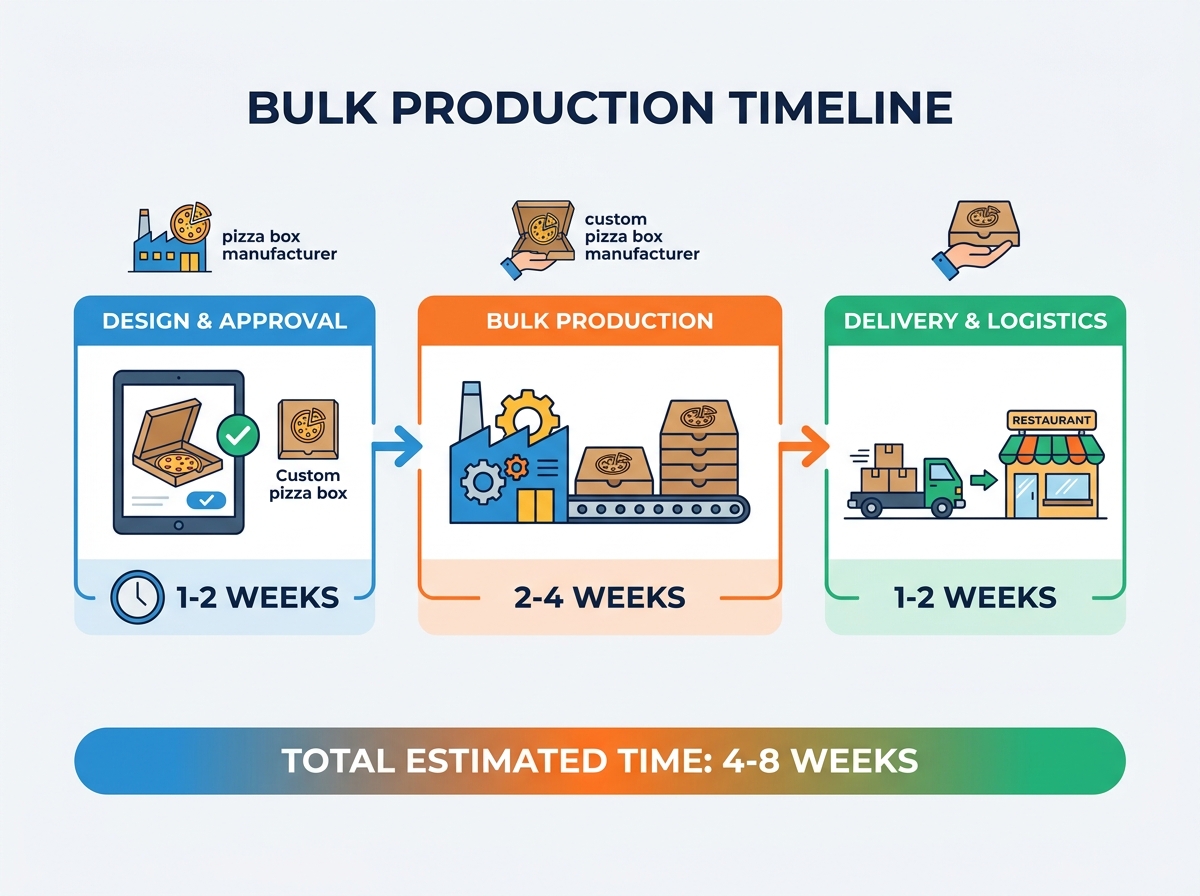
Procurement teams frequently miscalculate lead times by confusing production time with total turnaround time. Production time refers strictly to the days the factory spends physically manufacturing the product on the floor. Total turnaround time encompasses the entire procurement cycle, from the moment you submit artwork to the day the pallets arrive at your loading dock. Establishing accurate success criteria for procurement requires breaking down this end-to-end timeline into distinct phases.
Production starts in the prepress department. Buyers submit vector artwork to the factory, usually in Adobe Illustrator or PDF format. The manufacturer's prepress technicians align this artwork with precise structural dielines. They check for proper bleed, ensure critical text stays within safe zones, and verify that the color space is set to CMYK or specific Pantone spot colors. Proper alignment ensures logos and graphics fold correctly over the edges of the assembled carton without shifting.
Once the layout is finalized, the factory generates digital proofs or physical mock-ups for client review. Administrative triggers dictate exactly when the production clock starts. Factories do not schedule machine time based on verbal agreements. The official lead time begins only after the client provides written approval of the final proof and the accounting department confirms receipt of the initial deposit. Slow client response times during the proofing stage remain the most common cause of early project delays.
First-time custom orders require specialized physical tooling. The factory must manufacture custom cutting dies. For high-speed production, these are typically rotary dies—curved wooden boards embedded with steel cutting blades, scoring rules, and ejection rubber. The steel blades stamp out the exact structural shape of your carton, while the scoring rules create the creases that allow the box to fold easily.
Simultaneously, the prepress team produces photopolymer printing plates. Each color in your design requires a separate plate. If your design features red, black, and green, the factory creates three distinct plates. Creating these tools requires precision engineering and takes several days to complete. However, this step is entirely bypassed on exact reorders. Once the cutting dies and printing plates exist in the factory's tooling library, subsequent production runs skip Phase 2, drastically reducing the overall turnaround time for future shipments.
This phase represents the core physical manufacturing process. High-capacity facilities start at the corrugator. Massive rolls of kraft paper feed into the machine, where steam and heat soften the paper. The machine forms the fluted inner medium and glues it between two flat linerboards to create rigid corrugated sheets. These sheets cure and are then cut to size.
The blank sheets move to the rotary die-cutters and flexographic presses. When sourcing bulk printed pizza boxes, operators must account for factory scheduling. The machinery pulls the sheets through a series of anilox rollers that apply water-based ink via the photopolymer plates. In a single continuous pass, the machine prints the graphics, cuts the structural shape, scores the fold lines, and strips away excess scrap material. The 10 to 20-day window accounts for both the actual machine throughput and the waiting period required to secure dedicated time on the manufacturing line.
Transit times vary wildly based on geographical proximity. Domestic freight typically requires 2 to 5 days via full truckload (FTL) or less-than-truckload (LTL) carriers. Conversely, overseas shipping via ocean freight adds 30 to 45 days to the total turnaround time, plus additional days for customs clearance, port drayage, and rail transport.
Regardless of origin, bulk cartons are shipped flat. The factory bundles them in stacks of 50, ties them with poly twine, and stacks them onto standardized 40x48 pallets. Workers apply edge protectors and tightly wrap the pallets in stretch film. This flat-packing method optimizes warehouse storage space and minimizes freight costs. Precision die-cutting and scoring during the manufacturing phase ensure these flat boards take only seconds to assemble on-site by restaurant staff during busy dinner rushes.
Different operational choices dictate how fast an order can be fulfilled. Every specification, from the structural material to the complexity of the artwork, impacts the factory's ability to turn raw materials into finished goods quickly. Understanding these variables allows procurement teams to make informed decisions.
The fastest way to secure packaging is to purchase blank, unprinted stock inventory. Distributors keep standard sizes readily available in warehouses for immediate dispatch. While stock packaging ships within 24 to 48 hours, it sacrifices brand visibility. Custom branding requires the extensive setup, tooling, and dedicated machine scheduling outlined in the standard production timeline. If you face an immediate stockout, ordering a small run of stock boxes can bridge the gap while your custom order finishes production.
Order size directly affects factory scheduling. Facilities often squeeze low MOQ pizza boxes into production gaps between larger runs. Because small runs require less machine time, they can sometimes be completed faster if the factory has immediate availability. Conversely, massive bulk orders require days of dedicated, scheduled machine time. Factories must forecast their capacity weeks in advance to accommodate runs of 100,000 units or more without disrupting their existing client commitments.
The supply chain of raw materials plays a critical role in production speed. Standard corrugated fluting and kraft paper are ubiquitous and rarely cause delays. Most pizza cartons utilize B-flute or E-flute profiles. B-flute offers excellent stacking strength, while E-flute provides a smoother surface for high-quality printing. However, specialized requirements can extend lead times significantly if materials are not kept in standard inventory.
Procuring specialized food-grade pizza packaging may involve sourcing FSC-certified paper, applying specialized grease-resistant interior coatings, or utilizing specific FDA-compliant water-based inks. If the factory must special-order these raw materials from paper mills or chemical suppliers, the production clock pauses until the inventory arrives at the facility.
The chosen printing method alters setup and run speeds. The industry standard is 1-to-3 color flexographic printing. Flexography uses fast-drying water-based inks printed directly onto the corrugated board, allowing for rapid setup and high-speed throughput. High-color lithographic laminating or digital printing offers superior photographic quality but involves slower setup times, slower production speeds, and additional manufacturing steps. For example, litho-lamination requires printing a top sheet separately and then gluing it to the corrugated base, extending the overall lead time.
Printing Methods Comparison
Printing Method | Setup Time | Production Speed | Best Use Case |
|---|---|---|---|
Flexographic | Fast | Very High | Standard 1-3 color logos, high volume runs. |
Litho-Lamination | Slow | Medium | Photographic quality, complex multi-color designs. |
Digital Printing | Very Fast | Low | Short runs, variable data, low minimum orders. |
Procurement teams must vet a potential custom pizza box manufacturer rigorously to ensure they can meet promised deadlines. A supplier's quoted lead time is only as reliable as their underlying operational infrastructure. You need to look past the sales pitch and evaluate the actual factory floor.
When evaluating a supplier, ask specific questions about their daily output capacity and shift schedules. Factories running three shifts, 24 hours a day, possess significantly more flexibility to absorb rush orders than facilities operating a single daily shift. Furthermore, inquire about machine redundancy. If a facility relies on a single rotary die-cutter and that machine breaks down, your order halts entirely. Reliable partners maintain multiple redundant machines to ensure mechanical failures do not impact client delivery dates.
Geographic location presents a fundamental trade-off between speed, communication, and unit economics. Local domestic suppliers offer shorter transit times, easier communication regarding design changes, and the ability to conduct on-site press checks. Overseas factories offer highly competitive unit costs but introduce longer lead times, complex logistics, and the inherent risks of customs delays and port congestion. You must weigh the inventory carrying costs against the unit savings.
Rushing production to meet an aggressive deadline often leads to quality assurance failures. When machines run beyond optimal speeds or operators skip calibration steps, the resulting cartons may feature misaligned prints, weak structural fluting, or improper scoring that prevents the carton from folding correctly. A reliable pizza box manufacturer performs standard QA checks at regular intervals during the run without delaying the final shipment.
Edge Crush Test (ECT): Measures the cross-direction crushing of the corrugated board to ensure it can withstand stacking pressure during delivery.
Cobb Test: Evaluates the water absorptiveness of the paper. This ensures grease and moisture from the hot food do not immediately compromise the structural integrity of the carton.
Rub Test: Checks ink adhesion to ensure the branding does not smear or transfer onto employees' hands or customers' clothing.
Caliper Measurement: Verifies the thickness of the board remains consistent throughout the entire production run.
Fold Tolerance Check: Operators pull random samples off the line and manually assemble them to ensure the scoring rules are cutting to the correct depth.
Production Timeline Comparison
Order Type | Pre-Production | Tooling Setup | Mass Production | Total Estimated Factory Time |
|---|---|---|---|---|
New Custom Order | 2-5 Days | 3-7 Days | 10-20 Days | 15-32 Business Days |
Exact Reorder | 1-2 Days | 0 Days (Bypassed) | 10-15 Days | 11-17 Business Days |
Stock/Blank Inventory | 0 Days | 0 Days | 0 Days | 1-2 Business Days (Dispatch) |
Even with a reliable partner, the procurement process can break down due to external factors or administrative errors. Identifying these risks early allows operators to implement actionable workarounds and keep their supply chain moving.
The most frequent client-side delay involves submitting improper artwork files. Submitting rasterized, low-resolution artwork or using incorrect color profiles forces the prepress team to halt the project and request new files. If you submit a JPEG instead of a vector file, the factory cannot separate the colors for the printing plates. To mitigate this risk, require strict adherence to manufacturer dielines and utilize experienced packaging designers who understand commercial print specifications.
Factory backlogs surge during major sports seasons, such as the Super Bowl or March Madness, as well as during major winter holidays. During these peak periods, standard lead times can double as machine capacity maxes out globally. Paper mills also experience backlogs, slowing down the delivery of raw linerboard to the corrugated plants. To mitigate seasonal delays, operators must forecast inventory needs 3 to 4 months in advance and place bulk orders well prior to peak manufacturing seasons.
Global paper shortages, freight strikes, or severe weather events can sever the supply chain unexpectedly. If the factory cannot receive raw linerboard, they cannot produce your cartons. Mitigate this risk by negotiating staggered shipping and warehousing agreements. Many manufacturers will produce a massive bulk order upfront and hold safety stock in their own distribution centers, releasing pallets to your restaurants on a weekly or monthly schedule.
Timeline requirements directly impact the bottom line. Operators must balance the need for rapid replenishment against the financial benefits of strategic, long-term procurement planning. Understanding how factory overhead works helps you negotiate better terms.
When inventory drops to critical levels, operators may request a rush order. Jumping the production queue requires the factory to break into existing schedules, pay workers overtime, or expedite raw material freight. This incurs a significant financial premium. Procurement teams must evaluate when the cost of expediting is justified versus the catastrophic cost of a complete stockout that halts restaurant operations. Often, paying a 20% rush premium is cheaper than closing a store for three days.
Analyzing the return on investment for ordering 3 to 6 months of inventory at once reveals significant operational advantages. Larger upfront capital expenditures and increased local storage requirements trade off against lower manufacturer overhead. Producing massive volumes in a single run results in highly affordable custom packaging and completely eliminates the risk of lead-time delays, as the inventory is already secured and sitting in your warehouse.
Audit your current inventory run-rate to determine exactly how many weeks of safety stock you currently hold.
Request structural dielines from prospective manufacturers immediately to give your design team ample time to format artwork correctly.
Initiate a small pilot order to test the factory's timeline accuracy, print quality, and the on-site assembly speed of the physical cartons.
Establish a staggered delivery contract with your chosen supplier to lock in bulk pricing while minimizing your own warehouse space requirements.
A: Standard production takes 2 to 4 weeks for a first-time custom order. Reorders are much faster, typically taking 10 to 14 days. The production clock only starts after you approve the final design proof and the factory receives your initial deposit.
A: MOQs vary significantly by manufacturer. Facilities specializing in digital printing offer low MOQs starting around 500 units. Traditional high-speed flexographic factories usually require minimums ranging from 5,000 to 10,000 units to justify the machine setup time.
A: Yes, many manufacturers can expedite orders, but it depends entirely on their current machine capacity. Expediting usually incurs substantial rush fees to cover overtime labor and queue-jumping. Even with rush fees, physical tooling creation still requires several days.
A: First-time orders require the prepress team to format artwork and the factory to manufacture physical tooling. Creating custom wooden cutting dies and photopolymer printing plates takes several days. On reorders, these tools are already archived, allowing the factory to skip directly to printing.
A: Standard corrugated board is inherently food-safe and readily available. If your brand requires specialized eco-friendly kraft paper, custom grease-resistant coatings, or specific FDA-compliant inks that the factory does not stock regularly, lead times will increase while they source those materials.
A: Bulk cartons are shipped completely flat and strapped into dense bundles on standard pallets. This flat-packing method maximizes the number of units that fit inside a freight truck, lowering shipping costs. Precision factory scoring ensures staff can fold them into 3D shapes in seconds.


