
Views: 0 Author: Site Editor Publish Time: 2026-07-30 Origin: Site


A collapsed lid or crushed packaging during delivery instantly degrades product quality, leading to refunds, negative reviews, and brand damage. Restaurant operators and procurement teams often treat packaging as a pure commodity, ignoring how structural geometry—specifically flute direction and profile—dictates failure rates under the stress of heat, moisture, and stacking.
Selecting the optimal packaging requires evaluating the physics of corrugated board. This guide breaks down how flute orientation, board profiles, and environmental factors impact compression strength, providing a technical framework for evaluating your next packaging supplier.
Flute Orientation Dictates Load Distribution: The direction of the flutes relative to the box dimensions determines both vertical stacking strength (Box Compression Test) and horizontal rigidity (sag resistance).
Profile Trade-Offs (B-Flute vs. E-Flute): Larger flutes (B-flute) offer superior top-to-bottom compression strength but are more susceptible to deflection and deformation; smaller flutes (E-flute) provide tighter structural rigidity, better insulation, and a superior printing surface.
Moisture is the Ultimate Stressor: Steam and grease degrade corrugated integrity rapidly. Evaluating ventilation cutouts and waterproof pizza boxes is critical to maintaining compression strength during transit.
Cushioning vs. Rigidity: Selecting the right corrugated pizza boxes requires balancing the shock absorption (cushioning) needed to protect transit contents with the load-bearing capacity required for stacked delivery.
Storage and Scalability Impact: Flute selection directly affects warehouse footprint and shipping costs, making it a critical variable in supply chain efficiency.
Corrugated board relies on a central fluted medium sandwiched between two flat linerboards. These flutes act as continuous arches, providing remarkable strength and rigidity relative to their weight. The orientation of these arches fundamentally changes how the board handles applied force. When the flute direction runs parallel to the depth of the container, it significantly enhances vertical compression strength. This orientation aligns the structural arches with the downward force of stacked items, preventing the sidewalls from buckling under pressure during transit.
Conversely, when the flute direction runs parallel to the width, it impacts horizontal rigidity. This orientation directly affects the lid. Flutes spanning the width resist bending moments, preventing the center of the lid from sagging downward onto the food. Proper alignment ensures the packaging maintains its shape, balancing top-to-bottom load-bearing capacity with horizontal span support. Operators must specify the correct orientation based on whether their primary failure mode is sidewall crushing or lid sagging.
Flute Orientation | Primary Structural Benefit | Common Failure Prevented | Best Application Scenario |
|---|---|---|---|
Parallel to Depth (Vertical) | High top-to-bottom compression strength | Sidewall buckling under heavy stacks | High-volume delivery with multiple stacked items |
Parallel to Width (Horizontal) | High bending resistance across spans | Center lid sagging onto the food | Large format pies with wide unsupported spans |
An unavoidable reality in packaging engineering is that bigger boxes sag faster. The structural demands placed on a standard 12-inch container are vastly different from those required for large-format 16-inch or 18-inch custom printed pizza boxes. As the surface area of the lid increases, the unsupported span grows, altering the physics of the entire structure.
This increased span length exponentially increases bending moments across the center of the board. Without precise alignment of the flute direction, the lid becomes highly susceptible to center-point collapse under its own weight or external loads. Engineers must calculate the necessary flute density and orientation to bridge this gap effectively. A 16-inch span requires significantly more horizontal rigidity than a 10-inch span, often necessitating a shift in board grade or flute profile to prevent the arches from deflecting under the increased load.
Evaluating board strength requires understanding the difference between raw material metrics and finished product performance. The Edge Crush Test (ECT) serves as the baseline metric for the raw corrugated board's top-to-bottom strength. It measures the amount of force required to crush a small sample of board on its edge. While ECT provides a useful indicator of raw material quality, it does not tell the whole story for field applications.
The Box Compression Test (BCT) is the more accurate real-world metric for a finished Pizza Box. BCT accounts for the actual geometry, including folds, creases, and ventilation cutouts, mapping the true load-path distribution. Different board geometries and flute take-up factors modify how force travels through the finished structure. Relying solely on outdated metrics like burst strength (Mullen test) ignores these complex structural dynamics. Burst strength measures puncture resistance, which is largely irrelevant for food delivery where stacking and moisture are the primary stressors.
Identify the ECT rating of the raw board to establish a baseline material strength.
Conduct a BCT on the fully assembled, empty container to measure dry stacking strength.
Introduce the actual food product to simulate thermal and moisture loading.
Perform a secondary BCT after 30 minutes of moisture exposure to determine the real-world failure point.
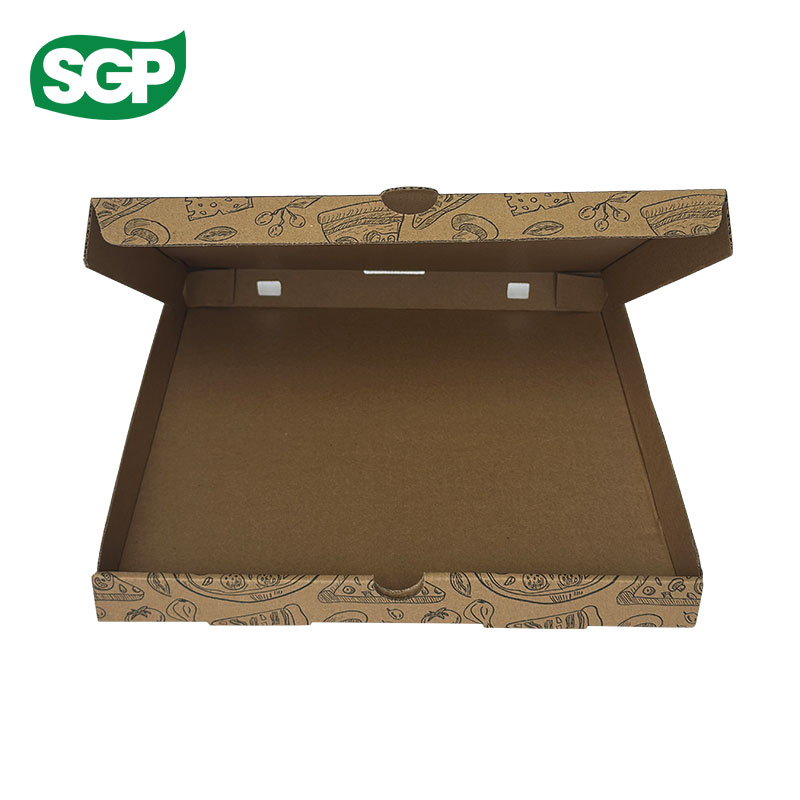
B-flute corrugated board features approximately 47 flutes per foot and a thickness of roughly 1/8 inch. This profile is engineered for robust performance under heavy loads. Its primary advantage lies in superior vertical compression strength, making it ideal for stacking multiple heavy items, such as deep-dish pies, during high-volume delivery runs. The larger arches also provide high-impact cushioning, absorbing transit shocks and protecting the contents from sudden drops or bumps in the delivery vehicle.
However, B-flute presents a structural phenomenon known as the deformation paradox. While these larger flutes provide higher peak top-to-bottom compression strength, they experience greater structural deflection before reaching ultimate failure. This means the board may exhibit localized denting or slight crushing on the surface while still holding the overall load. Operators must weigh this surface deformation against the need for maximum vertical strength, especially if presentation upon delivery is a primary concern.
E-flute board is significantly denser, boasting approximately 90 flutes per foot with a thickness of just 1/16 inch. This tighter flute spacing fundamentally alters the board's physical characteristics. The high density of structural arches reduces surface deformation, creating a rigid, flat plane that resists localized crushing. Furthermore, the smaller, more numerous flutes create superior trapped-air insulation, minimizing heat loss and reducing condensation buildup inside the package.
E-flute often outperforms B-flute in preventing center-sag on wider lids, despite having a lower overall profile thickness. This is due to the high density of the structural arches, which provide consistent resistance against bending moments across horizontal spans. For operations prioritizing a rigid presentation and thermal retention, E-flute presents a highly engineered solution that balances physical strength with thermal dynamics.
Feature | B-Flute | E-Flute |
|---|---|---|
Flutes per Foot | ~47 | ~90 |
Thickness | 1/8 inch | 1/16 inch |
Stacking Strength | Very High | Moderate to High |
Sag Resistance | Moderate | Excellent |
Insulation | Standard | Superior (Trapped Air) |
Paper is inherently hygroscopic, meaning it readily absorbs moisture from its surrounding environment. In food delivery, trapped steam is the primary enemy of structural integrity. When hot food releases steam into a closed corrugated environment, the paper fibers absorb the moisture, softening the structural arches. This process can reduce the rigidity of the flutes by up to 50% within minutes, drastically lowering the BCT rating.
The relationship between flute size, heat retention, and moisture condensation is a delicate balance. Larger flutes may hold more air, but if that air becomes saturated with steam, the entire board structure weakens rapidly. Managing this internal climate is essential for maintaining the compression strength required for safe delivery. If the arches absorb too much moisture, they lose their ability to transfer weight to the sidewalls, resulting in immediate structural failure.
To combat steam buildup, packaging requires ventilation cutouts. However, this introduces a direct engineering trade-off. Removing material from the sidewalls to create vents immediately reduces the overall Box Compression Test rating. The structural integrity of the corners and sidewalls is compromised wherever a cutout interrupts the continuous load-bearing path.
Research into cutout configurations reveals that the shape, quantity, and alignment of vents drastically alter sidewall strength. Circular vents distribute stress more evenly than rectangular cutouts with sharp corners, which create stress concentrations. Furthermore, placing vents too close to the vertical creases weakens the load-bearing corners. Optimal vent placement requires balancing efficient steam release with maximum preservation of corner and sidewall integrity.
Avoid placing vents within two inches of any vertical corner crease.
Utilize circular or oval cutouts rather than sharp-cornered rectangles to distribute stress.
Align vents horizontally rather than vertically to maintain continuous vertical load paths.
Test different vent quantities to find the minimum number required for adequate steam release.
Moisture management extends beyond ventilation. Grease-resistant and moisture-barrier coatings are a structural necessity rather than a mere cosmetic upgrade. When grease and condensation penetrate the inner linerboard, they break down the adhesive bonds holding the flutes in place, leading to rapid structural collapse.
Utilizing waterproof pizza boxes prevents the inner liner from absorbing this moisture. By keeping the paper fibers dry, these barriers maintain the integrity of the flute's arch structure during prolonged delivery routes. This ensures the packaging retains its intended compression strength from the kitchen to the customer's door, regardless of the transit time or the moisture content of the food.
The structural profile of corrugated board directly impacts print quality. Larger flutes, such as B-flute, often cause a phenomenon known as washboarding or fluting. This occurs when the linerboard dips slightly between the wide structural arches, creating visible ridges on the surface. When printed, these ridges distort high-quality graphics and cause uneven ink distribution, resulting in a substandard visual presentation.
Because of its tightly packed arches, E-flute provides a smooth, flat surface that eliminates washboarding. This makes E-flute the industry standard for packaging requiring crisp flexographic or lithographic printing. Brands looking to maximize visual impact without sacrificing structural rigidity consistently rely on denser flute profiles to ensure their logos and artwork render perfectly across the entire surface area.
Flute thickness plays a major role in operational efficiency and supply chain logistics. Because E-flute is half the thickness of B-flute, it allows for significantly more units to be stacked on a single pallet. This reduction in physical volume translates directly to operational advantages for high-volume facilities.
Operators utilizing thinner corrugated pizza boxes require less warehouse space for inventory storage. Additionally, maximizing the number of units per pallet reduces inbound freight shipments, streamlining the supply chain and lowering logistical overhead. Evaluating flute profiles requires looking beyond just physical strength to understand the broader impact on storage and shipping scalability.
Calculate the current pallet yield using B-flute packaging.
Request a pallet configuration spec sheet for E-flute alternatives.
Compare the number of pallets required for a standard monthly order.
Evaluate the reduction in inbound freight shipments and warehouse rack space.
Selecting the right supplier begins with clearly defining the operational demands placed on your packaging. Buyers must establish specific success criteria based on real-world usage. Key variables include the average delivery radius, which dictates the time the package spends in transit absorbing moisture. You must also define the maximum stacking height inside delivery bags and the average weight and moisture content of the food being transported.
Without these defined parameters, suppliers can only offer generic recommendations. By quantifying your delivery environment, you force suppliers to engineer a solution that meets your exact load-bearing and moisture-management requirements.
Do not rely on generic marketing claims when evaluating suppliers. Demand hard data, including ECT ratings, BCT performance data under moisture-loaded conditions, and exact flute profile specifications. Once you have the data, validate it through physical testing in your own facility.
Conduct a live stress test by simulating a 30-minute delivery in a thermal bag with a real, hot product. Follow this immediately with a stacking test to measure deflection and structural failure points. This real-world validation ensures the packaging performs under actual operational stress rather than just in a dry laboratory environment.
Switching packaging suppliers introduces specific operational risks. Buyers must watch for inconsistent board quality between production runs, variations in the ratio of recycled to virgin kraft paper, and hidden tooling costs for custom vent configurations. Virgin kraft paper offers superior strength and moisture resistance compared to heavily recycled boards, which often have shorter, weaker paper fibers.
To mitigate these risks, implement a strict pilot phase for any new packaging rollout. Monitor failure rates closely during the first month, inspect inbound pallets for board consistency, and maintain open communication with the supplier regarding any structural deviations. Establish a quality control checklist for receiving personnel to verify board thickness and vent alignment on every delivery.
The structural integrity of delivery packaging is a precise engineering calculation based on flute direction, profile density, and moisture management. High-volume delivery operations prioritizing space and print quality should lean toward E-flute, while operations stacking heavy, dense items may require the vertical strength and cushioning of B-flute—provided moisture and venting are scientifically optimized.
Audit your current failure rates, specifically noting instances of sagging lids or crushed corners during peak delivery hours.
Request detailed technical specification sheets from your current vendor to establish baseline ECT and BCT metrics.
Initiate a comparative Box Compression Test evaluation with alternative suppliers using live product simulations.
Review your warehouse footprint to determine if switching to a denser flute profile could optimize storage efficiency.
A: Flutes running parallel to the depth increase vertical stacking strength, while flutes running parallel to the width increase resistance to bending and horizontal sagging across the lid.
A: E-flute is generally preferred for its balance of rigidity, insulation, printability, and storage efficiency, though B-flute is utilized for maximum vertical load-bearing capacity and impact cushioning.
A: Sagging occurs when the horizontal span of the lid exceeds the flute's bending resistance, a failure point that is heavily accelerated by steam absorption weakening the corrugated arches.
A: Yes, cutting vent holes removes material from the sidewalls, which reduces the overall compression strength. Strategic placement is required to balance steam release with structural integrity.
A: ECT measures the raw strength of the corrugated board, while BCT measures the actual stacking strength of the finished, folded container under load.
A: Barrier coatings prevent grease and steam from soaking into the paper fibers. By keeping the board dry, the flutes maintain their structural arch shape and load-bearing capacity.


