
Views: 0 Author: Site Editor Publish Time: 2026-09-01 Origin: Site


Delivering 18-inch to 24-inch pizzas pushes standard packaging to the breaking point. The exponential increase in dough, cheese, and toppings creates massive weight loads. Steam generation multiplies rapidly across these wide surface areas. This combination of heat, moisture, and gravity tests the absolute limits of corrugated board. Packaging failure here goes far beyond a simple product flaw. Center sag ruins the presentation instantly. Crushed toppings anger hungry customers. Grease blowouts destroy car seats, and soggy crusts ruin the dining experience entirely. These failures directly drive customer refunds and generate brutal negative reviews online. They cause severe brand damage in high-ticket catering, family, and party orders. Procurement teams and pizzeria operators need a rigorous technical evaluation framework. You must validate dimensions, load-bearing capacity, and material integrity before committing to bulk supplier contracts. Solving these engineering challenges ensures your food arrives exactly as it left the oven.
Dimensional Accuracy: Extra-large boxes range from 18"x18" up to 24"x24", but require a minimum 2-inch depth to accommodate topping clearance and prevent lid crush.
Structural Validation: Standard E-flute corrugated board fails at extra-large spans; B-flute or double-wall construction with a minimum 32 ECT (Edge Crush Test) is mandatory for load validation.
Moisture & Grease Management: The surface area of a 20"+ pizza generates significant steam, requiring precise ventilation and often the integration of waterproof pizza boxes or specialized grease-resistant coatings.
Operational Compatibility: Procurement must validate flat-storage footprint, assembly speed, and exact exterior fitment with commercial insulated delivery bags prior to purchase.
Let us break down the math of a 24-inch pizza. A standard 16-inch pizza has about 201 square inches of surface area. A 24-inch pizza has over 452 square inches. That is more than double the physical space. This means double the dough, double the sauce, and double the cheese. A fully loaded 24-inch meat lovers pizza can easily weigh between seven and eight pounds. When you pull that massive item out of a 500-degree oven, it releases a tremendous volume of steam.
Traditional pie cuts leave long, triangular slices that meet in the middle. The crust provides an outer ring of structural support, but the center relies entirely on the tension of the baked dough. Party cuts, or square cuts, eliminate that tension. You end up with center pieces that are nothing but heavy, wet toppings on a soft dough base. This concentrates the entire weight load directly in the middle of the packaging.
Over a span of 20 to 24 inches, gravity pulls that center weight downward. The steam rising from the food attacks the paper fibers of the lid. The corrugated board absorbs the moisture, the fibers swell, and the board loses its rigidity. The lid bows downward under its own weight and the ambient humidity inside the container. It eventually collapses directly onto the cheese.
Menu engineering dictates your packaging dimensions. You cannot force a large pie into a tight space without causing damage. Family-size orders typically utilize 18"x18"x1.9" dimensions. Party-size offerings demand 20"x20"x2" to 22"x22"x2" profiles. Massive catering orders require 24"x24"x2" configurations.
You must always account for a 0.5-inch to 1-inch buffer zone around the outer crust. This internal clearance prevents edge-crushing during transit. Delivery drivers take sharp turns. They hit potholes. The food shifts violently inside the vehicle. If the crust touches the inner wall of the packaging, the impact crushes the dough and forces the cheese to slide off the slice.
The 2-inch depth requirement remains absolutely non-negotiable for party-sized pies. Heavily topped specialty pizzas demand this extra vertical clearance. Standard 1.5-inch depths fail miserably in this application. The extra vertical space ensures thick cheese layers never adhere to the lid. Piled toppings remain perfectly intact. Skimping on depth saves fractions of a cent on paper costs but costs dollars in refunded orders. When sourcing extra large pizza boxes, verify the internal depth with a tape measure. Do not trust the nominal dimensions printed on the supplier invoice.
Nominal Size | Usable Internal Space | Recommended Depth | Target Menu Item |
|---|---|---|---|
18" x 18" | 17.25" x 17.25" | 1.9 inches | Family Size / 10 Slices |
20" x 20" | 19.25" x 19.25" | 2.0 inches | Party Size / 16 Squares |
22" x 22" | 21.25" x 21.25" | 2.0 inches | Jumbo Party / 24 Squares |
24" x 24" | 23.25" x 23.25" | 2.0 inches | Catering / 32 Squares |
Standard E-flute corrugated board suits 12-inch and 14-inch sizes perfectly. It measures about 1/16 of an inch thick. It offers a smooth surface for printing but suffers from exceptionally low span strength. E-flute collapses easily under the sheer weight of larger pies.
B-flute provides a significantly thicker profile, measuring roughly 1/8 of an inch. It delivers superior crush resistance across broad surface areas. B-flute serves as the mandatory baseline requirement for wide spans. It maintains structural integrity when subjected to heavy steam and stacked loads. The thicker flutes create stronger vertical columns within the paper board.
Heavy catering orders exceeding 22 inches often push standard B-flute to its absolute limits. Double-wall corrugated board becomes necessary at this extreme threshold. Double-wall construction stacks two fluted layers together, typically combining a B-flute and a C-flute layer. It guarantees the lid remains rigid over massive 24-inch spans. This robust architecture prevents center sag entirely. It provides peace of mind for high-value catering deliveries where presentation dictates future business.
ECT measures the vertical stacking strength of corrugated board. It determines exactly how much pressure the edges withstand before buckling. This metric proves vital during chaotic multi-order delivery runs. Drivers frequently stack four or five heavy orders together in a single insulated bag. The bottom container bears the combined weight of the entire stack.
A 32 ECT rating serves as the absolute minimum baseline for 18-inch sizes. Anything lower guarantees the bottom units will collapse under the top load. Procurement teams should evaluate a 44 ECT rating for 24-inch catering applications.
The Mullen Burst Test evaluates sheer puncture resistance. It measures how much force breaks through the flat side of the board. While ECT dictates stacking strength, Mullen dictates handling durability. Kitchen staff move fast. They grab stacks of folded board, toss them onto prep tables, and shove them into delivery bags. High Mullen ratings prevent accidental punctures from thumbs and sharp bag zippers. Both metrics help you validate the true durability of your packaging choices. Ignore nominal thickness and demand verified ECT and Mullen ratings from your supplier.
Prolonged exposure to internal temperatures exceeding 180°F weakens structural adhesives rapidly. Steam penetrates the inner corrugated layers relentlessly. It softens the starch-based glue holding the flutes to the linerboard. This thermal deformation drastically reduces stacking strength over a 30-minute delivery window. A container feeling rigid on the kitchen cut table often turns into a soggy mess upon arrival.
You must implement a rigorous framework for testing load validation in your own kitchen. Do not rely on laboratory spec sheets.
Assemble four units of your proposed packaging.
Cook four of your heaviest, most moisture-dense menu items.
Box the items immediately out of the oven and stack them four-high on a prep table.
Place a standard insulated delivery bag over the stack to trap the heat and steam.
Wait exactly 30 minutes to simulate a long delivery route.
Remove the bag and inspect the bottom unit for corner buckling, center sag, and adhesive separation.
This practical test reveals hidden weaknesses. If the bottom unit fails, you must upgrade your ECT rating or switch to a thicker flute profile.
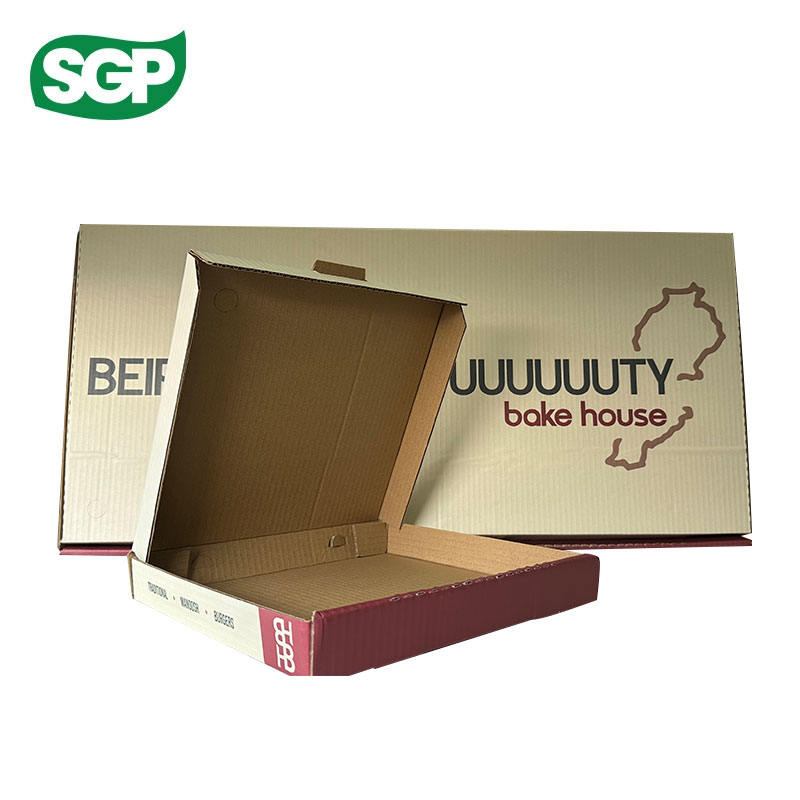
Large surface areas create a delicate thermodynamic trade-off. You must balance heat retention against moisture release perfectly. Trapping all the heat ensures a hot delivery. It also guarantees a soggy, unappetizing crust. Releasing too much steam keeps the crust crisp. It unfortunately results in cold, rejected food. Optimal vent hole placement solves this complex dynamic.
Rear panel vents allow steam to escape away from the customer's hands during carrying. Side panel vents promote active cross-airflow during transit. As the delivery vehicle moves, air pushes through the side vents, carrying excess moisture out the back.
Avoid placing vents too close to structural corners. Corner vents weaken the load-bearing pillars of the packaging. Proper placement prevents structural weakening while allowing adequate steam escape. Test different vent configurations during your thermal validation process. Punch out different combinations of vents and measure the crust crispness after a 20-minute hold time.
High-moisture and high-grease applications demand robust engineering solutions. Deep dish, extra cheese, and meat-heavy party pizzas release massive amounts of liquid fat. You must assess the operational need for waterproof pizza boxes in these specific scenarios. Standard corrugated board absorbs hot grease rapidly. The oil breaks down the paper fibers, leading directly to bottom blowouts and ruined car interiors.
Internal barrier coatings offer excellent, integrated protection. Clay-coated interiors block grease penetration effectively without adding assembly time. Bioplastic linings provide superior moisture resistance for steamy environments.
Secondary inserts present a viable alternative approach if you want to use standard uncoated board. Corrugated grease pads elevate the crust above the pooling oil, keeping the dough crisp. Parchment liners offer a highly cost-effective barrier against grease, though they do nothing for steam. Compare these options carefully based on performance and operational efficiency on the makeline.
Moisture Control Method | Primary Advantage | Best Use Case | Operational Impact |
|---|---|---|---|
Clay-Coated Interiors | Excellent grease blocking | Meat-heavy party pizzas | Zero added assembly time |
Bioplastic Linings | Superior steam resistance | High-moisture deep dish | Zero added assembly time |
Corrugated Grease Pads | Elevates crust above oil | Extra cheese catering orders | Requires manual insertion |
Parchment Liners | Cost-effective barrier | Standard large family pies | Requires manual insertion |
Printing on large B-flute corrugated board introduces highly specific mechanical challenges. The thicker flutes create an inherently uneven surface. This causes the dreaded washboarding effect during the printing process. As the printing plates press down, the ink settles heavily into the valleys between the flutes and lightly on the peaks. It creates visible, ugly vertical stripes across your branding. Standard 12-inch sizes hide this better than massive 24-inch expanses.
Flexographic printing handles simple vector graphics and single colors well. It struggles massively with high-resolution imagery or complex gradients on B-flute. The washboarding distorts the image entirely.
Litho-laminate printing solves this exact issue for custom printed pizza boxes at the 20-inch to 24-inch scale. The facility prints your design on a high-quality, flat top sheet of paper first. The machine then laminates this printed sheet directly to the corrugated board. This guarantees crisp, vibrant branding across massive surface areas without any flute distortion.
Strict compliance requirements mandate the use of food-safe, water-based inks for any packaging touching consumables. Solvent-based inks release toxic volatile organic compounds. You must ensure your supplier strictly adheres to these health regulations. Large printed areas face extreme exposure to high heat and steam. This creates a severe risk of dangerous ink migration.
Poorly cured ink transfers easily onto the food. It also stains the delivery driver's hands and the customer's countertops. Odor transfer presents another major operational risk. Uncured ink emits harsh chemical smells when exposed to 180-degree steam. These odors ruin the dining experience instantly, making the food taste like industrial chemicals.
Proper thermal curing processes lock the ink permanently into the substrate. This eliminates migration and odor risks entirely. Always request curing certifications and food-safety documentation from your printing partner before approving a production run.
Pallet footprint calculations prove absolutely critical for flat 24"x24" units. These massive dimensions consume enormous back-of-house storage space. A standard 40"x48" pallet holds significantly fewer 24-inch units compared to 16-inch variants. You must calculate your weekly volume strictly against available dry storage shelving. Running out of storage space during a busy weekend causes operational chaos.
Assembly speed impacts kitchen efficiency directly during peak hours. Standard tuck-and-fold designs work quickly. They unfortunately lack the rigidity needed for massive pies. Heavy-duty locking tabs take slightly longer to fold. They provide essential structural support for massive loads, locking the front and side panels together securely. Evaluate this ergonomic trade-off carefully. Train your staff to fold locking tabs efficiently to minimize prep delays on the cut table.
Procurement teams often fall into a very common, expensive trap. They rely solely on nominal dimensions like 18"x18". This leads directly to severe insulated bag mismatches. Folded B-flute corners add significant exterior bulk. This material thickness often adds 0.5 inches to the total footprint. An 18-inch unit might actually measure 18.5 inches externally once assembled.
It will not fit into a standard 18-inch delivery bag. The driver will fight the zipper, eventually tearing the bag or crushing the packaging. You must measure internal bag dimensions against true exterior dimensions.
Assemble the packaging completely, locking all tabs.
Measure the exterior width from the outside of the left hinge to the outside of the right hinge.
Measure the exterior depth from the front lock to the rear hinge.
Compare these exact numbers to the internal seam-to-seam measurements of your delivery bags.
Account for corner expansion and material thickness accurately. Check zipper clearances carefully. Complete this step before purchasing any new delivery gear or finalizing contracts.
Buying cheaper, lower-ECT packaging seems highly appealing on paper. This conceptual trade-off often backfires spectacularly in real-world operations. Flimsy packaging leads directly to massive hard costs. Refunded orders destroy your profit margins quickly. Ruined specialty pizzas waste highly expensive ingredients like premium mozzarella and cured meats. A single collapsed lid can cost you a lucrative, recurring catering contract with a local office.
Investing in a premium pizza box prevents these catastrophic failures entirely. The slightly higher unit price acts as a reliable insurance policy. It protects against operational disasters and brand damage. Evaluate the true cost of a failed delivery. Factor in the food cost of the remake, the driver's secondary trip, and the lost customer lifetime value. You will quickly realize premium packaging pays for itself through reduced refund rates and higher customer retention.
Request unprinted, flat prototypes from suppliers to conduct hands-on folding and rigidity evaluations in your own kitchen.
Execute in-house thermal and stacking tests using your heaviest, most moisture-dense menu items to validate ECT ratings.
Measure fully assembled prototypes meticulously against your current insulated delivery bags to guarantee zipper clearance.
Demand verified ECT ratings, flute profiles, and food-safe ink certifications directly from the manufacturer before signing bulk contracts.
A: Standard dimensions include 18"x18", 20"x20", 22"x22", and massive 24"x24" configurations. A minimum 2-inch depth is absolutely required for specialty and party pizzas. This extra vertical space prevents the lid from crushing thick toppings and heavy cheese layers during transit.
A: Standard pie cuts yield 8 to 12 large slices for family sizes. Party or square cuts can yield 16 to 32 smaller squares. Square cuts distribute heavy toppings across the entire surface, which significantly increases the center load and structural stress on the packaging.
A: You must specify B-flute corrugated board instead of standard E-flute. Additionally, mandate a minimum 32 ECT rating for 18-inch sizes. Scale this up to 44 ECT or double-wall construction for 24-inch spans to maintain absolute rigidity under heavy heat and moisture.
A: No. Nominal dimensions ignore the added exterior bulk of folded B-flute corners. This material thickness often adds 0.5 inches to the footprint. You must purchase specialized catering bags and measure internal clearances against the true folded exterior dimensions.
A: Yes, especially for meat-heavy, extra-cheese, or deep-dish orders. Massive surface areas release high volumes of grease and moisture. Barrier coatings or specialized liners prevent the corrugated board from absorbing oil and causing catastrophic bottom blowouts.
A: Heavy ink saturation can slightly impact board stiffness. Printing directly on thick B-flute causes a washboarding effect in flexographic printing. Litho-laminate printing solves this by applying a pre-printed top sheet, maintaining both structural integrity and premium visual quality.
A: E-flute is thinner and offers excellent printability, but it lacks the span strength required for sizes over 16 inches. B-flute is significantly thicker. It provides superior crush resistance and rigidity, making it the mandatory standard for supporting the weight of large-format pizzas.


