
Views: 0 Author: Site Editor Publish Time: 2026-10-20 Origin: Site


Independent pizzerias face a frustrating catch-22. Custom packaging drives brand differentiation and customer retention. However, traditional production runs demand massive upfront capital and warehouse space. The standard entry point for custom packaging often sits between 10,000 and 25,000 units. For growing brands, committing to these high minimum order quantities ties up critical cash flow. It creates logistical nightmares regarding storage and limits the ability to run agile marketing campaigns. Securing branded packaging at lower volumes is entirely possible. It requires understanding the manufacturing process and knowing exactly where to look. This guide breaks down how to evaluate suppliers, navigate production constraints, and source packaging without destroying unit economics. You will learn how to turn a simple corrugated box into a moneymaking asset for your operation.
Industry Baselines: Traditional flexographic printing necessitates high MOQs (typically 5,000+ units) to offset plate and setup costs, making digital printing the primary avenue for low-volume orders and local market testing.
Complete Expense Breakdown: The per-unit price of a box is only one factor; buyers must calculate tooling fees, freight, the hidden costs of warehousing bulk orders, and the opportunity cost of generic packaging.
Material Matters: Choosing between Kraft and white corrugated cardboard impacts not only print fidelity but also thermal retention, structural integrity, and perceived brand value.
Strategic Sourcing: Growing brands can bypass high MOQs through digital print specialists, distributor warehousing agreements, or phased packaging upgrades that balance "good" quality with "cheap" entry costs.
The ROI of Packaging: A custom pizza box manufacturer should be viewed as a marketing partner; utilizing box real estate for storytelling and loyalty programs directly increases profitability.
Understanding production thresholds is the first step in sourcing custom packaging. Traditional manufacturers generally require 5,000 to 10,000 units for a basic production run. If your operation requires highly customized structural designs, unique die-cuts, or specialized coatings, that minimum threshold often scales up to 25,000 units or more. These numbers are dictated by the physical realities of industrial printing equipment.
The economics of high minimums are rooted in the fixed costs of flexographic printing. This traditional method requires the creation of custom photopolymer plates for every single color in your design. These plates are etched using UV light and mounted onto heavy steel printing cylinders. Ink is pumped into an anilox roll, which transfers a precise amount of ink to the plate before stamping the corrugated board. Machine setup involves calibrating ink viscosity, aligning the registration to ensure colors do not overlap incorrectly, and running test sheets. Setting this up takes significant time per color. The material and time wasted during this setup phase must be amortized over a large production run. Running 500 boxes on a massive flexographic press would result in unit costs that no pizzeria could absorb. Therefore, a traditional pizza box manufacturer relies on volume to make the unit economics viable.
For independent shops, these high minimums create a severe storage dilemma. Ordering 10,000 boxes is a physical logistics challenge. A standard 40x48 inch warehouse pallet holds approximately 2,500 flat 14-inch B-flute boxes. An order of 10,000 units translates to four full pallets weighing roughly 800 pounds each. Moving these requires a pallet jack and clear aisle space. Storing them requires heavy-duty steel racking. Local health codes universally mandate that all food packaging sit at least six inches off the floor and eighteen inches below ceiling sprinkler heads. Most independent shops simply lack the back-of-house square footage to comply with these regulations while storing a six-month supply of packaging. This physical reality forces operators to seek alternative supply chain solutions that align better with their actual spatial constraints.
Bypassing the massive volume requirements of traditional flexography requires a shift in procurement strategy. Digital printing has revolutionized the corrugated packaging industry. Unlike flexography, digital printing eliminates the need for custom photopolymer plates. Digital printing utilizes industrial CMYK inkjet arrays that spray water-based inks directly onto the corrugated substrate. Because there are no physical plates to mount or cylinders to align, the setup time drops from hours to minutes. You simply load the PDF file into the raster image processor, calibrate the print heads, and start feeding the board. This technology allows suppliers to offer MOQs as low as 100 to 500 units. The primary trade-off is a higher per-unit cost. However, the upfront capital requirement is significantly lower because there are zero tooling or plate fees involved.
This low-volume capability provides a massive agile marketing advantage. Pizzerias can run seasonal promotions, print limited-edition boxes for local sports teams, or test new branding in specific neighborhoods without a long-term commitment. If a marketing campaign fails to resonate, you are not left holding thousands of obsolete boxes. You simply update the digital file for the next short run of low MOQ pizza boxes.
Another viable bootstrap approach is the stock box and custom branding strategy. This involves purchasing unprinted stock boxes in low volumes and applying custom branding manually. Operators often use large custom rubber stamps, high-quality roll labels, or custom-printed greaseproof tray liners. A prep cook can stamp 100 boxes in twenty minutes before the dinner rush. While this saves significant capital and works well for rustic brands, it introduces hidden labor costs. Folding boxes and applying stickers takes prep time away from your kitchen staff. You must carefully balance these labor constraints against the capital savings when trying to keep margins intact.
For operators who want the low per-unit cost of a massive run without the storage nightmare, distributor warehousing and drip fulfillment offer a perfect middle ground. In this scenario, a pizzeria commits to a high-volume run to secure bulk pricing. The supplier prints them all at once to maximize press efficiency. However, the manufacturer or a third-party distributor holds the inventory in their facility. They release and bill for smaller pallets on a monthly basis. This ensures you never run out of branded packaging while keeping your back-of-house clear of unnecessary pallets.
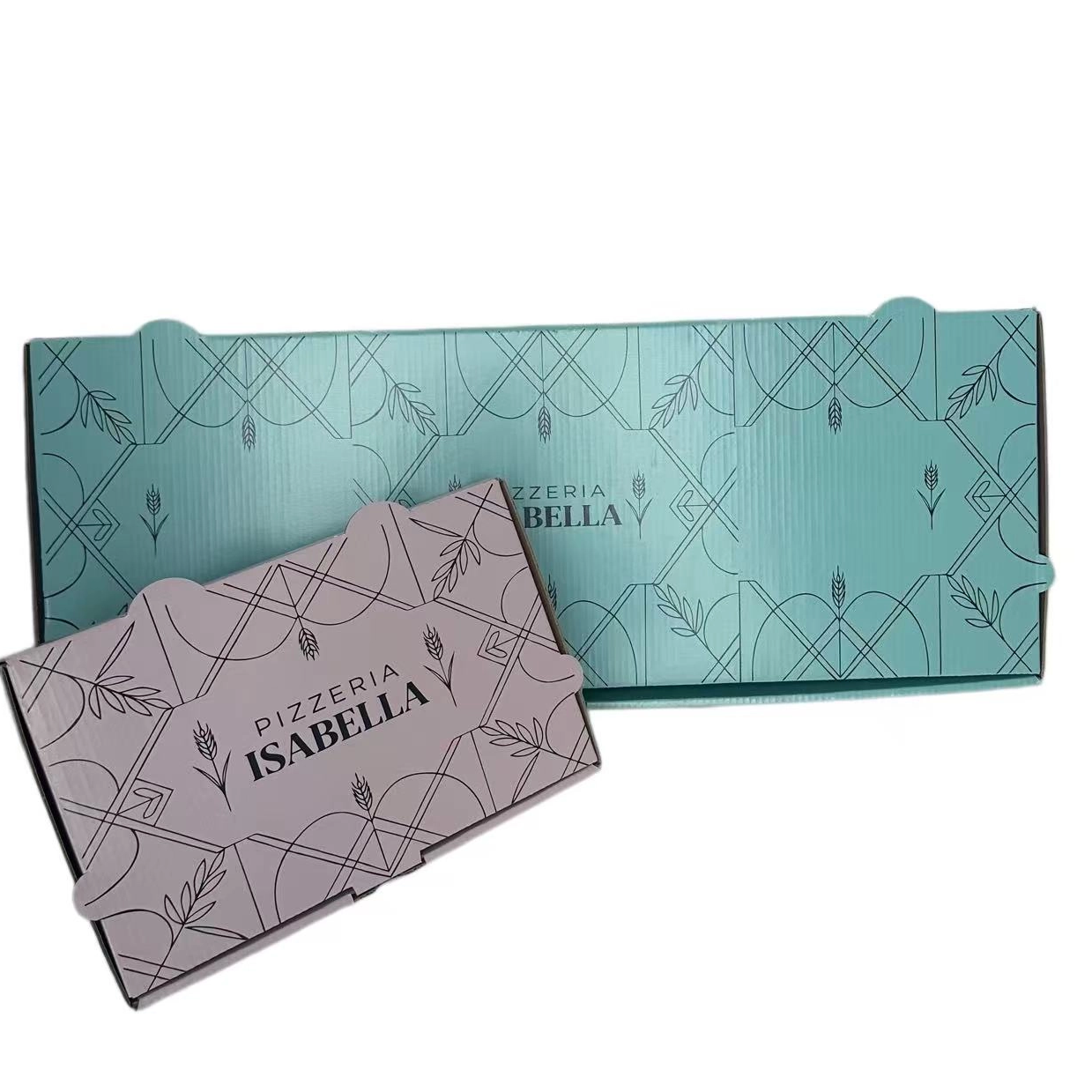
The foundation of any great takeout experience is the structural material holding the food. Operators must analyze the performance differences between Kraft and white corrugated cardboard to find the sweet spot between performance and cost. Kraft is unbleached pulp. It has longer fibers, making it slightly stronger. It naturally hides grease spots and minor scuffs during transit. However, unbleached paper limits color vibrancy. Bright reds and yellows often appear muted or muddy when printed directly on Kraft paper.
White corrugated cardboard provides a premium canvas for high-impact graphics. The bleached surface allows colors to pop, ensuring your logo catches the eye from across the room. The downside is that white cardboard utilizes shorter fibers, making it slightly weaker. It also shows grease stains and sauce spills much more easily. Grease shows up as translucent yellow stains on white board. If your product is particularly heavy or greasy, white boxes may look messy by the time they reach the customer's dining table. A reliable custom pizza box manufacturer will provide samples of both materials so you can conduct real-world grease tests.
Flute profiles also dictate performance. The fluting is the wavy arched paper sandwiched between the inner and outer liners.
Flute Type | Thickness | Crush Resistance | Print Surface | Best Application |
|---|---|---|---|---|
E-Flute | 1/16 inch | Moderate | Excellent | 10-inch to 12-inch thin crust pies |
B-Flute | 1/8 inch | High | Good | 14-inch to 18-inch heavy topping pies |
F-Flute | 1/32 inch | Low | Superior | Frozen pizzas or single slice boxes |
C-Flute | 11/64 inch | Very High | Fair | Deep dish or heavy Chicago style |
B-Flute is thicker, offering excellent crush resistance and thermal insulation. It is ideal for stacking multiple heavy pies during a busy Friday night delivery rush. E-Flute is thinner and denser. It takes up less storage space and provides a smoother surface for high-resolution printing, but it sacrifices a slight amount of thermal retention and vertical crush strength.
Food safety compliance is non-negotiable. The packaging comes into direct contact with hot, greasy food, meaning chemical migration is a serious risk. The manufacturer must use FDA-compliant, food-safe inks and adhesives. Industrial inks containing heavy metals or toxic solvents cannot be used anywhere near consumable products.
Furthermore, the regulatory landscape is rapidly shifting regarding per- and polyfluoroalkyl substances (PFAS). These chemicals were historically used to create grease-resistant barriers on paper products. Many regions have now strictly banned PFAS in food packaging. You must ensure your supplier provides certified PFAS-free materials for all food-grade pizza packaging to avoid severe regulatory fines and protect your customers' health. Suppliers must use alternative aqueous coatings to achieve grease resistance safely.
Moisture management determines the quality of the food upon arrival. Steam is the enemy of a crispy crust. A hot pizza releases massive amounts of water vapor. If the box is sealed tight, the vapor condenses on the colder inside lid and drips back down onto the food. Proper steam release through strategically placed ventilation holes is critical. Vent holes must be placed on the side panels, not the top. Top vents let heat escape too fast. Side vents create a cross-breeze that pulls moisture out while trapping heat under the lid.
Locking mechanisms also require close inspection. Assess the tab and fold designs. Roll-end tuck-front (RETF) designs are common. The front flaps fold over and lock into slots. If the slots are cut too tight, the prep cook fights the box, slowing down the line. If they are too loose, the front locking tabs pop open during third-party delivery transit, exposing the food to contamination.
A corrugated box is a blank billboard that enters your customer's home. Industry data suggests a takeout box averages multiple viewers per order. Evaluate if the manufacturer can print high-resolution graphics that turn this real estate into a customer retention tool. High-contrast QR codes printed on the lid can drive customers directly to your proprietary ordering app, bypassing third-party delivery commissions. Note that printing a black QR code on brown Kraft paper often fails because smartphone cameras cannot distinguish the edges. Print QR codes on a white background block for reliable scanning. Inside-lid messaging, coupons, and brand storytelling elevate the perceived value of the meal and encourage immediate repeat business.
Focusing solely on the per-unit price of a box is a dangerous trap. Traditional printing involves initial sunk costs that can shock first-time buyers. Tooling, plates, and setup fees add up quickly. A four-color flexographic design requires four separate photopolymer plates. These plates wear out after roughly 100,000 impressions and must be replaced. Cutting dies are made of steel rules pounded into plywood and also carry fabrication fees. This significantly increases the first-order invoice, making that seemingly cheap per-unit price much more expensive upfront.
Freight and shipping logistics represent another massive hidden cost. When you ship flat corrugated cardboard, you are essentially shipping a lot of air and heavy paper. Because boxes are low density, they often ship at a higher freight class, making Less Than Truckload (LTL) shipping disproportionately expensive. Freight costs can completely ruin the ROI of a cheap per-unit price if the manufacturer is located across the country. Sourcing from a regional supplier often yields better overall margins once shipping line items are calculated into the final invoice for bulk printed pizza boxes.
Spoilage and obsolescence carry significant financial risk. Ordering a two-year supply of boxes to secure a lower price assumes your business will remain static. Menu changes, a sudden rebranding effort, or updated local regulatory requirements can render thousands of stored boxes completely obsolete. Throwing away two pallets of unusable packaging destroys any savings gained from the initial bulk discount.
Finally, consider the opportunity cost of generic packaging. While plain brown boxes save money on the invoice, they cost you revenue in the long run. Failing to personalize your packaging sacrifices brand loyalty. In a crowded local market, a generic box makes your product forgettable. Custom packaging serves as a physical touchpoint that reinforces your brand identity long after the meal is consumed.
Transitioning to custom packaging involves supply chain risks that must be managed proactively. Failing to secure a reliable pipeline can disrupt your daily operations and damage your brand consistency.
Operational Risk | Business Impact | Mitigation Strategy |
|---|---|---|
Lead Time Delays and Stockouts | Running out of custom boxes forces a sudden pivot to generic alternatives, confusing customers and disrupting brand consistency. | Establish clear Service Level Agreements (SLAs) for reorder lead times. Maintain a strict 30-day buffer stock in-house. Favor domestic suppliers to reduce overseas shipping volatility. |
Print Quality Inconsistencies | Colors bleeding, misaligned registration, or industrial ink transferring onto the food surface, causing health concerns. | Demand physical proofs before full production begins. Ensure the manufacturer uses water-based, food-safe inks and maintains strict internal QA processes for print registration. |
Cash Flow Tie-Ups | Sinking massive capital into a year's worth of packaging limits operational funds needed for marketing, payroll, or equipment repairs. | Negotiate net-30 or net-60 payment terms. Utilize split-shipment warehousing agreements to align your cash outflow with actual monthly box usage. |
Managing these risks requires open communication with your chosen manufacturing partner. Treat them as an extension of your operations team rather than a simple vendor. Clear expectations regarding delivery schedules, quality control, and payment terms will prevent costly disruptions down the line.
Take the following actionable steps to upgrade your packaging strategy today:
Audit your current monthly box usage across all sizes to establish an accurate baseline for inventory consumption.
Measure your exact available back-of-house storage footprint to determine how many 40x48 inch pallets you can safely hold without violating fire codes.
Request physical material samples of both Kraft and white corrugated board from three shortlisted manufacturers.
Conduct in-house thermal retention and structural integrity tests by placing hot food in the sample boxes for thirty minutes.
Design artwork that includes a clear call-to-action, such as a QR code linking to your direct ordering platform, to maximize packaging ROI.
A: Traditional flexographic printing usually requires a minimum of 5,000 to 10,000 units to offset setup and custom plate expenses. Digital printing technology bypasses these plate requirements entirely. This allows for minimum order quantities as low as 100 to 500 units, making it ideal for testing.
A: Digital printing carries a higher per-unit cost than flexography. However, it requires zero plate or setup fees. This lack of upfront tooling costs makes digital printing significantly cheaper overall for low-volume runs, seasonal promotions, and local market testing.
A: Kraft is unbleached, offering a rustic look that hides grease well, but it limits color vibrancy. White cardboard provides a premium, bright canvas that makes colorful logos pop, though it shows grease stains and sauce spills much more easily during transit.
A: You must verify that your manufacturer uses FDA-compliant, water-based inks and adhesives. Additionally, request documentation proving the corrugated materials are certified PFAS-free, ensuring no harmful forever chemicals migrate into the hot food.
A: Yes. Utilizing the exterior and interior box real estate for brand storytelling, high-resolution QR codes, and targeted coupons drives customer retention. It redirects customers to your proprietary app, saving you money on third-party delivery commissions and encouraging repeat orders.
A: Many larger distributors offer drip fulfillment and warehousing agreements. You commit to a large volume to secure bulk pricing, and they hold the inventory in their facility, shipping and billing you for smaller pallet quantities on a monthly basis to alleviate your space constraints.


