
Views: 0 Author: Site Editor Publish Time: 2026-10-24 Origin: Site


The hidden operational drain of crushed deliveries plagues the food service industry. Structural failure in transit leads directly to ruined product, immediate customer refunds, and irreversible brand damage. Standard packaging evaluation relies heavily on dry, empty-box metrics. These factory-floor tests completely fail to account for the destructive combination of high heat, trapped steam, grease saturation, and dynamic transit loads during peak delivery windows. When a hot item enters a closed environment, it releases massive amounts of moisture. This moisture attacks the paperboard structure instantly.
Establishing a rigorous, real-world stack performance testing protocol is non-negotiable. You must objectively evaluate packaging options to balance unit performance against actual failure rates. Relying on basic supplier specifications leaves your operations vulnerable to catastrophic failure during high-volume shifts. This guide breaks down the physical mechanics of packaging collapse and provides actionable testing frameworks to eliminate transit-related product damage.
Thermal and Moisture Variables: Box Compression Testing (BCT) is only valid for food delivery when conducted using heated, moisture-emitting loads rather than empty, ambient-temperature boxes.
Flute Profile Trade-offs: Selecting between B-flute and E-flute corrugated board dictates the critical balance between thermal insulation, storage footprint, and vertical crush resistance.
Coating and Ink Impacts: The application of heavy ink loads on custom printed pizza boxes or the use of barrier coatings for waterproof pizza boxes directly alters paperboard rigidity and moisture vapor transmission rates.
Real-World Validation: Procurement decisions must be based on multi-phase testing that simulates thermal delivery bag environments, driver carrying mechanics, transit vibration, and maximum stack heights.
You cannot improve what you do not accurately measure. Establishing what constitutes a passing grade for a pizza box requires strict operational definitions. A successful package must exhibit zero lid deflection onto the product after 45 minutes. This must hold true inside a zipped thermal bag under a three-box stack. Any sagging that allows the cardboard to touch the cheese or toppings represents a structural failure. Success also means the bottom liner remains intact without tearing when lifted. The locking tabs must stay engaged despite transit vibration. Defining these parameters upfront prevents subjective evaluations and sets a hard baseline for supplier accountability.
Moisture vapor acts as a rapid destructive force on paper packaging. Corrugated board relies on hydrogen bonds between paper fibers for its rigidity. When hot steam hits the inner liner, it penetrates these fibers. The moisture breaks the hydrogen bonds, softening the material instantly. Compressive strength drops by up to 50% within the first ten minutes of exposure. This rapid degradation explains why a container feels sturdy in the kitchen but collapses upon arrival.
Grease migration compounds this structural weakening. Oils from the food wick into the bottom liner and travel up the sidewalls. Grease displaces the air pockets within the paper fibers. It lubricates the fiber connections, causing them to slide against one another under pressure. This dual attack of steam and grease destroys the structural integrity of the base and load-bearing walls. Without targeted barrier protection, even the thickest cardboard will eventually succumb to this chemical breakdown.
Vertical stack strength relies almost entirely on the four corners of the container. The sidewalls provide minimal load-bearing capacity compared to the folded corner pillars. When a stack shifts during transit, the weight distribution moves off the corners and onto the weaker center spans of the sidewalls. This lateral shift causes the walls to bow outward. Once the walls bow, the corners lose their vertical alignment and buckle under the weight above them. You must evaluate the specific folding mechanism of the corners. Double-folded corners or reinforced locking tabs provide significantly higher resistance to this buckling effect than single-fold designs.
Warehouse pallet stacking represents a static, dry environment. Boxes sit perfectly aligned, distributing weight evenly down the strongest vertical corners. Delivery bag stacking introduces dynamic, humid, and vibrating conditions. Vehicles hit potholes, make sudden stops, and navigate sharp turns. These forces apply lateral stress to the packaging walls. The locking tabs experience shear forces that static tests never replicate.
Driver handling mechanics introduce another layer of stress. Carrying a stack single-handedly from the bottom center creates a severe fulcrum effect. The weight of the upper boxes pushes down on the edges, while the driver's hand pushes up in the middle. This accelerates lid collapse significantly compared to two-handed edge carrying. Traditional Edge Crush Test (ECT) scores provided by manufacturers assume perfectly distributed vertical loads. They do not account for the localized pressure of a driver's hand or the lateral shifting inside a moving vehicle.
The dimensions of the packaging exponentially alter the center-sag risk. A 10-inch personal container has a short span across the lid. The structural integrity easily supports the weight of items stacked above it. An 18-inch extra-large container presents a massive unsupported span. The center of the lid becomes highly vulnerable to deflection. Larger spans require entirely different flute specifications to maintain rigidity.
You cannot scale up a small design and expect it to perform identically at a larger size. The span-to-strength ratio dictates that as the surface area increases, the vertical crush resistance decreases disproportionately. You must evaluate the specific sizing requirements of your menu. A flute profile that works perfectly for small orders may fail catastrophically when applied to family-sized portions.
Understanding supplier ratings requires context. A 32 ECT rating means the board can withstand 32 pounds of vertical pressure per linear inch before crushing. However, this rating applies to a small, dry sample of the corrugated board. It does not reflect the performance of a fully assembled, steam-filled container. You must interpret these ratings as a baseline, not a guarantee of operational success.
Adapting the Box Compression Test (BCT) is mandatory for accurate evaluation. Standard BCT applies pressure evenly across the entire surface area. For food delivery, you must adapt this test to measure load-bearing capacity specifically on the lid's center. Applying localized pressure mimics the reality of uneven stacking and driver handling. You need to know exactly how much weight the center span can handle before it deflects downward by more than half an inch.
Metric | Standard Definition | Food Delivery Application | Limitation |
|---|---|---|---|
ECT (Edge Crush Test) | Measures vertical compression strength of a small board sample. | Indicates baseline material strength before assembly. | Does not account for moisture, grease, or dynamic transit forces. |
BCT (Box Compression Test) | Measures total load an empty, assembled box can bear. | Evaluates corner strength and overall structural design. | Typically performed dry; fails to simulate thermal bag humidity. |
Modified BCT (Hot Load) | Measures load capacity with internal heat and moisture. | Simulates real-world stacking inside delivery bags. | Requires specialized testing setups and precise time intervals. |
Controlling internal humidity dictates structural survival. You must evaluate the placement, size, and efficiency of vent holes. Vents placed too low on the sidewalls get blocked by the product. Vents placed on the top lid allow steam to rise directly into the bottom of the container stacked above it. Rear-facing or high-sidewall vents generally offer the best evacuation routes without compromising the stack.
You face a constant battle balancing heat retention against rapid steam evacuation. If you trap too much heat, the moisture destroys the cardboard and ruins the food texture. If you vent too aggressively, the product arrives cold. Measuring the Moisture Vapor Transmission Rate (MVTR) helps identify the exact point where steam escapes fast enough to preserve the flutes, but slow enough to maintain safe serving temperatures.
Built-in structural features drastically alter stack performance. Corner folds, base legs, or extended tabs elevate the carton slightly off the surface below it. This elevation redistributes vertical weight down the strongest pillars of the structure. It also creates a small air gap between stacked items. This gap improves airflow and prevents condensation from pooling on the lid of the container below.
Plastic savers serve as a secondary fail-safe. They should never be the primary structural support. If the cardboard relies entirely on a plastic tripod to prevent collapse, the board specification is too weak. The saver exists to catch sudden dynamic shocks, like a vehicle hitting a pothole. It is not designed to bear the constant static load of a heavy stack over a 45-minute delivery route.
The physical proximity of the food to the sidewalls impacts overall integrity. If the product fits too tightly, grease wicks directly into the load-bearing walls. This immediate saturation weakens the corners, which are the most critical structural components of corrugated pizza boxes. A tight fit also restricts internal airflow, trapping steam against the paperboard.
Conversely, too much internal volume creates different problems. A loose fit allows the product to slide during transit, altering the center of gravity. Excess empty space also cools down rapidly, negatively impacting heat retention. You must specify dimensions that leave exactly enough perimeter space for airflow without allowing the product to shift violently during sudden stops.
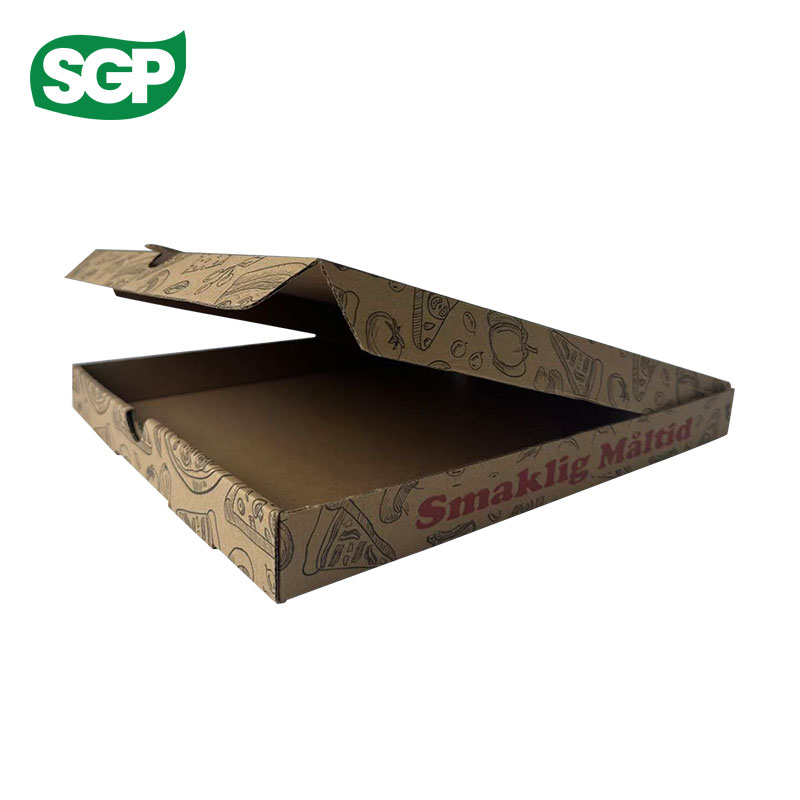
The flute profile determines the physical characteristics of the packaging. B-flute is thicker, featuring larger arches between the liners. This thickness provides excellent thermal insulation and high vertical crush resistance. It handles heavy stacks well. However, B-flute requires a significantly larger storage footprint. It takes up more space on shelves and in delivery vehicles.
E-flute offers a thinner profile with more flutes per linear foot. It provides a superior, smoother print surface for branding. It saves massive amounts of back-of-house storage space. However, because it is thinner, it requires denser, higher-quality paper grades to maintain the same stack strength as B-flute. F-flute is even thinner, typically reserved for retail clamshells rather than heavy-duty delivery applications. Choosing between B and E flute dictates your entire operational workflow.
Flute Profile | Thickness (Approx.) | Flutes per Linear Foot | Primary Advantage | Primary Disadvantage |
|---|---|---|---|---|
B-Flute | 1/8 inch | 47-53 | Superior vertical crush resistance and insulation. | Consumes maximum storage space; rougher print surface. |
E-Flute | 1/16 inch | 90-96 | Excellent printability and highly compact storage. | Lower thermal retention; requires denser paper for strength. |
F-Flute | 1/32 inch | 125-132 | Ultra-smooth surface for high-end graphics. | Insufficient structural integrity for heavy hot food stacks. |
Paper composition directly affects moisture resistance. Virgin Kraft paper utilizes long, unrefined pine fibers. These long fibers interlock tightly, providing superior tensile strength and natural resistance to moisture penetration. Kraft maintains its rigidity far longer in a humid delivery bag environment. It is the gold standard for heavy-duty applications.
Testliner consists of recycled paper fibers. Each time paper is recycled, the fibers become shorter and weaker. While Testliner is highly eco-friendly and cost-effective, it absorbs moisture much faster than virgin Kraft. Under high humidity, recycled fibers separate quickly, leading to rapid structural collapse. You must carefully evaluate whether the environmental benefits of Testliner outweigh the performance risks in your specific delivery radius.
Internal barrier coatings change the physics of the package entirely. Applying a grease-resistant lining prevents oils from migrating into the bottom liner. This maintains base rigidity and prevents the bottom from falling out during handling. Utilizing waterproof pizza boxes involves advanced coatings to repel both grease and water vapor simultaneously.
However, these coatings introduce a severe trade-off. By moisture-proofing the interior, you eliminate the paperboard's natural ability to absorb excess ambient humidity. The steam has nowhere to go but up. If your ventilation design is inadequate, the trapped steam will rain back down onto the product, ruining the texture. You must pair barrier coatings with highly engineered ventilation systems to balance moisture management.
Branding applications can inadvertently destroy structural strength. The flexographic or lithographic printing process applies physical pressure to the corrugated board. If the machinery is improperly calibrated, the printing plates crush the internal flutes. This pre-damages the board before it ever reaches your store. You must inspect incoming shipments for signs of flute crushing beneath heavy ink deposits.
Heavy ink saturation also alters moisture dynamics. Large blocks of dark ink on custom printed pizza boxes can seal the outer liner, changing how the board breathes. This can increase the moisture absorption rate of the unprinted areas. Complex printing requires longer production planning. You must factor in extended lead times for custom runs to ensure you never run out of branded inventory during peak seasons.
You must abandon dry testing immediately. Begin by establishing a "Hot Load" baseline. Use actual hot food items straight from the oven. If food waste is a concern, use heated water weights. Heat silicone bags filled with water to 200 degrees Fahrenheit. Place them inside the assembled packaging. This simulates realistic internal temperatures and immediate steam release.
Assemble three identical test units and place the heated loads inside.
Stack the three units squarely on a stainless steel prep table.
Leave the stack in a static position for exactly 30 minutes.
Use a digital caliper to measure the center lid deflection of the bottom unit at 10-minute intervals.
Record the exact millimeter drop. If the lid deflects more than 12 millimeters, the board specification fails under static thermal load.
Move the testing into the actual delivery environment. Place a fresh three-to-five box stack, fully loaded with hot items, inside a zipped thermal delivery bag. Zip the bag completely shut to trap all humidity. Let it sit for 15 minutes to build maximum internal moisture. This replicates the environment sitting on the dispatch rack.
Pick up the loaded thermal bag using a one-handed center hold from the bottom.
Walk briskly for two minutes, simulating the trip from the kitchen to the vehicle.
Place the bag in a vehicle and drive a standard 15-minute route.
Include sudden stops, sharp turns, and speed bumps to apply lateral shear force.
Return to the testing facility and prepare for immediate unboxing.
The final phase evaluates the end-user experience. Bring the thermal bag back into the testing facility. Remove the stack exactly as a customer would receive it. Evaluate the exterior condition first. Check for bottom-sogginess, grease bleed-through, and structural warping. The outside must look pristine to maintain brand standards.
Open the bottom unit of the stack and inspect the internal lid for product contact.
Check the locking tabs to see if they tore or disengaged during transit.
Lift the product out and inspect the bottom liner for tearing or cardboard residue.
Document all findings with photographs to share with your procurement team and suppliers.
Upgrading packaging specifications always increases the upfront unit cost. You must calculate whether this increase is justified by operational savings. Track your current rate of crushed-item refunds, driver remakes, and negative reviews related to presentation. Assign a hard dollar value to these failures.
If a 15% increase in unit cost eliminates 90% of transit-related refunds, the return on investment is usually positive. Thicker flutes and virgin kraft liners cost more per unit, but they protect the primary product. You must shift the procurement mindset from finding the cheapest flat cardboard to finding the most cost-effective delivery vessel. Cheaper materials that fail consistently cost far more in lost revenue and wasted labor.
Back-of-house operations dictate scalability. Thicker corrugated materials impact your inventory space severely. If you switch from E-flute to B-flute, you will fit fewer units on a standard storage rack. This requires more frequent deliveries from your supplier and tighter inventory management. You must measure your available storage volume before committing to a thicker profile.
Assembly speed during peak hours is equally critical. Stiffer, thicker boards require more physical force to fold. Complex structural supports or locking tabs slow down the assembly line. Time your staff folding 50 units of the current design versus 50 units of the proposed new design. If the new design takes twice as long to fold, it will create massive bottlenecks on a busy Friday night.
Consistent performance requires strict supplier auditing. A sample batch might pass your Phase 3 testing perfectly, but the actual production run could utilize lower-grade paper to cut costs. You must establish a routine quality assurance protocol for incoming shipments. Weigh a bundle of 50 flat boxes from every new pallet. If the weight drops by more than 5% compared to your approved sample, the supplier has likely substituted a lighter paper grade. Rejecting substandard shipments at the loading dock prevents catastrophic failures during your delivery shifts.
Adopting grease-resistant or waterproof coatings introduces significant compliance risks. Upcoming legislation strictly targets PFAS (per- and polyfluoroalkyl substances), commonly known as forever chemicals. These chemicals were historically used to create grease barriers in food packaging. Using non-compliant coatings exposes your operation to severe fines and public relations disasters.
You must mitigate this risk proactively. Demand comprehensive compliance documentation from every supplier. Require certified laboratory results proving the absence of PFAS in their barrier coatings. Test alternative eco-friendly barrier solutions, such as water-based aqueous coatings or bioplastic laminates. Ensure these sustainable alternatives still perform adequately under the rigorous Phase 2 transit vibration tests.
Audit your current inventory by measuring the center lid deflection of a three-stack after 30 minutes of hot load exposure.
Require suppliers to provide modified BCT data that accounts for 85% internal humidity rather than dry factory conditions.
Transition family-sized orders to B-flute virgin kraft to eliminate wide-span center sagging during transit.
Implement a standardized driver handling policy that mandates two-handed edge carrying to prevent fulcrum stress on the bottom container.
A: There is no single universal standard, as requirements vary by dimensions and stack height. A reliable delivery container should withstand at least 30 to 40 pounds of vertical pressure under high-humidity conditions without deflecting more than half an inch at the center lid.
A: Improperly calibrated printing machinery applies too much pressure, crushing the internal flutes and destroying vertical strength. Heavy ink saturation can also seal the outer liner, altering how the paperboard absorbs and releases moisture, potentially accelerating structural collapse.
A: They prevent grease and moisture from weakening the bottom liner, which improves base rigidity. However, they trap steam inside. Without highly engineered ventilation, this trapped steam will ruin the food texture, even if the structure remains intact.
A: Hot food releases massive amounts of steam. The thermal bag traps this moisture, which quickly breaks the hydrogen bonds in the paper fibers. This reduces the corrugated board's compressive strength by up to 50%, causing it to collapse under the weight of stacked items.
A: Edge Crush Test (ECT) measures the vertical strength of a small, flat board sample. Box Compression Test (BCT) measures the load-bearing capacity of a fully assembled unit. BCT is far more relevant for evaluating real-world stack performance, especially when modified for high humidity.
A: Larger dimensions create a wider unsupported span across the lid. This increases the span-to-strength ratio, making the center highly vulnerable to sagging. A flute profile that supports a 10-inch span perfectly will often fail when stretched across an 18-inch span.


