
Views: 0 Author: Site Editor Publish Time: 2026-09-26 Origin: Site


Packaging has evolved from a purely functional logistical requirement into a high-visibility, post-purchase marketing asset that creates a lasting physical connection with the consumer. Brands must balance the rising costs of packaging materials with consumer demands for sustainable practices, while fulfilling the marketing department's need for increased brand impressions and customer acquisition. The physical carrier you hand to a customer is often the first and last tactile experience they have with your retail presence. This guide provides a technical and strategic framework to evaluate whether transitioning to a custom printed paper bag strategy yields a measurable return on investment (ROI) for brand promotion, factoring in material costs, operational realities, brand consistency, and consumer psychology. We look at structural integrity, print methods, and material selection to ensure your packaging strategy aligns with actual field performance and consumer expectations.
Marketing ROI: Custom paper bags function as high-retention physical advertisements that draw in new customers and extend brand visibility far beyond the point of sale, provided the structural integrity encourages reuse.
Brand Storytelling: A well-designed paper bag is a tangible extension of your brand story, communicating core values (like quality and sustainability) and ensuring brand consistency across the entire customer journey.
Material Strategy: Selecting the right substrate—such as an uncoated kraft paper bag versus a laminated, high-GSM option—directly impacts both brand perception and unit cost.
Operational Trade-offs: Successful implementation requires balancing Minimum Order Quantities (MOQs), storage footprint, and freight costs against the per-unit savings and efficiency of bulk custom printing.
Risk Mitigation: Ensuring verified sustainability credentials (e.g., FSC certification) is critical to avoid greenwashing accusations that can negate the promotional benefits of paper packaging.
Defining what constitutes a successful promotional packaging strategy requires moving beyond basic unit cost analysis. Organizations must establish clear success criteria to measure performance in the field. Key metrics include cost per impression, social media sharing frequency, customer retention rates, and new customer acquisition. When you hand a customer a Paper Bag, you deploy a physical marketing asset into the real world. If the packaging fails structurally or visually, it actively harms brand perception. High-quality packaging drives measurable engagement metrics that marketing teams can track and optimize over time. You must treat the carrier as an extension of your advertising budget rather than a simple warehouse expense.
Analyzing the post-purchase lifecycle of packaging reveals its true promotional value. Durability dictates the likelihood of secondary reuse by the consumer. A structurally sound bag multiplies brand impressions in public spaces, drawing in new customers as the original buyer carries it through shopping malls, transit systems, and city streets. This secondary usage transforms a simple carrier into a moving billboard. The longer the bag remains in circulation, the lower the effective cost per impression becomes. Structural integrity directly correlates with extended promotional lifespans. A bag that survives the initial trip home and gets reused for carrying lunches or returning items generates dozens of unpaid impressions.
Custom packaging holds your brand story in a tangible format. The materials, colors, and typography you select reinforce brand identity and commitment to quality long after the initial purchase. Consumers form subconscious judgments about a company based on the tactile feedback of their packaging. Flimsy materials suggest cutting corners, while robust construction implies a premium product inside. Your packaging serves as a physical ambassador, speaking for your brand values when your sales team cannot. Every fold, glued seam, and printed logo communicates your operational standards directly to the end user.
Tactile packaging elements heavily influence perceived product value. There is a direct correlation between heavyweight paper packaging and luxury brand positioning. The unboxing experience begins the moment the customer takes the bag from the counter. Heavyweight materials, textured finishes, and crisp folds create a premium customer experience that elevates the perceived worth of the items inside. This psychological effect encourages customers to share their purchases on social media, generating organic, user-driven brand promotion. Retailers leverage this by designing interiors with contrasting colors or adding custom tissue paper, turning a simple transaction into a memorable event.
Consumer preference has aggressively shifted toward plastic-free alternatives. Evaluating this shift is mandatory for modern brand positioning. Adopting paper packaging signals corporate responsibility, meets strict sustainability expectations, and builds essential brand trust. Shoppers actively seek out brands that align with their environmental values. Providing a recyclable or compostable carrier demonstrates a commitment to reducing environmental impact. This serves as a powerful promotional narrative in modern marketing campaigns. Brands that ignore this shift face public backlash and lose market share to competitors who prioritize sustainable material sourcing.
Selecting the correct base substrate dictates both the visual outcome and the environmental message of your packaging. Unbleached or bleached options offer an organic, eco-friendly aesthetic. A kraft paper bag works best for minimalist branding, communicating environmental values, and maintaining cost-efficiency. The kraft pulping process retains longer wood fibers, resulting in superior tensile strength compared to heavily processed papers. The porous nature of this material absorbs ink deeply, resulting in muted, natural tones that appeal to eco-conscious demographics.
Coated or laminated paper offers superior print fidelity and water resistance. These substrates support vibrant colors and sharp photographic reproduction. Lamination applies a thin layer of plastic film (like BOPP) over the printed surface, providing a glossy or matte finish. This process often sacrifices recyclability because municipal facilities cannot easily separate the plastic film from the paper fibers. Coated options fit best in high-end retail environments where a premium finish is strictly required to match luxury brand standards.
Mapping Grams per Square Meter (GSM) to product weight is a critical engineering step in packaging procurement. GSM measures the density and thickness of the paper. Underspecifying GSM leads to catastrophic bag failure. A torn bag spilling merchandise onto the sidewalk results in severe negative brand association. Over-engineering the GSM ensures the bag survives the initial journey and encourages the secondary reuse that drives marketing impressions.
GSM Range |
Common Applications |
Structural Characteristics |
|---|---|---|
70 - 90 GSM |
Pharmacy bags, light bakery items, small accessories. |
Highly flexible, low tear resistance. Not suitable for handles. |
100 - 120 GSM |
Standard apparel, fast food takeout, lightweight groceries. |
Moderate strength. Supports twisted paper handles for loads up to 3kg. |
150 - 180 GSM |
Premium retail, heavy groceries, cosmetics. |
Stiff and durable. Supports heavy loads and complex handle integrations. |
200 - 250+ GSM |
Luxury goods, electronics, heavy glass bottles. |
Rigid, board-like feel. Requires scored fold lines to prevent cracking. |
Handle comfort dictates the duration a customer is willing to carry the bag, directly impacting promotional visibility. If a handle cuts into the user's hand, they will discard the bag immediately upon arriving home. Evaluating handle types is necessary for optimizing the user experience and extending the promotional lifecycle.
Twisted Paper: Cost-effective, machine-applied, and fully recyclable. Manufacturers twist strips of kraft paper into tight cords and glue them to a reinforcing patch inside the bag. Standard for retail and grocery applications.
Flat Paper: Highly economical and often used for takeout food. These handles fold flat against the bag for easy storage but offer lower carrying comfort for heavy loads over long distances.
Die-Cut: Integrated directly into the bag structure. This creates a clean, modern aesthetic but reduces the usable volume of the bag, as items cannot sit above the handle line.
Premium Ribbon or Cotton: Soft, comfortable, and luxurious. These handles encourage long-term reuse but complicate the recycling process, as the consumer must manually remove the fabric before recycling the paper body.
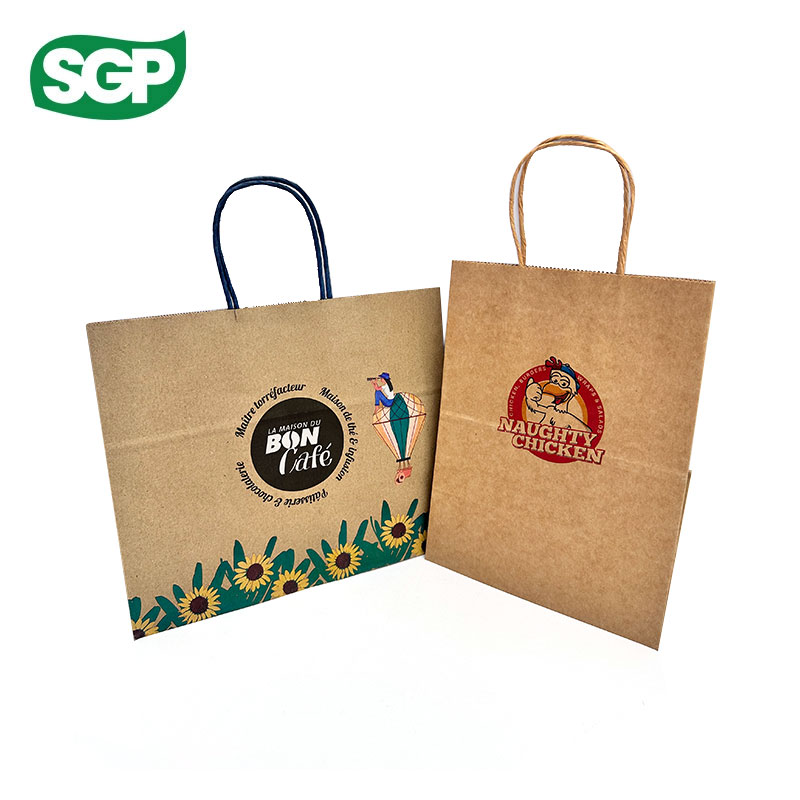
Choosing the right printing method depends entirely on your design complexity, order volume, and budget. Each technology offers distinct advantages for custom packaging production. Understanding these differences prevents costly production errors and ensures your marketing artwork translates accurately to the physical product.
Printing Method |
Best Application |
Volume Requirement |
Visual Fidelity |
|---|---|---|---|
Flexographic |
Simple 1-2 color logos, vector graphics, text. |
High volume (10,000+ units). |
Standard. Best for solid colors. Prone to slight registration shifts. |
Offset |
Photographic quality, complex gradients, tight registration. |
Medium to High volume. |
Premium. Sharpest detail available. Requires smooth substrates. |
Digital |
Variable data, multi-color short runs, rapid prototyping. |
Low volume (Under 1,000 units). |
High. No printing plates required, allowing for immediate design changes. |
Navigating ink limitations on porous substrates requires specific design adjustments. When designing a custom printed paper bag, designers must account for dot gain. This is the tendency of wet ink to spread as it absorbs into uncoated fibers, which can turn fine text into illegible smudges. Understanding bleed requirements ensures colors extend fully to the edge of the bag without leaving unprinted white margins after the paper is cut and folded.
Color matching requires careful consideration between Pantone (spot colors) and CMYK (process colors). The base color of the paper heavily impacts the final ink appearance. Printing yellow ink on brown kraft results in a muddy, illegible logo. Designers must use opaque inks or print a white base layer under the colors to maintain vibrancy on dark substrates.
Standardizing your custom print runs across various packaging lines helps manage printing more efficiently. It reduces color-matching errors and ensures strict brand consistency. When a brand uses multiple vendors without standardized artwork files, the resulting packaging often displays varying shades of the corporate colors. Establishing strict brand guidelines, including specific Pantone codes and required clear space around logos, ensures that every bag manufactured aligns perfectly with your visual identity. You must provide your manufacturing partners with locked vector files and demand physical drawdowns (ink samples on the actual paper stock) before approving mass production.
In the luxury apparel sector, packaging must match high price-point expectations and elevate the in-store experience. Focus on high-GSM materials to provide structural rigidity. Incorporate finishing techniques like foil stamping, UV spot gloss, and blind embossing to create tactile interest. Premium handle integration, such as knotted grosgrain ribbon, signals exclusivity. The goal is to make the packaging feel like a secondary product. Customers often keep these bags to store items in their closets or use them as gift bags, extending the brand's presence inside the home for months or even years.
The hospitality sector requires balancing brand promotion with strict functional requirements. Grease resistance, heat retention, and FDA compliance for direct or indirect food contact are non-negotiable. Structural stability for delivery and takeout scenarios ensures the brand presentation remains intact upon arrival. Utilizing high-quality paper food packaging prevents leaks and maintains food temperature, protecting the customer experience. A well-branded takeout carrier turns every food delivery into a localized marketing event. Neighbors and coworkers see the branded bag, acting as a direct endorsement of your restaurant.
Utilizing high-impact, short-run custom bags provides immediate brand differentiation in crowded commercial environments. Attendees collect numerous promotional items on trade show floors, and the largest, most durable bag inevitably becomes the primary carrier for all other materials. By supplying a premium, oversized carrier with bold branding, your company effectively co-opts the visibility of every other vendor. The structural integrity must support heavy catalogs and samples to ensure the attendee carries your logo throughout the entire event without the handles tearing out.
Tooling, printing plates, and machine setup costs dictate the financial viability of custom printing. Manufacturers require Minimum Order Quantities (MOQs) to absorb these initial setup expenses. Understanding the volume threshold where custom becomes cost-effective is vital for procurement teams. Ordering 500 units might result in a high per-unit cost due to plate fees, whereas ordering 10,000 units drops the per-unit cost significantly, making the promotional ROI highly favorable. You must forecast usage accurately to leverage volume discounts without overextending capital or filling your warehouse with obsolete branded materials.
Calculating the volumetric weight of stored packaging is essential for accurate logistics planning. Paper carriers consume significant warehouse space because they do not nest as tightly as plastic alternatives. The hidden costs of warehousing large runs of custom packaging can erode the unit-cost savings achieved through bulk ordering. Organizations must weigh the cost of storing pallets of inventory against the strategy of utilizing blank stock bags paired with custom stickers or stamps for lower-volume needs. Efficient supply chain management ensures packaging is delivered just-in-time, minimizing storage overhead and protecting the paper from humidity damage in unclimate-controlled warehouses.
Moving from fragmented, multi-vendor unbranded packaging to a consolidated custom strategy can reduce overall costs. Auditing your current procurement often reveals overlapping sizes and redundant inventory across different product lines. By standardizing bag sizes and consolidating orders with a single manufacturer, brands streamline procurement, secure better volume pricing, and ensure uniform quality. This consolidation frees up capital that can be reinvested into higher-quality materials or advanced printing techniques, ultimately improving the marketing impact of the packaging.
Frameworks for attributing value to packaging are necessary to justify the investment to stakeholders. Brands can track engagement by printing dynamic QR codes on the gussets or base of the bag, directing users to exclusive landing pages, loyalty sign-ups, or discount codes. Monitoring user-generated content and tracking unboxing videos on social media provides qualitative data on customer satisfaction. By assigning a value to these digital interactions and secondary physical impressions, marketing teams can calculate a definitive ROI for their packaging spend, proving that the bags generate revenue rather than just consuming operational budgets.
Manufacturing defects pose a significant risk to brand reputation. The risk of ink offsetting (wet ink bleeding onto clothing), handle detachment under load, or bottom gusset blowouts must be managed proactively. Mitigation requires rigorous pre-production sampling. Brands should demand physical prototypes and conduct tear testing, dynamic drop tests, and moisture resistance evaluations before authorizing mass production. Establishing clear Acceptable Quality Limit (AQL) standards with the manufacturer ensures defective batches are rejected at the factory level before they reach your retail stores and cause customer embarrassment.
The reputational risk of claiming sustainability without verifiable proof is severe. Consumers and regulatory bodies actively scrutinize environmental claims. To avoid greenwashing accusations, sourcing from suppliers with recognized certifications is mandatory. Look for Forest Stewardship Council (FSC) or Sustainable Forestry Initiative (SFI) chain-of-custody certifications. These credentials guarantee that the wood pulp used in your packaging originates from responsibly managed forests. Having these logos printed on the bottom of your bag allows your marketing team to promote your sustainability initiatives safely and accurately.
Navigating the 8-12 week lead times typical for overseas manufacturing requires precise inventory forecasting. Stockouts force brands to purchase expensive emergency replacements, disrupting brand consistency and confusing customers. Balancing overseas sourcing trade-offs involves maintaining a safety stock domestically while waiting for larger, cost-effective ocean freight deliveries. Implementing automated inventory tracking prevents unexpected shortages and ensures your retail locations never run out of branded carriers during peak seasonal rushes.
Conduct a physical audit of your current packaging inventory to identify consolidation opportunities across different product lines.
Specify the exact GSM and handle type required for your heaviest products to prevent structural failures in the field.
Request unprinted structural samples from manufacturers to perform dynamic drop tests and static load evaluations.
Standardize your artwork files using exact Pantone spot colors to guarantee visual uniformity across all production batches.
A: Minimum order quantities depend heavily on the chosen printing technology and the manufacturer's equipment. Digital printing handles short runs, often starting around 500 units, which works well for limited promotions. Flexographic and offset printing require custom plates and extensive machine setup. These methods typically demand minimums between 5,000 and 10,000 units to absorb the initial setup expenses and deliver a viable per-unit cost.
A: Plastic carriers generally offer a lower upfront unit cost. However, kraft paper significantly elevates consumer perception. Shoppers view unbleached paper as environmentally responsible and structurally premium. The slight increase in unit cost pays off through positive marketing impact, stronger brand trust, and strict compliance with emerging municipal bans on single-use plastics.
A: Yes. Manufacturers apply food-safe, water-based, or soy-based inks exclusively to the exterior surfaces. The interior must remain unprinted or feature an FDA-approved barrier coating. This prevents ink migration into the food product, ensuring the packaging remains completely safe for direct or indirect contact while still delivering strong exterior brand promotion.
A: Offset printing delivers the highest resolution for complex logos, photographic images, and intricate color gradients. It produces sharp lines and precise color matching. To achieve maximum fidelity, you must print on smooth, coated paper rather than porous substrates. Offset printing requires custom plates, meaning you must commit to higher production volumes.
A: They function as a physical extension of your digital and retail presence. By using exact Pantone color matching and standardized typography, custom carriers ensure the customer’s visual experience remains uniform. This consistency reinforces brand recognition from the moment they leave the store until they unpack the items at home.
A: Specify uncoated paper stocks and avoid plastic laminations, UV spot gloss finishes, or metallic foil stamping. Use water-based inks and twisted paper handles instead of synthetic ribbons or nylon cords. Always request chain-of-custody documentation from your supplier to confirm the materials meet local municipal recycling and commercial composting standards.
A: Heavy retail items like footwear, hardback books, or glass bottles require a minimum of 150 to 200 GSM. You should also specify a reinforced cardboard bottom insert and a turn-top construction. Securely glued handles are mandatory to prevent tearing and ensure the carrier survives the journey under heavy loads.


