
Views: 0 Author: Site Editor Publish Time: 2026-03-12 Origin: Site


If you’ve ever hosted a meeting, catered an event, or ordered pizza for a busy family night, you’ve probably faced the same question: how long can pizza sit out in the box before you should move it to the fridge (or decide it’s time to toss it)? From our packaging perspective, the pizza box is designed to protect the product, hold heat for delivery, and keep slices easy to serve. But a box cannot “freeze time.” Once hot pizza is sitting at room temperature, two things start happening in parallel: food safety time is counting, and pizza quality is changing.
In general food safety guidance, the common rule is to avoid leaving perishable foods at room temperature for more than 2 hours—and if the environment is hot (around 90°F / 32°C or above), the window is usually 1 hour. This “2-hour rule” is widely stated in official sources and food safety education materials.
At SGP Packaging, we work with businesses that want pizza packaging to perform better during delivery, staging, and serving. In this article, we’ll answer the question “how long can pizza sit out in the box?” in a practical way—covering safe time windows, what changes inside the box over time, and simple handling tips that help you protect both quality and operational convenience.
A useful, widely referenced guideline is:
Up to 2 hours at room temperature
Up to 1 hour if the temperature is above 90°F / 32°C
That guidance is commonly presented by food safety authorities as a general rule for perishable foods left out.
Pizza counts as a perishable food because it typically contains ingredients like cheese, meat, and cooked toppings. So while the pizza may still look “fine” after a few hours, the recommended safe window doesn’t keep extending just because it is inside a pizza box.
A pizza box can hold heat for a while, but it does not keep pizza out of the temperature range where bacteria grow fastest (often described as the “danger zone” concept in food safety education). Food safety guidance emphasizes that perishable foods should not sit out beyond the recommended time limits because bacteria can multiply at room temperature conditions.
In real-life terms, a pizza box:
slows down cooling (compared to leaving pizza uncovered)
protects slices from dust and handling
keeps pizza easy to stack and serve
But it also:
traps steam, which can quickly affect crust texture
does not provide refrigeration
may keep the pizza warm for comfort, but not “hot enough” to maintain safe holding indefinitely
So the box is a quality and handling tool, not a long-term holding method.
Even if you focus only on taste and texture, pizza changes quickly once it sits.
Hot pizza releases steam. Inside a closed box, steam has nowhere to go. The longer the pizza sits, the more the crust absorbs moisture, and the less crisp it feels.
As pizza cools, cheese firms up and oils separate. Toppings can become less appealing—especially if condensation drips back onto the surface.
Grease and condensation can collect on the base of the box. If the box has no ventilation or if slices are stacked, sogginess increases.
From a packaging standpoint, these are reasons why pizza boxes often include design details like venting features and corrugated structure—to balance heat retention and moisture control during delivery and short staging.
Below is a practical reference table for common scenarios.
Situation | Environment | Practical “sit out” window | Best next step |
Family dinner, normal room | 68–75°F (20–24°C) | Up to 2 hours | Refrigerate leftovers promptly |
Party buffet, long serving time | Room temp, repeated opening | Treat as 2-hour limit total | Serve small batches, re-stock from fridge |
Outdoor picnic / hot car risk | ≥90°F (32°C) | About 1 hour | Keep chilled until serving; don’t leave in sun |
Delivery staging at office | Room temp | Up to 2 hours | If delayed, chill and reheat later |
These time windows align with commonly published food safety guidance about perishable foods left out and the reduced window in high heat.
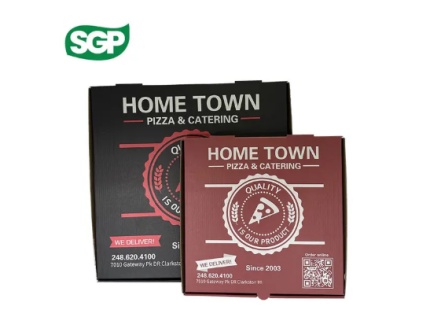
Many people assume: “If it’s still warm, it’s fine.” The problem is that pizza can be warm but not hot enough to be held safely for long periods, especially once it begins cooling and sits in a closed box. Food safety guidance focuses on time and temperature control, and consistently recommends refrigerating perishable foods within the 2-hour rule (or 1 hour in high heat).
For events and catering, the operational takeaway is:
If you need pizza hot for longer than typical delivery-to-eating time, consider active hot holding equipment, not just keeping it in the box.
If you need to keep pizza for later, cool it and refrigerate within the time window.
If you know you’ll have leftovers, the best approach is to plan for it early.
Instead of leaving the whole pizza on the table, store extra slices earlier and keep only what will be eaten soon.
A pizza box is convenient short-term, but for refrigeration it may take up space and can allow slices to dry out. Many people prefer transferring slices to containers or wrapping.
Food safety sources commonly list pizza as a leftover item that is typically stored 3–4 days in the refrigerator.
Reheating can improve eating experience, but it does not make “left out too long” pizza automatically acceptable. Food safety guidance emphasizes refrigeration timing and warns against leaving perishables out beyond recommended limits.
The practical decision rule many kitchens use:
If pizza has been out within the time window, refrigerate and reheat later as desired.
If pizza has been out beyond the time window, it’s safer to discard.
From a packaging viewpoint, the pizza box has two main goals during the first part of the pizza’s life:
Protect and deliver the pizza in good condition
Keep slices presentable and easy to serve
Some design elements that can help short-term quality include:
corrugated board structure to maintain shape and insulation
venting strategy to reduce steam buildup
grease resistance to protect the base and improve handling
strong stacking strength for delivery and catering staging
These don’t change the food safety clock, but they can improve customer experience during delivery and serving.
Ask these questions:
How long has it been out?
If it’s approaching 2 hours at room temperature, plan to store or discard.
How hot is the environment?
If you’re outdoors or in a hot room (around 90°F/32°C+), use the shorter 1-hour window.
Is this for serving now or saving for later?
Serving now: keep it within the safe window and avoid long open-air staging.
Saving: refrigerate promptly and reheat later.
So, how long can pizza sit out in the box? A practical and widely used guideline is up to 2 hours at room temperature, and up to 1 hour if temperatures are above 90°F / 32°C. The pizza box helps protect the product and can support short-term quality during delivery and serving, but it doesn’t replace proper time-and-temperature handling. If you plan ahead—serve in smaller batches, refrigerate leftovers promptly, and use packaging that supports heat balance and handling—you can keep both the eating experience and the workflow more consistent.
At SGP Packaging, we support pizza businesses and food operators with packaging solutions designed for real-world delivery and serving needs. If you’re optimizing pizza box performance for takeout, delivery, or catering, you’re welcome to learn more through SGP Packaging and contact our team for packaging options and support.
A common guideline is no more than 2 hours at room temperature for perishable foods, including pizza.
If the temperature is above 90°F / 32°C, the recommended window is often 1 hour.
A pizza box can hold heat and protect the pizza, but it does not replace refrigeration or extend the recommended safe time limits.
Food safety charts commonly list pizza leftovers as typically 3 to 4 days in the refrigerator.


