
Views: 0 Author: Site Editor Publish Time: 2026-03-19 Origin: Site


Packaging costs rarely rise because of one big mistake. They creep up through dozens of small decisions—box size that’s “close enough,” material that’s a little stronger than needed, print designs that trigger extra plates or slower runs, shipping cartons that don’t cube out, or minimum order quantities that force you to hold inventory too long. If you sell pizza, you feel these costs everywhere: in the unit price of each pizza box, in freight, in warehousing, and even in customer complaints when boxes arrive crushed or greasy.
From our perspective as a packaging supplier, the best cost reductions usually happen when the pizza box manufacturer and the buyer work as partners, not as “quote-only” counterparts. A manufacturer can see cost drivers across the whole production chain—paper grades, converting yield, print setup time, die-line efficiency, stacking, palletization, and shipping. When those pieces are optimized together, the savings can be significant without lowering perceived quality. In this article, we’ll share practical ways a manufacturer can help you reduce packaging costs while keeping the performance you need for real-world delivery and takeout.
Before cutting cost, it helps to know what you’re paying for. Most pizza box cost is influenced by:
Material (paperboard grade, flute type, coatings)
Box design (dimensions, venting, structure, locking)
Printing (colors, coverage, process vs spot, setup)
Production efficiency (die-cut yield, speed, waste)
Logistics (carton packing, pallet pattern, freight)
Inventory (MOQs, storage, damage, obsolescence)
A good pizza box manufacturer doesn’t just sell you a box—they help you engineer a packaging system that fits your product, your operations, and your supply chain.
Right-sizing is one of the fastest ways to lower total packaging cost because it cuts waste at every step—from paper usage to freight and storage. When a 12-inch pizza is routinely placed in a 13-inch box “just in case,” the extra space looks minor, but it adds up: you consume more board per unit, fit fewer boxes per pallet, and pay more per shipment because you’re transporting air. Oversized boxes also take up more backroom space, and they can even reduce delivery quality by allowing the pizza to slide, which may increase customer complaints and remakes.
A reliable pizza box manufacturer can help you define a size set that fits real products, not guesses. That means measuring true pizza diameter, crust height, and toppings clearance, then recommending a box range that covers your menu while stacking well and maximizing cartons-per-pallet. The practical goal is standardization: many brands reduce cost by narrowing sizes (for example, 10", 12", 14", 16") instead of adding niche sizes that raise MOQs, complicate forecasting, and create slow-moving inventory.
Pizza boxes must handle heat, steam, grease, and stacking pressure. But “strongest possible” is not always the most cost-efficient.
A manufacturer can help you select board grades that meet your real needs:
Delivery-heavy operations may need better rigidity and compression strength
Dine-in / quick turnover may need less structural strength
Grease resistance needs differ between thin crust and extra-cheese styles
Paper weight and stiffness
Single wall vs stronger constructions
Liner quality
Coatings (if required)
A smart goal is fit-for-use performance, not blanket over-specification.
When pizza boxes are die-cut from large sheets, the layout determines how much board becomes product vs scrap. Small changes in dimensions or flap geometry can increase yield per sheet.
A pizza box manufacturer can:
optimize the die-line layout
reduce trim waste
improve nesting on the sheet
maintain strength while cutting less material
Even a few percentage points of yield improvement can noticeably lower per-unit cost over large volumes.
Printing can add cost in multiple ways:
more colors = more plates and setup time
heavy ink coverage = slower drying and lower line speed
complex designs = higher waste during startup
frequent design changes = repeated setup cost
A manufacturer can help you redesign graphics for lower production cost while keeping brand impact.
Use fewer colors (or smarter spot color choices)
Reduce full-coverage backgrounds
Use consistent artwork across sizes (where possible)
Plan seasonal designs in larger batches
Print Decision | What Happens in Production | Cost Impact |
Full background coverage | more ink, slower drying | higher unit cost |
1–2 spot colors | faster runs, simpler setup | lower cost |
Many small text elements | risk of waste / rework | higher risk cost |
Standardized artwork | stable repeat production | lower setup cost |
Sometimes you don’t need heavier board—you need a better structure. Small design features can improve strength without material upgrades.
A manufacturer may propose:
improved locking corners
reinforced edge design
optimized vent holes
better stack stability for delivery
This approach often reduces “hidden costs” from damaged boxes, returns, or customer dissatisfaction.
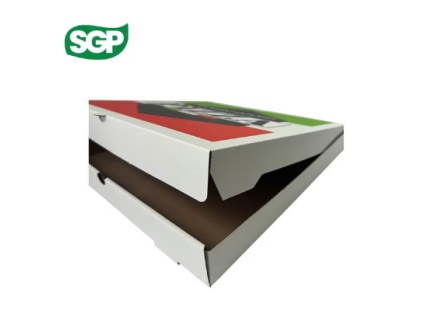
Packaging cost is not just unit price. Freight can be a major cost driver—especially for bulky items like pizza boxes.
A manufacturer can reduce your landed cost by optimizing:
how many boxes fit per carton
carton dimensions to maximize container space
pallet patterns to reduce wasted cubic space
stacking stability to reduce damage
Better cubing-out means:
lower freight per 1,000 boxes
fewer pallets to handle
lower warehouse labor cost
A supplier that understands shipping realities can help you save beyond the invoice price.
Some buyers focus only on MOQ and unit price. But inventory cost is often larger than you think:
warehouse space
damage over time
cash tied up
design changes that make stock obsolete
A manufacturer can support cost reduction by:
recommending an economical MOQ strategy
batching production efficiently
supporting multi-SKU scheduling (to reduce your total stock)
improving lead times and delivery planning
When ordering is aligned with your sales rhythm, you avoid paying for storage and waste.
A box that fails in the field costs more than the box itself. The cost shows up as:
remakes
refunds
bad reviews
lost customers
emergency reorders
Manufacturers help reduce these risks by controlling:
board consistency
die-cut accuracy
glue and fold performance
print registration
moisture control in packing and shipping
Consistency reduces operational surprises—and those surprises are often the biggest “hidden packaging costs.”
The most effective cost reduction projects usually look like this:
You share your current box specs, volumes, and delivery scenario
The manufacturer evaluates material, design, print, and logistics cost drivers
Several options are proposed (good / better / best)
You test what matters (stacking, grease resistance, delivery performance)
You lock a repeatable spec and scale it
This is value engineering—cutting cost without cutting function.
Area | Quick Question | Typical Savings Source |
Size | Are you using larger boxes than needed? | less material + better freight |
Material | Is board grade over-specified? | lower paper cost |
Die-line | Is sheet yield optimized? | less scrap |
Printing | Are you using too many colors/backgrounds? | faster runs + less ink |
Logistics | Are cartons/pallets cubing out efficiently? | lower freight |
Inventory | Are you holding too many SKUs/too much stock? | lower storage + cash flow |
Reducing packaging costs is rarely about “finding the cheapest pizza box.” It’s about building a box system that matches your product and your supply chain—right size, right board, efficient printing, reliable structure, and freight-friendly packing. A capable pizza box manufacturer can help you find savings in places you might not see from the buyer side: die-line yield, production speed, palletization, and consistency that prevents expensive failures.
At SGP Packaging, we work with businesses that want to reduce total packaging cost without sacrificing real-world performance for delivery and takeout. If you’d like, you can share your current pizza box sizes, board requirements, printing style, and estimated volumes. We can help you review cost drivers and recommend practical options to improve efficiency and reduce your overall packaging spend.
By optimizing box size, board grade, die-line efficiency, and print complexity while maintaining the performance requirements for stacking, heat, and grease control.
Not always. A better structure or improved die-line yield can reduce cost without weakening the box, and logistics optimization can cut costs beyond material changes.
Using fewer colors, reducing full-coverage backgrounds, standardizing artwork across sizes, and planning production in larger batches typically lowers setup cost and improves run efficiency.
Pizza boxes are bulky, so carton size, pallet pattern, and container utilization can significantly change freight cost per unit—often as much as the unit price savings.


