
Views: 0 Author: Site Editor Publish Time: 2026-05-25 Origin: Site


Delivering a hot, fresh pizza presents a timeless logistical dilemma for restaurant owners everywhere. You must maintain the ideal serving temperature of 70 to 85 degrees Celsius during transit. Simultaneously, you need to keep the crust perfectly crisp without turning it soggy. Packaging serves as a highly functional thermodynamic tool rather than just a simple transport vessel. The material you choose directly impacts food quality upon arrival. It also shapes brand perception and fundamentally drives your repeat order rates over time. We will closely evaluate the two main industry contenders for this job. We will look at traditional corrugated cardboard and modern folding cartons. This evidence-based comparison focuses purely on thermal performance and commercial delivery viability. You will learn the exact physics behind heat retention and moisture control. Finally, we will guide you toward making the best structural packaging choices for your specific operational model.
Corrugated Dominates Delivery: The fluted core of corrugated boards creates active air pockets, forming a necessary thermal barrier that folding cartons lack.
Moisture-Heat Balance is Critical: Effective heat retention requires calculated ventilation; fully sealed boxes trap steam and ruin texture.
Folding Cartons Have a Niche: While poor for 30-minute deliveries, folding cartons excel in retail display and dine-in leftover scenarios.
Structural Engineering Matters: Flute type (B vs. E), precise box sizing, and base rigidity prevent heat loss via conduction.
Supplier Capabilities Dictate Quality: Partnering with specialized corrugated pizza box manufacturers ensures access to food-grade materials and exact die-cutting for thermal efficiency.
Understanding thermal dynamics helps you choose better packaging materials. Corrugated board utilizes a brilliant three-layer engineering structure. A wavy fluted core sits securely between two flat paper liners. This fluted layer actively traps air inside the box walls. It functions exactly like a double-pane glass window in a home. The trapped air creates an invisible insulating buffer around the food. It slows down convective heat loss significantly during transit. Your delivery drivers gain more time to reach the customer. The food remains within the safe and delicious temperature zone.
Folding cartons operate under entirely different physical constraints. They usually consist of 200 to 600 gsm solid paperboard. They offer extremely minimal thermal resistance compared to fluted designs. Their dense physical structure actually works against them in delivery. High physical density leads to rapid conductive heat loss. The board absorbs the food heat and immediately passes it outside. Uninsulated folding cartons fail thermal tests very quickly. Inside them, hot food drops below optimal holding temperatures in under 10 minutes. This makes them entirely unsuitable for traditional neighborhood delivery routes.
Hot pizza presents a particularly unique thermodynamic challenge. Trapped heat naturally generates rising steam from the hot sauce and cheese. This creates the classic moisture paradox in food delivery. If steam cannot escape, it falls back onto the pizza. Fully sealed environments will instantly ruin a crispy crust. Corrugated board absorbs and vents moisture much more efficiently. It performs far better than standard solid folding paperboard. This delicate thermodynamic balance prevents a soggy base. Simultaneously, it keeps the cheese perfectly melted and warm.
Always match the material breathability to your specific pizza style.
Avoid entirely coating the inside of boxes if you bake high-moisture pizzas.
Ensure your boxes feature clean, unobstructed vent holes on the sides.
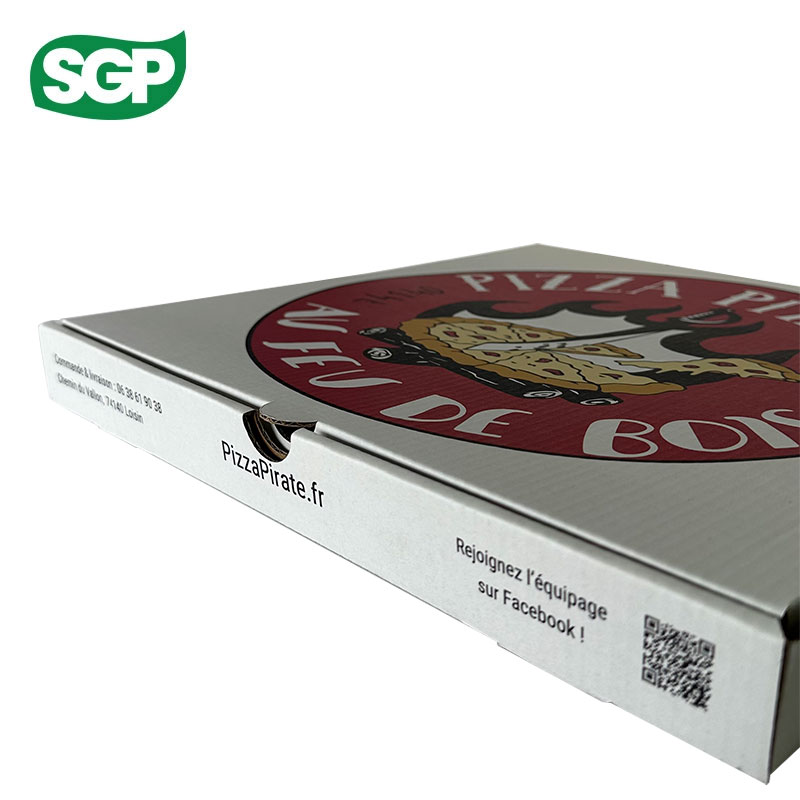
We must acknowledge exactly where folding cartons win the battle. They definitely provide superior visual presentation and aesthetic charm. They offer incredibly smooth, high-fidelity print surfaces for intricate artwork. This makes them ideal for highly visual, premium applications. For instance, they work beautifully for Custom White Boxes with Logo designs. Luxury brands often use them for specialty limited-edition runs. The smooth surface accepts metallic inks and UV coatings flawlessly. If visual impact outranks thermal needs, folding cartons hold strong value.
We recommend folding cartons for very specific, non-delivery scenarios. They work exceptionally well for short-distance food transport. Food truck operators handling immediate walking orders love them. You might also use them effectively for dine-in leftovers. They suit frozen or unbaked retail pizzas perfectly on supermarket shelves. In these specific cases, immediate heat retention simply is not the objective. Customers will consume or reheat the food on their own terms. Here, the premium look overrides the lack of structural insulation.
However, traditional delivery fleets face severe operational trade-offs with them. Relying on folding cartons for 30-minute trips carries high risks. You will likely deliver cold, structurally compromised food to your customers. Diners notice poor food quality immediately upon opening the lid. This ultimately harms your brand reputation heavily over time. A premium visual look cannot save a cold, soggy meal. You must align your material choice with your actual service model.
Material Use-Case Comparison Chart | ||
Operational Scenario | Recommended Material | Primary Business Objective |
|---|---|---|
30-Minute Neighborhood Delivery | Corrugated Board | Maximum heat retention and moisture venting |
Dine-In Leftovers (Doggy Bags) | Folding Carton | Compact storage and high brand visibility |
Frozen Supermarket Retail | Folding Carton | Superior graphic printing and freezer stability |
Large Volume Catering | Corrugated Board (B-Flute) | Extreme stacking strength and heat retention |
Flute selection remains the most critical engineering decision you will make. Let us examine the two most common profiles used today. B-flute material measures about 1/8 of an inch in thickness. It resists steam-induced warping remarkably well under heavy loads. It provides robust thermal protection for larger, heavier food items. If you sell massive 14-inch or 18-inch pies, choose B-flute. It supports the weight effortlessly while trapping a thick air blanket.
E-flute offers a compelling, modern alternative for smart operators. It measures much thinner at roughly 1/16 of an inch. Despite being thin, it operates highly efficiently for standard sizes. It wraps tighter to the product overall. This physically minimizes the internal air cavity surrounding the food. A smaller air cavity heavily reduces rapid heat dissipation. Furthermore, E-flute saves up to 50% in your warehouse storage space. You can stack twice as many boxes on a single shelf.
A top-tier Custom Design Pizza Box requires careful structural engineering inside and out. It must incorporate precise, often asymmetrical ventilation holes along the edges. These dedicated vents release excess steam quickly into the atmosphere. Crucially, they do this without dumping internal heat simultaneously. Poorly cut holes either trap too much steam or let cold air rush in. Precision engineering guarantees the exact correct airflow ratio.
You must also actively prevent conductive heat loss from the bottom. "Downward-warping" poses a major threat during winter deliveries. Steam softens a completely flat box base rapidly. The soggy bottom sags and touches cold surfaces directly. It touches cold car seats or chilly metal patio tables. This direct physical contact accelerates conductive heat loss dramatically. Quality corrugated structures maintain strict rigidity through clever folding techniques. Some advanced designs even use die-cut thermal legs. These structural legs preserve a crucial bottom air gap above flat surfaces.
Using heavy B-flute for small 8-inch pizzas, wasting warehouse space.
Punching symmetrical vent holes that create a cross-breeze, cooling the food.
Ignoring bottom rigidity, allowing the box to sag onto cold countertops.
Matching box dimensions strictly to your pizza size is absolutely essential. The "cavity effect" dictates how fast your food cools down. Oversized boxes create a massive, empty internal air cavity. This extra cold air leaches heat directly from the hot food. The food expends energy trying to heat the empty space. Snug packaging fits retain core thermal mass much more efficiently. A 12-inch pie belongs exactly in a 12.5-inch box. Never use a 14-inch box just to consolidate your inventory.
Box shape variables also play a surprising role in thermal dynamics. Standard square boxes remain highly cost-effective and perfectly stackable. We see them used universally across the global restaurant industry. However, non-square variants offer highly specific structural benefits. Octagonal or cut-corner styles reduce the internal air volume slightly. Trimming the empty corners removes dead air space from the equation. This provides marginally better heat retention for long delivery routes. It also visually differentiates your brand from local competitors.
We must analyze practical cost-reduction strategies regarding your packaging budget. You want to save money without sacrificing essential heat retention. Consider using unbleached kraft paper instead of premium bleached white board. Kraft paper performs thermally identically to white paper but costs less. You can also optimize your ink coverage significantly on the lid. Minimalist designs save massive amounts on printing costs over time. Never compromise on core board thickness to save a few pennies. Reducing board thickness destroys insulation and guarantees cold food complaints.
Cost vs. Performance Optimization Strategies | ||
Cost Reduction Method | Impact on Heat Retention | Operational Recommendation |
|---|---|---|
Switching from White to Kraft Board | None (Zero Impact) | Highly Recommended for budget optimization |
Downgrading Flute Thickness | High Negative Impact | Avoid; increases risk of cold food and soggy crusts |
Reducing Box Dimensions to Fit Snugly | Positive Impact | Highly Recommended; eliminates dead air space |
Simplifying Ink/Print Colors | None (Zero Impact) | Highly Recommended for scalability |
Guide your B2B purchasing carefully to ensure long-term operational success. You must vet potential corrugated pizza box manufacturers thoroughly before signing contracts. Look specifically for extreme precision in their die-cutting processes. Clean, fully punched vent holes are strictly crucial for moisture escape. Ragged or blocked holes will ruin your crust texture instantly. You also need highly reliable board grading from your partner. Consistent grading prevents box crush or collapse during busy Friday night stacking.
Ensure your chosen manufacturer prioritizes material safety and strict health compliance. They must use verified food-safe, high-temperature industrial adhesives. Inks should never release volatile organic compounds (VOCs) under heat stress. When exposed to 85°C steam, cheap inks emit terrible chemical odors. These toxic fumes absorb directly into the cheese and crust. This ruins the food taste and destroys your public reputation forever. Ask for written compliance certificates for all inks and glues.
Always request physical packaging samples first before placing massive orders. Run live 30-minute thermal degradation tests yourself in your own kitchen. Put a hot pie in the sample box and start a timer. Measure the temperature and crust texture after exactly 30 minutes. Do this strict testing before committing to high Minimum Order Quantities (MOQs). A good supplier will confidently provide samples for this exact purpose.
Request and review their food-safe ink and adhesive certifications.
Inspect sample boxes for clean, fully punched ventilation holes.
Stack five loaded sample boxes to verify structural crush resistance.
Conduct a live 30-minute temperature test comparing their box to your current one.
Confirm their warehouse storage options and lead times for high MOQs.
Corrugated cardboard proves scientifically and practically superior in every way. It outperforms folding cartons easily for heat retention in delivery models. The fluted air pockets act as an unbeatable thermal barrier. Precise ventilation prevents the dreaded soggy crust while maintaining heat. Folding cartons simply lack the physical structure to survive long deliveries.
Treat your packaging as a critical thermal utility first and foremost. Think of it as a marketing billboard second. Your customers want hot, crispy food above all else. Choose E-flute or B-flute designs carefully based on your menu. Base this structural choice heavily on your pizza weight and warehouse constraints.
Take action by auditing your current packaging's heat-loss rate today. Run a strict 30-minute test in your own kitchen tonight. Reach out to specialized packaging manufacturers for a complete structural review. Upgrading your box structure will immediately increase your customer satisfaction rates.
A: Yes. Octagonal or cut-corner boxes reduce the internal volume of empty air, which can slightly reduce the rate of heat dissipation compared to standard square boxes.
A: No. Corrugated paperboard has a smoke point around 400°F, and absorbed pizza grease drops its ignition point to ~350°F. Inks and industrial adhesives can also release toxic fumes when baked. Always remove the pizza from the box to reheat.
A: Not necessarily. While thicker flutes (like B-flute or C-flute) hold more air, a precisely sized E-flute box with optimal venting can keep pizza just as warm by reducing the internal air cavity, while saving significant storage space.


